# Process Control, Instrumentation & SIL Automation for Stössel Class 4 & 5 Critical Chemical Reactions
In fine chemical and Active Pharmaceutical Ingredient (API) plants, chemical syntheses categorized under Stössel Criticality Class 4 and Class 5 represent the most hazardous operational regime for batch and semi-batch stirred tank reactors.
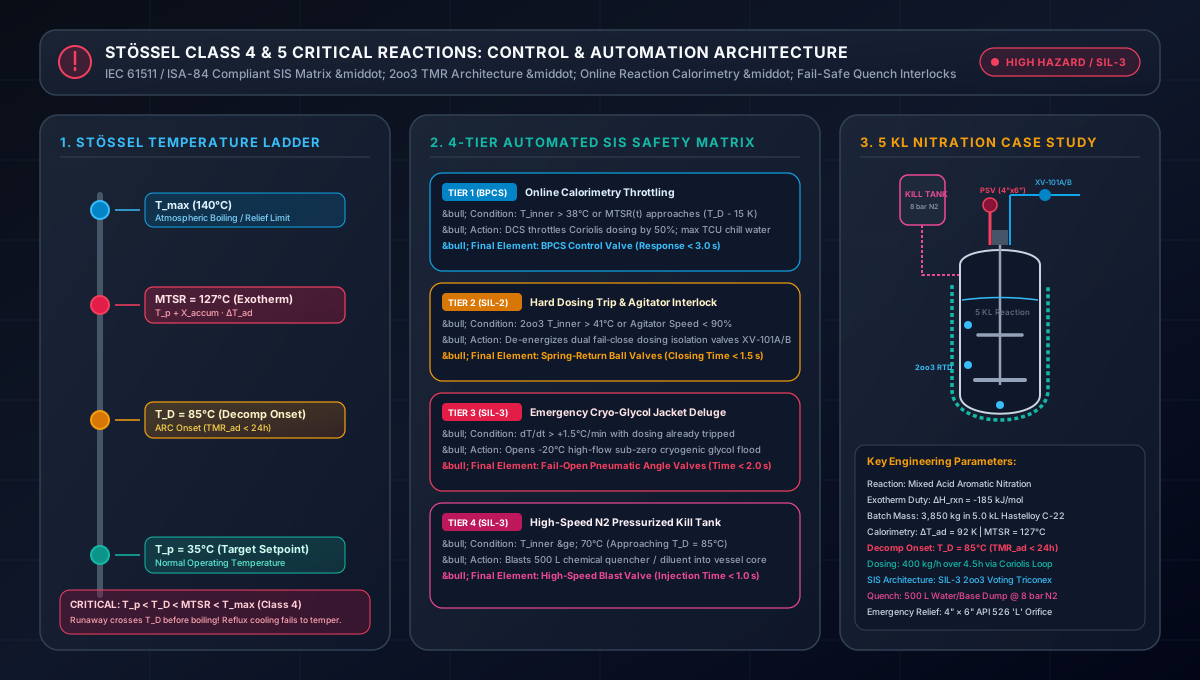
Because secondary exothermic decompositions can be triggered before or during normal heat transfer limitations, passive cooling and standard operator intervention are mathematically and physically incapable of arresting a runaway. Safely managing these critical reactions requires a rigorous multi-layered defense combining reaction calorimetry (RC1e / ARC), fault-tolerant 2oo3 field instrumentation, Basic Process Control System (BPCS) online soft-sensors, and SIL-2 / SIL-3 Safety Instrumented Systems (SIS) with fast-acting automated mitigation.
# 1. Fundamentals: The Stössel Criticality Hierarchy
Developed by Dr. Francis Stoessel, this fundamental process safety framework ranks reaction runaway severity by comparing four characteristic temperatures:
- (Process Operating Temperature): The target setpoint maintained during normal synthesis (e.g., ).
- (Maximum Temperature of the Synthesis Reaction): The maximum temperature the reaction mixture can reach adiabatically if all cooling is lost and accumulated unreacted reagent reacts completely:
where is the unreacted fraction () and is the adiabatic temperature rise:
- or (Decomposition Onset Temperature): The temperature at which secondary thermal decomposition becomes self-sustaining under adiabatic conditions (conventionally defined from Accelerating Rate Calorimetry, ARC, as the point where the Time-to-Maximum-Rate ):
- (Maximum Technical Temperature): The atmospheric boiling point of the reaction mixture (), or the temperature corresponding to the setpoint of the emergency pressure relief device ().
# The 5 Stössel Criticality Classes: Visual Temperature Hierarchy Diagram
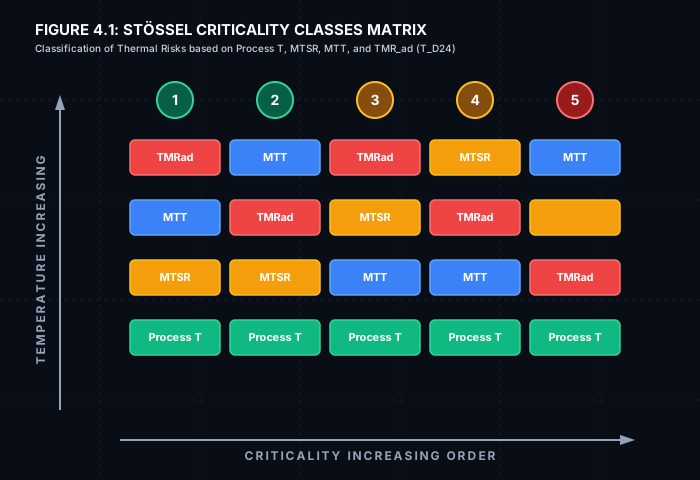
The following diagram visually represents how the 4 characteristic temperatures (, , / , and / ) arrange themselves across each class from lowest to highest temperature, showing how criticality increases from Class 1 (Safe) to Class 5 (High Thermal Explosion Hazard):
▲ TEMPERATURE INCREASES
│
│  [ CLASS 1 ]         [ CLASS 2 ]         [ CLASS 3 ]         [ CLASS 4 ]         [ CLASS 5 ]
│  🟢 (Safe)           🟢 (Safe)           🟡 (Moderate)       🟡 (High Hazard)    🔴 (Explosion)
│  ┌──────────────┐    ┌──────────────┐    ┌──────────────┐    ┌──────────────┐    ┌──────────────┐
│  │ TMRad / T_D  │    │ MTT / T_max  │    │ TMRad / T_D  │    │ MTSR         │    │ MTT / T_max  │  HIGH TEMP
│  ├──────────────┤    ├──────────────┤    ├──────────────┤    ├──────────────┤    ├──────────────┤
│  │ MTT / T_max  │    │ TMRad / T_D  │    │ MTSR         │    │ TMRad / T_D  │    │ MTSR         │
│  ├──────────────┤    ├──────────────┤    ├──────────────┤    ├──────────────┤    ├──────────────┤
│  │ MTSR         │    │ MTSR         │    │ MTT / T_max  │    │ MTT / T_max  │    │ TMRad / T_D  │
│  ├──────────────┤    ├──────────────┤    ├──────────────┤    ├──────────────┤    ├──────────────┤
│  │ Process T_p  │    │ Process T_p  │    │ Process T_p  │    │ Process T_p  │    │ Process T_p  │  LOW TEMP
│  └──────────────┘    └──────────────┘    └──────────────┘    └──────────────┘    └──────────────┘
│
└────────────────────── CRITICALITY INCREASING ORDER ────────────────────────────────────────►
# Detailed Matrix & Characteristic Temperature Mapping
| Parameter / Level | Class 1 🟢 | Class 2 🟢 | Class 3 🟡 | Class 4 🟡 | Class 5 🔴 |
|---|---|---|---|---|---|
| Top (Highest Temp) | / | / | / | / | |
| Upper-Middle Temp | / | / | / | ||
| Lower-Middle Temp | / | / | / | ||
| Bottom (Lowest Temp) | |||||
| Mathematical Hierarchy | (or ) | ||||
| Inherent Safety Physics | Inherently Safe: Even with total cooling loss, synthesis cannot reach boiling or decomposition. | Thermally Safe: Synthesis boils before reaching . Evaporative reflux cooling naturally halts runaway. | Evaporative Safe: Synthesis reaches boiling () before . Reflux must be maintained to prevent . | High Hazard: Reaction crosses BEFORE boiling () can temper it! Runaway is untempered. | Catastrophic Explosion: Decomposition begins at/near or runaway is completely untempered by boiling. |
| Risk Control Philosophy | Standard BPCS control. | Sized reflux condenser & BPCS cooling interlock. | Strict dosing rate () + condenser emergency cooling. | Mandatory SIL-2/3 automated trips + high-speed chemical quenching. | Continuous microfluidics, blast-rated cells, or dual independent SIL-3 SIS. |
# Validated Industrial Chemical Reaction Examples & Thermodynamic Calculations
To apply the Stössel criteria to real plant operations, process safety engineers calculate the thermal numbers using Reaction Calorimetry (RC1e) and Accelerating Rate Calorimetry (ARC):
# Calculation Formulation:
- Adiabatic Temperature Rise ():
- Maximum Temperature of Synthesis Reaction ():
(For full loss of cooling during maximum accumulation, ).
3. Decomposition Onset ():
Temperature where the Time-to-Maximum-Rate under adiabatic conditions equals 24 hours ().
4. Maximum Technical Temperature ( or ):
Atmospheric boiling point () under normal venting or boiling point at emergency relief setpoint ().
# Class 1 Example: Dilute Aqueous Neutralization / Hydrolysis
- Reaction: Aqueous ester saponification with dilute ().
- Operating Conditions: , , .
- Calorimetry Data:
- .
- Atmospheric boiling point (): .
- Decomposition onset (): (stable aqueous salts).
- Hierarchy: .
- Classification: Stössel Class 1 🟢 (Inherently Safe).
# Class 2 Example: Alkylation / Esterification in Low-Boiling Solvent
- Reaction: Acid-catalyzed Fisher esterification in Ethyl Acetate / Methanol ().
- Operating Conditions: , .
- Calorimetry Data:
- .
- Atmospheric boiling point (): (Methanol reflux).
- Secondary decomposition onset (): (thermal cleavage of ester).
- Hierarchy: .
- Classification: Stössel Class 2 🟢 (Thermally Safe via Reflux Cooling).
# Class 3 Example: Grignard Carbonylation or Sulfonation in Toluene
- Reaction: Sulfonation of aromatic ring with concentrated chlorosulfonic acid ().
- Operating Conditions: , .
- Calorimetry Data:
- Semi-batch controlled accumulation ( upset scenario):
- .
- Solvent boiling point (): (Toluene).
- Decomposition onset (): (acid chloride decomposition).
- Hierarchy: .
- Classification: Stössel Class 3 🟡 (Boils Before Decomposition). As long as condenser operates and vapor can vent, temperature cannot exceed , safely isolating the reaction from .
# Class 4 Example: Exothermic Aromatic Nitration in Sulfuric Acid
- Reaction: Mixed-acid mono-nitration of halobenzene ().
- Operating Conditions: , .
- Calorimetry Data:
- Full cooling failure with accumulated reagents ():
- .
- Solvent boiling point (): (high boiling sulfuric/nitro mix).
- Secondary decomposition onset (): (polynitro autocatalytic decomposition).
- Hierarchy: .
- Classification: Stössel Class 4 🟡 (HIGH HAZARD). If cooling fails, the reaction climbs past and triggers secondary decomposition long before it ever reaches boiling ()! Reflux cannot save the vessel; emergency active SIL-2/3 trips and chemical quenching are mandatory.
# Class 5 Example: Diazotization / Organic Azide Coupling / Thermal Peroxide
- Reaction: Diazonium salt generation from substituted aniline and sodium nitrite ().
- Operating Conditions: , .
- Calorimetry Data:
- .
- Diazonium secondary decomposition onset (): (severe explosion and nitrogen gas release: ).
- Solvent boiling point (): (aqueous matrix).
- Hierarchy: (and during hold times, ).
- Classification: Stössel Class 5 🔴 (CATASTROPHIC EXPLOSION HAZARD). The runaway triggers catastrophic gas release and explosive overpressurization, vastly exceeding relief nozzle capacities. Must be run in continuous flow micro-reactors ( holdup) or with high-speed automated deluge systems.
# 2. The Thermodynamic Trap: How Class 4 Degrades into Class 5
In process safety design, a synthesis is frequently classified as Stössel Class 4 under baseline laboratory conditions because:
However, in commercial plant operations, Class 4 is an unstable operating envelope. Under credible process upsets, the reaction thermodynamics and kinetics shift, causing the system to degrade directly into Stössel Class 5 (Thermal Explosion Hazard):
+---------------------------------------------------------------------------------------+
|              MECHANISMS OF CONDITIONAL TRANSITION: CLASS 4 -> CLASS 5                 |
+---------------------------------------------------------------------------------------+
|  BASELINE (CLASS 4):       T_p (35°C) < T_D (85°C) < MTSR (127°C) < T_max (140°C)     |
|                                                                                       |
|  UPSET MECHANISM A:        Reactant Accumulation (X_accum -> 1.0) or Solvent Loss     |
|  THERMODYNAMIC SHIFT:      MTSR spikes from 127°C to > 152°C (MTSR > T_max)          |
|  RESULTING HIERARCHY:      T_p < T_D < T_max < MTSR  ===> STÖSSEL CLASS 5             |
|                                                                                       |
|  UPSET MECHANISM B:        Catalytic Contamination (Rust/Acid) or Prolonged Hold Time |
|  KINETIC SHIFT:            TMR_ad collapses; T_D plunges from 85°C to <= 35°C         |
|  RESULTING HIERARCHY:      T_D <= T_p < MTSR         ===> STÖSSEL CLASS 5             |
+---------------------------------------------------------------------------------------+
# Mechanism A: Reactant Accumulation & Solvent Starvation ()
Under controlled semi-batch dosing, unreacted reagent accumulation is nominally restricted to , yielding a manageable instantaneous . However, if:
- Dosing occurs at a lower-than-design temperature (suppressing reaction rate while accumulating unreacted mass),
- The dosing pump overfeeds due to a Coriolis calibration drift, or
- Initial solvent charge is short-loaded (reducing batch heat capacity ),
the adiabatic temperature rise increases. With :
Because () now exceeds the atmospheric boiling point (), the hierarchy shifts from Class 4 to:
The reaction mixture now boils violently while simultaneously generating autocatalytic secondary decomposition gases (), overwhelming standard condenser cooling and blowing through normal relief lines.
# Mechanism B: Decomposition Onset () Collapse via Autocatalysis or Contamination
The decomposition onset temperature is not an invariant thermodynamic constant; it is kinetically governed. In Accelerating Rate Calorimetry (ARC):
If the batch is exposed to:
- Trace catalytic contaminants (e.g., rust particles from corroded carbon steel utility lines, trace copper, or residual wash acid),
- Autocatalytic intermediate build-up during an extended batch hold time, or
- Solvent stripping under vacuum,
the decomposition rate constant increases by an order of magnitude. This causes to collapse from down to or below the process operating temperature:
When , the reaction is operating inside the active decomposition zone during normal stirring. This is the most dangerous manifestation of Stössel Class 5: thermal explosion proceeds spontaneously without requiring any cooling failure!
# Mechanism C: Semenov Thermal Explosion Non-Equilibrium
Thermal stability requires that heat removal capacity exceeds heat generation rate at the operating temperature:
Because Arrhenius chemical heat release scales exponentially:
while jacket heat removal scales linearly:
once a thermal disturbance pushes past the critical inflection temperature, . At this point, the cooling jacket physically cannot remove heat fast enough, and the reaction accelerates exponentially into thermal runaway.
# 3. Multi-Layer Automation & Control Strategy (LOPA)
For Stössel Class 4 & 5 reactions, standard industry practice enforces a Layer of Protection Analysis (LOPA) compliant with IEC 61511 / ISA-84:
+---------------------------------------------------------------------------------------+
|                       INDEPENDENT SAFETY DEFENSE LAYERS                               |
+---------------------------------------------------------------------------------------+
|  Layer 1: BPCS Automation      - Cascade Temperature Control Loop                     |
|                                - Coriolis Mass-Flow Ratio Control                     |
|                                - Online Reaction Calorimetry Soft-Sensor (MTSR(t))    |
+---------------------------------------------------------------------------------------+
|  Layer 2: SIL-2 SIS Dosing Trip- 2oo3 Quad-Element Duplex RTDs Voting Logic           |
|                                - Automated Dosing Trip (Fail-Closed XV-101A/B < 1.5s) |
|                                * Note: Ineffective for 100% Pre-Charged All-In Batch! |
+---------------------------------------------------------------------------------------+
|  Layer 3: SIL-3 Rate-of-Rise   - 2oo3 dT/dt > 1.8°C/min Derivative Runaway Detection  |
|                                - Emergency Cryogenic Sub-Zero Glycol Jacket Deluge    |
+---------------------------------------------------------------------------------------+
|  Layer 4: Active Quench SIS    - Pressurized 12 bar N2 Chemical Kill / Inhibitor Dump |
|                                * THE ONLY ACTIVE SOLUTION for All-In Batch Runaways!  |
+---------------------------------------------------------------------------------------+
|  Layer 5: Passive Mechanical   - DIERS Leung Omega Two-Phase Rupture Disk + PSV       |
+---------------------------------------------------------------------------------------+
# A. Field Instrumentation Engineering (2oo3 TMR Architecture)
Triple Modular Redundant (2oo3) Temperature Sensing:
- Install 3 independent, dual-element RTDs inside a high-conductivity Hastelloy C-22 or Tantalum-sleeved thermowell.
- Position sensors at three critical elevations: reactor bottom dish (minimum stirring volume), impeller discharge path, and upper liquid zone.
- The safety logic solver executes 2oo3 voting logic: any two agreeing sensors above safety thresholds initiate immediate automated trip actions, filtering out single-channel sensor drift or false trips.
Dual Coriolis Mass Flow Meters:
- Install dual Coriolis meters in series on the hazardous reagent dosing line to monitor instantaneous mass addition rate () and fluid density () with precision.
Continuous Agitator Integrity Sensing:
- Measure real-time motor current draw, variable frequency drive (VFD) output torque, and an optical/inductive shaft rotation sensor.
- If agitation stops for more than , dosing must trip instantly to avoid building an unmixed, stratified layer of concentrated reagent.
# B. Online Reaction Calorimetry Soft-Sensor (Real-Time MTSR Tracking)
Traditional temperature controllers only react after the bulk temperature increases. For Class 4/5 reactions, the DCS must run a real-time thermal dynamic heat balance algorithm updated every :
The instantaneous unreacted accumulation fraction is tracked continuously:
The DCS dynamically predicts the instantaneous potential runaway temperature:
# C. 4-Tier Automated SIS Interlock Action Matrix
| Safety Tier | Trigger Condition | Automated SIS Action | Final Actuator & Speed |
|---|---|---|---|
| Tier 1: BPCS Throttling | or | Throttles Coriolis dosing control valve by ; drives TCU to maximum chilled water cooling. | Electric / Pneumatic Control Valve () |
| Tier 2: Hard SIS Dosing Trip | 2oo3 or Agitator trip or Cooling header | SIL-2 Interlock 01: De-energizes dual fail-close automated isolation valves () on dosing line. | Dual Spring-Return Automated Ball Valves () |
| Tier 3: Cryo-Glycol Jacket Deluge | (Early Runaway Detection) | SIL-3 Interlock 02: Fully opens sub-zero cryogenic chilled glycol deluge to reactor jacket. | Fail-Open Pneumatic Angle Valves () |
| Tier 4: Pressurized Chemical Quench | (e.g. ) or | SIL-3 Interlock 03: Blasts of chemical kill/inhibitor fluid directly into reactor core under pressure. | High-Speed Nitrogen Blast Valve () |
# 4. Industrial Case Study 1: 5.0 kL Exothermic Aromatic Nitration (Semi-Batch)
# Problem & Process Chemistry
A commercial fine chemical manufacturing plant executes an aromatic nitration in a Hastelloy C-22 Jacketed Reactor:
+-----------------------------------------------------------------------------------+
|                        CALORIMETRY & THERMAL RISK PROFILE                         |
+-----------------------------------------------------------------------------------+
|  * Process Operating Setpoint (T_p):         35.0 °C                              |
|  * Total Batch Mass:                         3,850 kg                             |
|  * Adiabatic Temperature Rise (Delta_T_ad):  92.0 K                               |
|  * Maximum Temperature of Synthesis (MTSR):  127.0 °C                             |
|  * Secondary Decomposition Onset (T_D):      85.0 °C   (ARC Onset: TMR_ad < 24h)  |
|  * Atmospheric Boiling Point (T_max / T_bp): 140.0 °C                             |
|                                                                                   |
|  BASELINE STÖSSEL RANKING (DESIGN CONDITIONS):                                    |
|  T_p (35°C)  <  T_D (85°C)  <  MTSR (127°C)  <  T_max (140°C)                      |
|  ===> STÖSSEL CLASS 4 CRITICAL REACTION (Catastrophic Runaway if cooling fails!)  |
|                                                                                   |
|  CONDITIONAL UPSET DEGRADATION TO CLASS 5:                                        |
|  * Reactant Accumulation / Solvent Shortage: MTSR > 140°C ===> STÖSSEL CLASS 5    |
|  * Catalytic Contamination / Extended Hold:  T_D <= 35°C   ===> STÖSSEL CLASS 5    |
|  * Reflux cooling cannot temper runaway; active SIS kill & cryo deluge mandatory! |
+-----------------------------------------------------------------------------------+
# Sizing the Semi-Batch Automated Safety Systems
- Dosing Rate & Heat Removal Equilibrium:
- Total exotherm: .
- Available cooling jacket area: , .
- With chilled water, max cooling capacity .
- Target Dosing Duration:
- Programmed dosing rate: regulated by Coriolis mass flow controller.
- Semi-Batch Dosing Shutoff Action:
- In semi-batch mode, de-energizing fail-close valves cuts off reagent supply within .
- Heat generation drops to near-zero as residual accumulated reagent () is consumed, keeping bulk temperature safely below .
# 5. Industrial Case Study 2: All-In Batch Runaway with Induction Delay (The "Uncontrollable Feed" Trap)
Now consider the high-risk scenario specifically raised in pharmaceutical operations: an All-In Batch reaction where 100% of raw materials are charged into the reactor prior to heating and stirring.

# The Chemistry & Operational Setup
A pharmaceutical plant prepares an active organometallic reagent (e.g., Grignard synthesis or acid-catalyzed condensation) in a Glass-Lined Reactor (GLR):
- Batch Mass & Reagent Charge:
- Magnesium metal turnings:
- Tetrahydrofuran (THF) solvent:
- Alkyl/aryl halide reagent:
- Total batch mass: ()
- Thermal Safety Parameters:
- Process Operating Setpoint ():
- Adiabatic Temperature Rise ():
- (at 100% accumulation):
- Secondary Decomposition Onset (): ()
- Solvent Atmospheric Boiling Point (): (THF boiling point)
Under nominal classification with controlled temperature, the reaction exhibits Stössel Class 4 characteristics (). However, because all reagents are pre-charged in a single vessel, from time zero. Once initiated, () vastly exceeds (), meaning the process is primed for an immediate catastrophic transition to Stössel Class 5!
# The Induction Period Phenomenon ()
The operator charges all reagents, seals the manhole, starts agitation at , and sets the reactor jacket to .
For the first , nothing appears to happen:
- Magnesium metal particles possess a surface passivation oxide layer () that inhibits contact with the halide.
- The bulk temperature flatlines at , and the BPCS temperature controller registers negligible heat release ().
- The False Sense of Security: Unsuspecting operators or standard automation assume the batch is inert, sluggish, or stable.
# The Sudden Uncontrollable Exotherm Spike
At , localized chemical activation strips the oxide barrier. The reaction initiates across active catalytic sites.
Because 100% of the stoichiometric reagents are already inside the vessel (), the reaction does not proceed at a metered dosing rate—it proceeds at full kinetic auto-acceleration:
Within , the instantaneous heat generation rate explodes:
Meanwhile, the reactor jacket's maximum heat removal capacity is severely limited:
Heat generation outpaces cooling capacity by 7:1!
The instantaneous adiabatic temperature rise rate accelerates exponentially:
As temperature rises from towards , Arrhenius kinetics double the reaction rate every , sending above !
# The Fatal Control Dilemma: Why Dosing Shutoff Fails Completely
In a semi-batch reaction, the primary SIL-2 safety interlock is straightforward:
IF (T_batch > Setpoint + 5°C) THEN:
    DE-ENERGIZE SOLENOID -> FAIL-CLOSE DOSING VALVES XV-101A/B
This halts reagent inflow, starving the reaction of fuel within .
In an All-In Batch reaction, this interlock is 100% USELESS.
There is NO feed valve to close; all of fuel is already inside the vessel! Simply stopping the feed line or tripping feed pumps does nothing because no pumps are running. Standard utility cooling is overwhelmed, and the reaction shoots past the THF boiling point () directly toward the decomposition onset , threatening explosive vessel rupture.
# Automated Engineering Controls to Mitigate the All-In Temperature Spike
When feed shutoff is physically impossible, the automation architecture must deploy active kinetic destruction and thermal inundation:
+---------------------------------------------------------------------------------------+
|             AUTOMATED MITIGATION SUITE FOR ALL-IN BATCH RUNAWAYS                      |
+---------------------------------------------------------------------------------------+
|  1. EARLY DETECTION:     2oo3 dT/dt Derivative Soft-Sensor (Trips at +1.8°C/min)      |
|                          Catches exotherm at 50°C, long before reaching T_D (85°C)    |
|                                                                                       |
|  2. CHEMICAL QUENCH:     High-Speed 12 bar N2 Accumulator Dump (< 0.8s blast)         |
|                          Floods 800 L catalyst poison / scavenger into impeller zone |
|                          Kinetically terminates reaction (> 99.8% inhibition in < 3s) |
|                                                                                       |
|  3. THERMAL INUNDATION:  Automated Cold Solvent Deluge Skid (1,500 L at -10°C)        |
|                          Dilutes concentration & provides instant sensible cooling    |
|                                                                                       |
|  4. UTILITY FLUSH:       Reverse-Thermofluid Cryogenic Jacket Deluge (-25°C Brine)    |
|                          Dumps hot water; floods jacket at 40 m³/h                    |
|                                                                                       |
|  5. OVERPRESSURE RELIEF: DIERS Sized 2-Phase Emergency Rupture Disk to Catch Tank     |
+---------------------------------------------------------------------------------------+
# 1. Early Predictive Detection via 2oo3 Rate-of-Rise () Voting
Standard high-temperature alarms () trigger too late because exponential kinetics outpace mechanical valve opening times.
The Triconex SIL-3 Logic Solver executes a real-time, filtered rate-of-rise derivative algorithm:
Trip Logic:
This initiates emergency mitigation at (while temperature is still only ), providing a vital safety margin before the decomposition onset is ever approached!
# 2. High-Pressure Nitrogen Accumulator Chemical Kill / Quench System
Because we cannot stop the feed, we must chemically destroy the reaction kinetics in situ:
- An Hastelloy C-22 accumulator tank is maintained at under dedicated high-purity Nitrogen.
- The tank contains an active chemical killing agent:
- For Grignard / organometallic reactions: an anhydrous catalyst poison / scavenger solution (e.g., controlled chelating inhibitor or inert proton-donor quencher).
- For acid-catalyzed condensation reactions: a concentrated neutralizing base (e.g., chilled triethylamine / caustic solution).
- For radical polymerization runaways: high-concentration TEMPO or hydroquinone radical trap.
- Actuation: Dual fail-open high-speed pneumatic ball valves () with booster relays opening in .
- Discharge Geometry: The quench fluid discharges through a high-velocity, multi-orifice dip-pipe submerged directly into the high-shear zone of the reactor impeller.
- Result: Within , the chemical killer diffuses through the bulk liquid, destroying active catalytic sites and reducing by . Heat generation ceases at the molecular level!
# 3. Reverse-Thermofluid Cryogenic Jacket Deluge
Simultaneously with the chemical kill, the SIS de-energizes the jacket heating supply:
- Fast-acting dump valves drain the tempering water from the jacket in .
- Automated cryogenic angle valves open to flood the jacket with chilled glycol brine at .
- The temperature of the batch safely peaks at , arresting the runaway below the decomposition onset !
# Inherent Safety Transformation: Eliminating the All-In Batch
While active automated chemical quenching provides an essential SIL-3 safety net, running a Stössel Class 4 or 5 reaction as an all-in batch violates modern Inherently Safer Design (ISD) principles.
Process engineering must implement one of two permanent design solutions:
# Option A: Semi-Batch with Automated Initiation Verification Protocol (AIVP)
Convert the recipe from all-in charging to a strictly controlled semi-batch process:
- Charge solvent, Magnesium, and only to of the halide reagent (the "heel").
- Heat to and allow the induction period to clear on this small quantity.
- The BPCS verifies positive chemical initiation via two online calorimetry criteria:
- Only after verified initiation does the safety PLC permissive allow the Coriolis dosing valve to open and feed the remaining reagent over a controlled window under cascade temperature control.
- If initiation fails within , the recipe halts automatically, preventing reagent accumulation.
# Option B: Continuous Flow Microreactor (E2E-CM)
Transition from a stirred tank to a continuous packed-bed microreactor:
- Magnesium turnings are packed into a continuous column reactor ().
- Halide reagent and solvent are metered continuously at high pressure.
- Because reactive hold-up volume is only (compared to in batch), even complete instantaneous runaway yields zero explosion hazard—the specific surface area () removes the entire heat of reaction isothermally!
# 6. Engineering Comparison: Semi-Batch vs. All-In Batch Safety Architecture
| Process Safety Parameter | Semi-Batch Dosing Regime | All-In Batch (Pre-Charged) Regime | Continuous Flow Synthesis |
|---|---|---|---|
| Reagent Accumulation () | Dynamically controlled () | Fixed at () | Negligible ( hold-up) |
| Potential Adiabatic Rise () | Limited by instantaneous feed hold-up | Full stoichiometric potential () | Fully dissipated continuously |
| Induction Period Risk | Low (only heel can accumulate) | Extreme (latent dormancy & sudden spike) | Non-existent (steady-state flow) |
| Primary Safety Action | Trip feed isolation valve () | Feed trip is 100% INEFFECTIVE | Stop inlet metering pumps () |
| Mandatory Active Mitigation | Jacket cooling + feed shutoff | High-pressure chemical kill tank | Passive inline heat exchange |
| Runaway Detection Metric | or | (Rate-of-Rise) | Pressure drop () & inline FTIR |
| Stössel Criticality Rating | Class 4 (manageable with SIS) | Class 4 degrading rapidly to Class 5 | Class 1 (Inherently Safer Design) |
| DIERS Relief Vent Area | Moderate ( PSV) | Large / Massive ( rupture disk) | Micro-orifice capillary vent |
# 7. Engineering Implementation & Safety Checklist
- Dual Series Dosing Isolation: Install two fail-closed pneumatic ball valves in series with spring-return actuators and limit switch position feedback (for semi-batch operations).
- Automated Initiation Verification Permissive (AIVP): For reactions with induction delays, program DCS software permissives requiring positive thermal initiation () on a heel before main reagent feed valves can open.
- High-Pressure Chemical Kill Skid: Maintain dedicated Nitrogen blanket on the emergency quench vessel with daily automated pressure transmitter verification and low-pressure alarm ().
- Submerged Vortex Sparger: Quench injection piping must penetrate below the minimum liquid operating level and terminate in a multi-orifice Hastelloy sparger directed into the impeller vortex.
- Derivative Rate-of-Rise Logic (): Safety logic solvers must calculate filtered rate-of-rise over a rolling 10-second window with 2oo3 temperature sensor voting to trigger mitigation before crossing .
- Fast-Response Thermowell: Specify tantalum-sleeved or thin-wall Hastelloy dual RTD assemblies with thermal response time .
- Uninterruptible Power & Stored Energy: Safety PLC logic solvers, solenoid valves, and high-speed blast actuators must be backed by a minimum 2-hour online static UPS battery system and dedicated pneumatic accumulator tanks.
- Proof Testing & Partial Stroke Testing (PST): Schedule quarterly automated partial stroke testing of safety isolation valves and kill dump valves to ensure zero mechanical sticking.
# Applicable Engineering Standards & Codes Used
The engineering methodologies, design correlations, and safety criteria detailed in this article adhere to the following international standards and industry codes:
- IEC 61511 / ISA-84: Functional Safety - Safety Instrumented Systems for the Process Industry Sector
- IEC 61508: Functional Safety of Electrical/Electronic/Programmable Electronic Safety-Related Systems
- OSHA 29 CFR 1910.119: Process Safety Management of Highly Hazardous Chemicals (PSM)
- CCPS (AIChE): Guidelines for Chemical Reactivity Evaluation and Application to Process Design
- DIERS Project Manual: Design Institute for Emergency Relief Systems - Methodologies for Runaway Reaction Relief Sizing
- NFPA 69: Standard on Explosion Prevention Systems (Deflagration Suppression & Isolation)
- NFPA 68: Standard on Explosion Protection by Deflagration Venting
- ISO 4126: Safety Devices for Protection Against Excessive Pressure