# Environmental, Social, and Governance (ESG) in Chemical & API Manufacturing: Scope 1, 2 & 3 Carbon Footprint Guide
# Executive Summary & Modern Regulatory Landscape
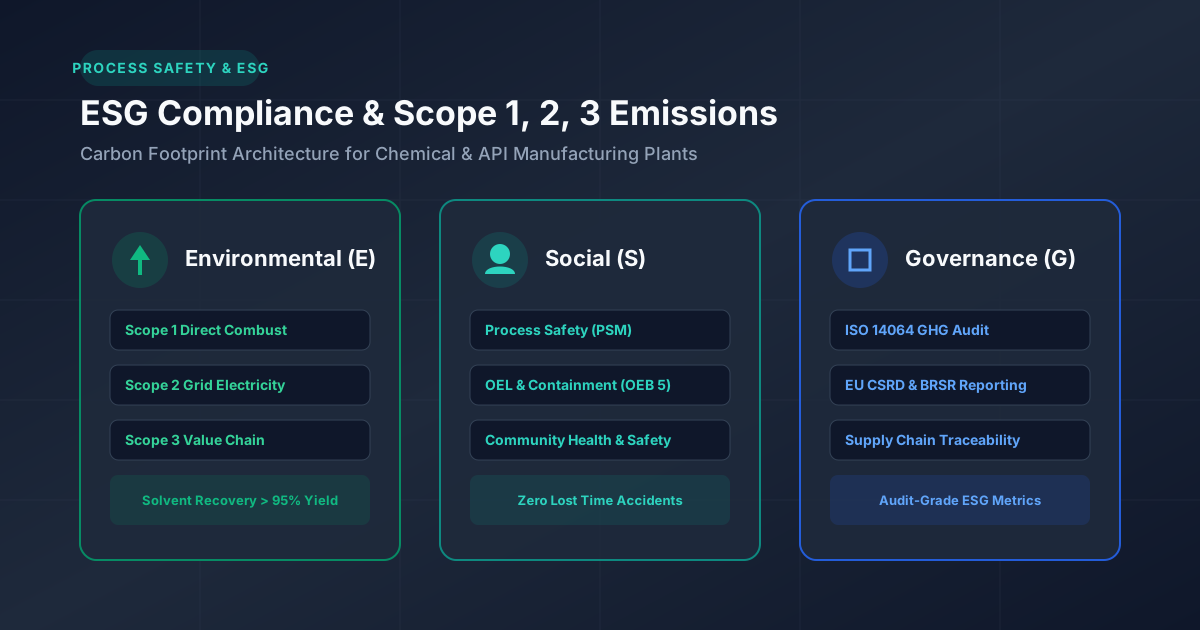
In the global chemical, Active Pharmaceutical Ingredient (API), and specialty chemical sectors, Environmental, Social, and Governance (ESG) performance has evolved from voluntary Corporate Social Responsibility (CSR) into a mandatory, board-level regulatory requirement.
Global regulatory frameworks—such as the EU Corporate Sustainability Reporting Directive (CSRD), SEC Climate-Related Disclosures, ISSB / IFRS S2 Climate Standards, and SEBI Business Responsibility and Sustainability Reporting (BRSR)—require chemical manufacturers to audit and report their Scope 1, Scope 2, and Scope 3 Greenhouse Gas (GHG) emissions with audit-grade precision.
This engineering guide details:
- The Three Pillars of ESG customized for chemical process plant operations.
- The GHG Protocol Corporate Standard (ISO 14064) framework for process plants.
- Detailed mathematical formulas for calculating Scope 1 (Direct Fuel & Fugitive VOCs), Scope 2 (Purchased Electricity & Steam), and Scope 3 (Supply Chain & Waste) emissions.
- Practical decarbonization engineering levers for API synthesis blocks.
- The Reusable Scope 1, 2 & 3 Carbon Footprint Calculator Excel Resource.
# 1. The Three Pillars of ESG in Process Manufacturing
                       ┌───────────────────────────────────────────────────────────┐
                       │   CORPORATE ESG FRAMEWORK FOR PROCESS MANUFACTURERS      │
                       └─────────────────────────────┬─────────────────────────────┘
                                                     │
         ┌───────────────────────────────────────────┼───────────────────────────────────────────┐
         ▼                                           ▼                                           ▼
┌───────────────────────────┐               ┌───────────────────────────┐               ┌───────────────────────────┐
│     ENVIRONMENTAL (E)     │               │        SOCIAL (S)         │               │      GOVERNANCE (G)       │
├───────────────────────────┤               ├───────────────────────────┤               ├───────────────────────────┤
│ • Scope 1, 2 & 3 GHGs     │               │ • Process Safety (PSM)    │               │ • EHS Compliance Audits   │
│ • Solvent Recovery (>95%) │               │ • Operator Exposure (OEL) │               │ • Anti-Bribery & Ethics   │
│ • Zero Liquid Discharge   │               │ • Community Health        │               │ • Board ESG Committees    │
│ • Circular Economy        │               │ • Industrial Hygiene      │               │ • Supply Chain Auditability│
└───────────────────────────┘               └───────────────────────────┘               └───────────────────────────┘
# 2. GHG Protocol Scope 1, 2 & 3 Emissions Architecture
Under the GHG Protocol Corporate Accounting Standard, greenhouse gas emissions are categorized into three distinct operational boundaries:
| GHG Boundary Scope | Definition & Physical Source | Typical Chemical & API Plant Examples | Primary Data Sources Required |
|---|---|---|---|
| Scope 1: Direct Emissions | Emissions from fuel combustion or equipment owned/controlled by the company. | Boilers (Natural Gas, HSD, Coal), thermic fluid heaters, incinerators, fugitive solvent VOC leaks, process reaction N2O / CO2. | Fuel meter logs, mass balances, VOC leak detection (LDAR). |
| Scope 2: Indirect Energy | Emissions from generation of purchased electricity, steam, heating, or cooling. | Grid electricity for agitator drives, chilled water plants, air compressors, purchased utility steam. | Utility electricity bills (kWh), steam invoices (MT). |
| Scope 3: Value Chain | All indirect emissions across upstream supply chain and downstream product lifecycle. | Raw chemical procurement, solvent manufacturing, waste transport & off-site incineration, employee commuting, air freight shipping. | Procurement ERP invoices, freight ton-km, waste manifest manifests. |
# 3. Step-by-Step Scope 1, 2 & 3 Emission Calculation Methodology
# 3.1 Scope 1 Direct Emissions (Stationary & Fugitives)
# A. Stationary Fuel Combustion:
For a plant burning 450,000 Liters of High Speed Diesel (HSD) per year in steam boilers:
# B. Fugitive Solvent VOC Losses:
For 15,000 kg of un-condensed Dichloromethane (DCM) lost through vacuum pump vents:
# 3.2 Scope 2 Indirect Energy Emissions (Grid Electricity & Steam)
- Location-Based Method: Uses the regional grid average emission factor (e.g., 0.00071 tCO2e/kWh for a coal-heavy grid).
- Market-Based Method: Accounts for zero-emission Renewable Energy Certificates (RECs) or Power Purchase Agreements (PPAs):
# 3.3 Scope 3 Upstream & Downstream Value Chain Emissions
Scope 3 encompasses 15 categories. In API synthesis, Category 1 (Purchased Raw Materials) and Category 5 (Waste Treatment) dominate:
# 4. Representative Chemical Plant Carbon Footprint Baseline
The table below illustrates a baseline ESG greenhouse gas inventory for a 1,200 MT/year API synthesis facility:
| Emissions Scope | Source Category | Activity Quantity | Unit | Emission Factor | Emissions (tCO2e/year) | % Share of Total Footprint |
|---|---|---|---|---|---|---|
| Scope 1 | Boiler Fuel (Natural Gas) | 1,250,000 | Sm³ | 0.00202 tCO2e/Sm³ | 2,525.00 | 12.8% |
| Scope 1 | HSD Diesel & Fugitives | 450,000 | Liters | 0.00268 tCO2e/L | 1,252.50 | 6.4% |
| Scope 2 | Grid Electricity (Location) | 8,500,000 | kWh | 0.00071 tCO2e/kWh | 6,035.00 | 30.6% |
| Scope 2 | Purchased Industrial Steam | 12,000 | MT | 0.17500 tCO2e/MT | 2,100.00 | 10.7% |
| Scope 3 | Cat 1: Raw Chemicals & Solvents | 3,500 | MT | 2.85000 tCO2e/MT | 6,982.50 | 35.4% |
| Scope 3 | Cat 5: Off-Site Incineration | 650 | MT | 1.12000 tCO2e/MT | 728.00 | 3.7% |
| Scope 3 | Cat 4 & 9: Logistics Freight | 770,000 | Ton-km | Various | 82.00 | 0.4% |
| TOTAL | All Scopes Baseline | — | — | — | 19,705.00 tCO2e | 100.0% |
# 5. Decarbonization Engineering Roadmap for API Plants
Energy Efficiency (MVR / VRU) ──► On-Site Renewable PPAs ──► Solvent Recovery (>95%) ──► Electrified Boilers ──► Net-Zero
- High-Efficiency Solvent Recovery (> 95% Yield): Recycled solvent eliminates Scope 3 raw material procurement footprint (2.85 tCO2e/MT).
- Boiler Electrification & Green Hydrogen: Swapping fossil fuel boilers for electric steam generators powered by renewable PPAs eliminates Scope 1 combustion emissions.
- Mechanical Vapor Recompression (MVR): Using MVR heat pumps on distillation columns reduces steam consumption by up to 70%.
# 6. Downloading the ESG Scope 1, 2 & 3 Excel Calculator Resource
Process engineers can download the pre-formatted Excel calculator resource (ESG_Scope_1_2_3_Emissions_Calculator.xlsx) from the Resources section.
It features:
- Dynamic Excel Formulas: Automatic multiplication of activity volumes by IPCC / DEFRA emission factors.
- Executive Dashboard: Automatically computes total corporate carbon footprint (tCO2e) and intensity ratios (tCO2e / MT API).
# Technical Conclusion
ESG compliance is no longer a corporate marketing exercise—it is a core chemical engineering discipline. By developing rigorous Scope 1, 2, and 3 GHG balances, process leads drive material efficiency, cut utility costs, and achieve science-based net-zero targets.
# Applicable Engineering Standards & Codes Used
The engineering methodologies, design correlations, and safety criteria detailed in this article adhere to the following international standards and industry codes:
- ASME PTC 25: Pressure Relief Devices Performance Test Codes
- ISO 50001: Energy Management Systems Requirements
- BS 845: Methods for Assessing Thermal Performance of Boilers for Steam and Hot Water
- IERR / Bureau of Energy Efficiency (BEE) Industrial Utility Guidelines: IERR / Bureau of Energy Efficiency (BEE) Industrial Utility Guidelines