ReactorCondenserReceiverFilterDryer
Safe, Scalable Process Engineering Solutions

Pharma Chemical
Engineering Hub

Process Engineering, Scale-Up, Technology Transfer, Process Safety, Utilities, and Pharmaceutical Manufacturing Excellence.

Comprehensive Process Engineering Platform

Empowering engineers with high-fidelity validation models, mechanical sizing tools, and rigorous technical guidelines.

Latest Technical Publications

Peer-reviewed detailed process guides, calculations methods, and safety controls.

Browse All Articles
Chemical Compatibility & Reactivity Matrices in Process Manufacturing: CCPS Chemical Reactivity Worksheet (CRW) & Functional Group Hazardous Interactions
Process Safety

Chemical Compatibility & Reactivity Matrices in Process Manufacturing: CCPS Chemical Reactivity Worksheet (CRW) & Functional Group Hazardous Interactions

A comprehensive chemical engineering guide to building chemical compatibility charts and assessing reactive chemical hazards. Details the CCPS & NOAA Chemical Reactivity Worksheet (CRW) methodology, functional group incompatibility mechanisms (gas evolution, thermal runaway, polymerization), binary compatibility matrices, and a downloadable Excel calculator.

Kiran SeepanaAug 20, 2026

Community Engineering Discussions

Join active technical threads, discuss scale-up dilemmas, and exchange cGMP solutions with fellow process engineers.

Only registered community members can start threads or answer.Log In orSign Up to participate.

Arvind g.(test)
Aug 21

What separation method is commonly used for water–IPA separation ?

Arvind g.(test)Aug 21

Distillation is used for bulk separation, followed by azeotropic or extractive distillation, molecular sieves, or pervaporation for dehydration.

Rajesh S.(Sun Pharma)
Aug 17

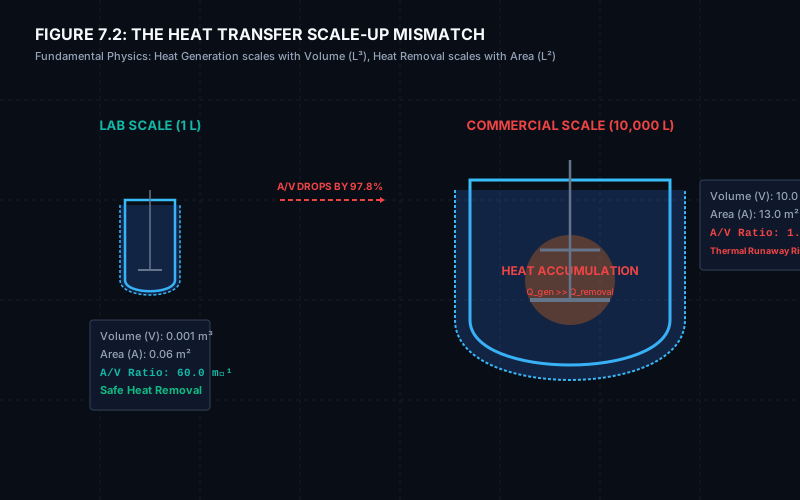
How do we prevent localized hot plumes and bis-adduct side impurities during rapid reagent addition in a 10 KL reactor?

Kiran S.(PharmaChemEng Hub)Aug 17

Hi Rajesh, This is a classic Damköhler mixing-controlled regime problem (Da_I = tau_mix / tau_rxn >> 1.0). When you add reagent from a top nozzle into a 10 KL vessel, bulk macromixing takes 45-90 seconds, whereas fast competitive reactions (like Grignard additions, acylations, and chlorinations) react within milliseconds. Incoming reagent droplets form a localized "hot plume" of unmixed reagent that attacks already-formed mono-product (A + B -> C, then C + B -> D), generating high levels of over-alkylated/bis-adduct impurities. Key Engineering Solutions: 1. Install a Subsurface Dip-Pipe: Direct the feed stream directly into the high-shear impeller discharge stream (discharge tip of the lower pitched blade turbine). This cuts micromixing engulfment time (tau_E) by >85%. 2. In-Line Static Mixer: Loop a small side-stream through an external jacketed static mixer where reagent is dosed under turbulent inline shear before returning to the vessel. 3. Cascade Temperature Control: Slave the jacket cooling valve to the reactor bulk temperature derivative (dT/dt) to preemptively trim cooling before the batch overshoots.

Priya N.(Dr. Reddy's Laboratories)Aug 18

We experienced this exact issue during technology transfer from 50 L pilot to 8 KL plant. Subsurface addition at the impeller discharge lowered our bis-impurity from 2.8% down to 0.18% without extending batch cycle time!

Priya N.(Dr. Reddy's Laboratories)
Aug 15

Why is our ANFD filtration cycle taking 16 hours at 5 KL scale while the lab Buchner funnel filtered in under 3 minutes?

Kiran S.(PharmaChemEng Hub)Aug 15

Hi Priya, Filtration scale-up is governed by Specific Cake Resistance (alpha_cake), which depends on Crystal Size Distribution (CSD): dt/dV = (mu * alpha_cake * c / (A^2 * deltaP)) * V + (mu * R_m / (A * deltaP)) Two root causes to investigate: 1. Crystal Attrition & Secondary Nucleation: At 1 L lab scale, impeller tip speed is v_tip ~ 1.5 m/s. In a 5 KL reactor with constant P/V scale-up, v_tip often spikes to 4.5-5.5 m/s. This high shear shatters delicate needle crystals into fines (< 20 microns). Specific cake resistance scales inversely with particle diameter squared (alpha proportional to 1/d_p^2). Halving mean crystal size quadruples filtration duration! 2. Nitrogen Cake Cracking: Applying excessive gas pressure (> 1.5 barg) dries and cracks the cake prematurely, causing nitrogen blow-by and poor mother-liquor displacement. Remedy: • Reduce agitator RPM during crystallization to just satisfy off-bottom suspension (N >= N_js via Zwietering correlation). • In the ANFD, run the smoothing paddle at ultra-low speed (5-8 RPM) under gentle 0.5-0.8 barg N2 pressure to continuously heal cracks during cake dewatering.

Amit P.(Cipla Ltd)
Aug 14

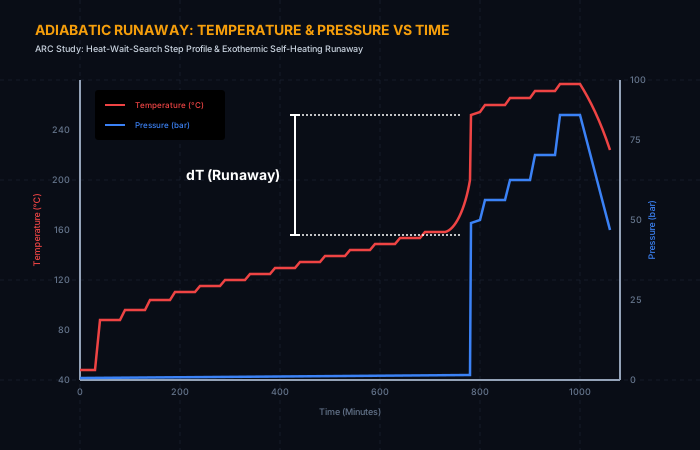
How do we determine if an exothermic hydrogenation reaction needs DIERS two-phase relief vent sizing vs SIL-2 interlocks?

Kiran S.(PharmaChemEng Hub)Aug 14

Amit, you must perform a 3-step thermal runaway screening using reaction calorimetry: 1. Reaction Calorimetry (RC1e): Measure synthesis exotherm (delta-H_rxn) and calculate adiabatic temperature rise (delta-T_ad = -delta-H_rxn / Cp). Then determine Maximum Temperature of Synthesis Reaction (MTSR = T_p + X_accum * delta-T_ad). 2. Accelerating Rate Calorimetry (ARC): Determine onset temperature of secondary decomposition (T_D) and Time-to-Maximum-Rate under adiabatic conditions (TMR_ad). 3. Stoessel Criticality Matrix: • Class 1 / 2: MTSR < T_D -> Controlled batch cooling. • Class 3 / 4 / 5: T_D < MTSR -> High thermal runaway risk if cooling fails during dosing. For relief sizing, hydrogenation systems are "hybrid" (gas generation from dissolved H2 + vapor pressure from boiling solvent). Standard single-phase API 520 equations undersize the vent by up to 500%. You must use DIERS (Design Institute for Emergency Relief Systems) Leung Omega two-phase chocked flow methodology with dual Rupture Disk + Safety Relief Valve combinations.

Vikram J.(Lupin Pharma)
Aug 12

What is the most economical condenser cooling utility for solvent recovery: Cooling Tower Water vs Chilled Water vs Brine?

Kiran S.(PharmaChemEng Hub)Aug 12

Vikram, Always match your condensing temperature to the highest-temperature utility that maintains an LMTD >= 15-20°C. Here is the operational economics comparison based on current pharmaceutical utility tariffs: • Cooling Tower Water (CTW @ ₹4.00/TR): Supply at 30°C, return at 36°C. Best for atmospheric distillation of high-to-medium boiling solvents: Methanol (64.7°C), Ethanol (78.3°C), IPA (82.6°C), Toluene (110.6°C). For a 400 kg/h methanol condensing duty (34.8 TR), CTW cost is only ₹139 / hour! • Chilled Water (CHW @ ₹9.00/TR): Supply at +5°C. Required for vacuum distillation (T_boil < 45°C) or low-boiling solvents like DCM (39.8°C) and Acetone (56°C). Cost is ₹313 / hour. • Chilled Brine (CBR @ ₹18.00/TR): Supply at -15°C. Strictly reserve for secondary vent scrubbers and cryogenic VOC traps to catch fugitive non-condensibles. Never use CBR on primary condensers for atmospheric solvents—it wastes high-cost compressor power and causes shell-side icing. Cost is ₹626 / hour.

Sneha K.(Zydus Lifesciences)
Aug 10

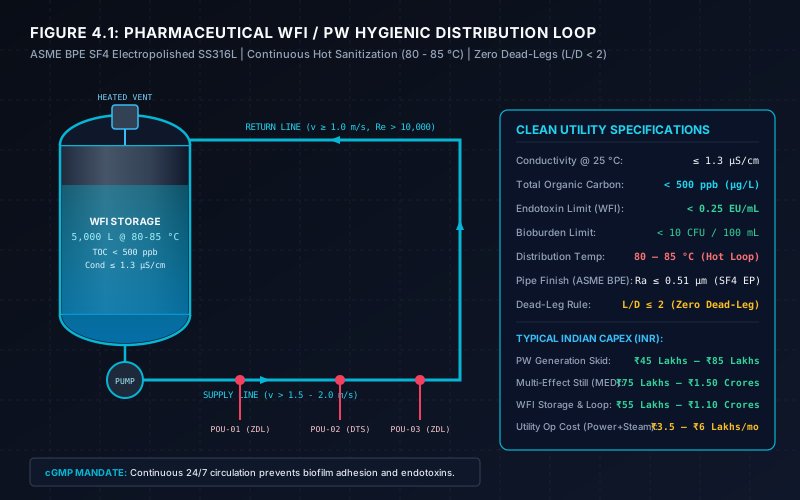
Why is periodic hot water sanitization (80-85°C) preferred over continuous chemical sanitization in Purified Water (PW) SS316L loops?

Kiran S.(PharmaChemEng Hub)Aug 10

Hi Sneha, Hot water sanitization (80-85°C) is universally preferred in cGMP pharmaceutical PW distribution loops for three critical reasons: 1. Zero Chemical Residues: Chemical biocides (ozone, peracetic acid, chlorine dioxide) require extensive post-sanitization rinse-out validation and continuous online TOC testing before releasing water to production. 2. Biofilm Eradication in Dead Legs: Thermal conduction penetrates into valve diaphragm crevices and dead legs (<= 1.5D rule) where chemical biocide flow velocity is stagnant. Maintaining 80°C for >= 60 minutes delivers lethal microbial kill (F_0 >= 20 min). 3. Automated Electronic Batch Records: Temperature transmitters at the loop return line provide continuous 21 CFR Part 11 compliant temperature logging on the building SCADA/DCS.

Arvind R.(Divi's Laboratories)
Aug 8

Mass Balance Closure Diagnostic: What is the acceptable tolerance limit in API manufacturing before a regulatory investigation?

Kiran S.(PharmaChemEng Hub)Aug 8

Arvind, Per ICH Q7 (Good Manufacturing Practice for Active Pharmaceutical Ingredients): 1. Total Material Balance Closure: Across a campaign, total mass reconciliation (Inputs = Output Pure API + Recovered Solvents + By-Products + Waste + Hold-up) must close between 98.0% and 102.0%. 2. Component API Yield Reconciliation: Pure active substance yield must fall within historically validated process validation limits (typically >= 95.0% of theoretical stoichiometry). If closure is < 95.0%, trigger a formal Out-Of-Trend (OOT) deviation to investigate: • Mother Liquor Assay: Uncrystallized API lost in mother liquor filtrate. • Physical Equipment Hold-Up: Material remaining on filter bags, ANFD dish bottoms, or transfer piping. • Flowmeter Density Errors: Volumetric solvent charging meters not temperature-compensated (e.g. methanol density varies 1.5% between 15°C and 35°C). • Fugitive Condenser Losses: Vent emissions from un-condensed volatile vapors.

Featured Equipment Vendors

Connect directly with manufacturers adhering to ASME-BPE, FDA, and clean utility standards.

Browse Vendor Directory
HVAC & AHU Manufacturers

Blue Star Limited - Industrial HVAC & AHU Systems

Leading manufacturer of custom double-skin AHUs, chilled water cooling coils, VFD fan assemblies, and energy-efficient pharmaceutical cleanroom air handling systems.

Mumbai / Chennai / Hyderabad, IndiaDetails
Automation Vendors

Finepac Structures Pvt. Ltd.

Designers of structured tower packing, mass transfer columns, liquid distributors, vapour-liquid separators, and distillation skids.

Pune, Maharashtra, IndiaDetails
Heat Exchanger Vendors

Jonam Engineering

Specialists in high-efficiency Shell & Tube heat exchangers, condensers, reboilers, and thermal equipment for chemical and pharma API plants.

Pune, Maharashtra, IndiaDetails
Support Engineering Excellence

Support the Platform & Buy Me a Coffee

If you find these chemical process sizing calculators, clean utility guides, and cGMP templates helpful, consider supporting our ongoing development. Your contributions help maintain high-speed servers, database modeling tools, and peer-reviewed engineering content.

SK

Seepana Kiran

Direct UPI Support
Instant UPI
paytm❤️UPI
Seepana Kiran UPI QR Code
seepana.kiran@ptyes
UPI IDseepana.kiran@ptyes
Pay via Any UPI AppScan with Paytm, Google Pay, PhonePe, or BHIM

Buy Me a Coffee

Global & Card Payments
Worldwide

Why Your Support Matters

  • 100% Free & Open technical tools for chemical and pharma engineers.
  • Fund high-performance cloud databases, serverless compute, and simulation engines.
  • Accelerate development of new Aspen-validated process modules and safety blue-prints.

Supporting international payments via Credit/Debit Cards, PayPal, and Apple Pay through our BuyMeACoffee portal.

Buy Me a Coffee on WebSecure international checkout via BuyMeACoffee