# Multiphase Transport Phenomena in Flow Chemistry: Gas-Liquid-Solid Dynamics, Mass Transfer Coefficients & Governing Equations
# Executive Summary & Transport Engineering Scope
In pharmaceutical synthesis and fine chemical processing, over 60% of commercial chemical reactions involve multiphase systems: Gas-Liquid (e.g., hydrogenations, ozonolyses, carbonulations), Liquid-Liquid (biphasic extractions, phase-transfer catalysis), or Gas-Liquid-Solid (heterogeneous catalytic hydrogenations, precipitation reactions). In legacy batch reactors (5,000 L stirred tanks), multiphase operations are severely limited by poor interfacial mass transfer (), gas-sparging bypass, and mechanical agitation shear limits.
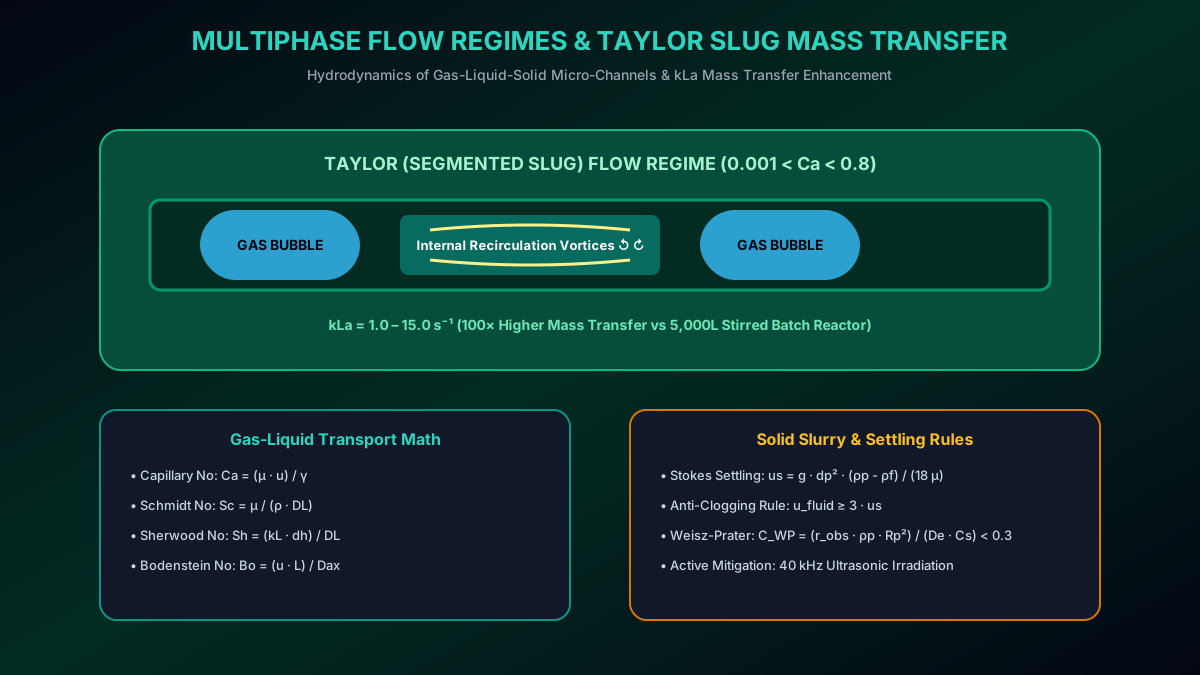
Continuous flow reactors dramatically intensify multiphase transport by confining fluids inside micro- and meso-channels (). This generates Taylor (Segmented Slug) Flow, expanding mass transfer coefficients by two orders of magnitude ().
This technical publication delivers a rigorous breakdown of multiphase flow regimes, establishes governing dimensionless transport equations (), and provides engineering strategies for preventing solid particle settling and channel clogging.
# 1. Gas-Liquid Flow Hydrodynamics & Taylor Slug Flow Regime
When gas and liquid phases are co-injected into a micro-channel, various flow regimes emerge depending on superficial gas () and liquid () velocities:
                    GAS-LIQUID FLOW REGIMES IN MICRO-CHANNELS
 ┌────────────────────────────────────────────────────────────────────────┐
 │ TAYLOR (SLUG) FLOW: Alternating Gas Bubbles & Liquid Slugs             │
 │ INTERNAL VORTEX: Rapid circulation inside liquid slug amplifies k_L a  │
 ├────────────────────────────────────────────────────────────────────────┤
 │                                                                        │
 │  (A) BUBBLY FLOW:     [•  •  •  •  •  •  •  •  •  •  •] (Low u_G)       │
 │                                                                        │
 │  (B) TAYLOR SLUG:     [  GAS  ] ◄==► ( LIQUID SLUG ) ◄==► [  GAS  ]    │
 │                       (Interfacial Recirculation Loops ↺ ↻)            │
 │                                                                        │
 │  (C) ANNULAR FLOW:    [=========== GAS CORE ===========] (High u_G)    │
 └────────────────────────────────────────────────────────────────────────┘
# 1.1 Hydrodynamic Flow Regime Comparison
| Flow Regime | Velocity Condition | Interfacial Area () | Mass Transfer Rate () | Industrial Application |
|---|---|---|---|---|
| Bubbly Flow | () | Mild fluorinations, slow oxygenation | ||
| Taylor (Slug) Flow | (Peak Performance) | Fast hydrogenations, ozonolysis, carbonylations | ||
| Annular Flow | () | Fast gas-phase acid quenching, volatile evaporation |
# 1.2 Physics of Taylor Slug Flow Mass Transfer
In Taylor flow, gas bubbles fill almost the entire channel cross-section, separated from the channel wall by a thin liquid film ().
The liquid slug between two gas bubbles experiences intense internal toroidal recirculation loops (recirculation vortices) driven by wall shear stress:
                  TOROIDAL RECIRCULATION IN A TAYLOR LIQUID SLUG
 ┌────────────────────────────────────────────────────────────────────────┐
 │ CONVECTIVE RECIRCULATION: Wipes the gas-liquid interface continuously, │
 │                          bypassing liquid film diffusion barriers.     │
 ├────────────────────────────────────────────────────────────────────────┤
 │                                                                        │
 │         ┌────────────────────────────────────────────────────┐         │
 │         │  ┌───► ───► ───►  (Recirculation) ───► ───► ───┐   │         │
 │  [GAS]  │  │                                         │   │  [GAS]  │
 │ BUBBLE  │  └───◄ ───◄ ───◄  (Channel Core)  ◄───◄ ───◄   │ BUBBLE  │
 │         └────────────────────────────────────────────────────┘         │
 └────────────────────────────────────────────────────────────────────────┘
The volumetric mass transfer coefficient () in Taylor flow is modeled by Van Baten and Krishna:
Where is molecular diffusivity, is slug velocity, and is channel hydraulic diameter.
# 2. Liquid-Solid Slurry Hydrodynamics & Particle Settling Prevention
Handling solid suspensions (e.g., heterogeneous catalysts like , inorganic bases like , or precipitated products) is a major engineering challenge in continuous flow.
                      SOLIDS HANDLING IN CONTINUOUS FLOW
 ┌────────────────────────────────────────────────────────────────────────┐
 │ CRITICAL SUSPENSION VELOCITY RULE:  u_fluid > u_settling               │
 │ STOKES SETTLING VELOCITY:  u_s = g · d_p² · (ρ_p - ρ_f) / (18 · µ)    │
 ├────────────────────────────────────────────────────────────────────────┤
 │                                                                        │
 │  (A) UNSTABLE (CLOGGING):   [ ░░░░  PARTICLE SETTLING  ░░░░ ] ──► PLUG  │
 │                                                                        │
 │  (B) ACTIVE ULTRASONIC:     ))) [ • • • SUSPENDED SLURRY • • • ] (((   │
 │                             (Piezoelectric Transducer 40 kHz)          │
 └────────────────────────────────────────────────────────────────────────┘
# 2.1 Stokes Particle Settling Velocity ()
Where:
- (acceleration due to gravity)
- = solid particle diameter ()
- = densities of solid particle and fluid ()
- = fluid dynamic viscosity ()
To prevent gravitational particle settling and micro-channel clogging:
# 2.2 Active & Passive Anti-Clogging Engineering Strategies
- Acoustic / Ultrasonic Irradiation: Mount piezoelectric ultrasonic transducers () directly onto flow reactor blocks. Acoustic cavitational streaming continuously breaks up agglomerates and cleans channel walls.
- Pulsed Flow / Oscillatory Baffled Reactors (OBR): Apply periodic fluid pulsation (, ) to keep solids in perpetual suspension at low net flow rates.
- Peristaltic & Diaphragm Slurry Pumps: Use valveless peristaltic or progressive cavity pumps to handle slurries up to solid loading without check-valve fouling.
# 3. Comprehensive LaTeX Governing Equations of Flow Chemistry
Continuous flow transport phenomena are governed by classical dimensionless numbers and differential mass/energy transport balances:
# 3.1 Fluid Dynamics & Momentum Transport
- Reynolds Number ():
- Capillary Number ():
(Governs transition between Taylor slug flow and dispersed bubbly flow; Taylor flow dominates when .)
# 3.2 Mass Transport & Axial Dispersion
- Schmidt Number ():
- Sherwood Number ():
- Bodenstein / Péclet Number ():
- Axial Dispersion Differential Equation:
# 3.3 Reaction Kinetics & Diffusion Limitations
- Damköhler Number ():
- Weisz-Prater Criterion () for Heterogeneous Flow Catalysis:
- If : The reaction is strictly kinetically controlled (no internal pore diffusion limitation).
- If : Severe internal pore diffusion limitation exists; catalyst particle size () must be reduced.
# 3.4 Heat Transport Balance
- Nusselt Number ():
- Prandtl Number ():
- Differential Heat Balance Equation for Flow Reactor:
# 4. Mathematical Rate Equations for Multiphase Reaction Regimes (Regimes 1 to 4)
In multiphase gas-liquid and liquid-liquid flow chemistry, chemical transformation occurs across phase boundaries. Depending on the relative rates of physical mass transfer () versus intrinsic reaction kinetics (), the system operates under one of four distinct reaction regimes:
# 4.1 First-Principles Governing Rate Equations
# Regime 1: Very Slow Reaction (Kinetic Control in Bulk Liquid)
- Physical Mechanism: The chemical reaction is much slower than physical absorption. The liquid phase is saturated with gas at equilibrium concentration . The reaction occurs uniformly throughout the bulk liquid volume fraction ().
- Governing Rate Equation:
# Regime 2: Slow Reaction (Mass Transfer Limited)
- Physical Mechanism: The reaction rate is moderate, but un-reacted gas is consumed rapidly in the bulk liquid, keeping the bulk concentration of near zero. Mass transfer across the gas-liquid interface limits the overall process rate.
- Governing Rate Equation:
# Regime 3: Fast Reaction (Reaction Confined to Liquid Film)
- Physical Mechanism: The reaction is faster than diffusion through the thin liquid film interface (Hatta Number ). Species is completely consumed within the liquid film before reaching the bulk liquid.
- Governing Rate Equation:
# Regime 4: Instantaneous Reaction (Film Boundary Front Control)
- Physical Mechanism: Intrinsic reaction kinetics are infinitely fast compared to diffusion. A sharp reaction zone forms inside the liquid film where species and liquid reactant meet and react instantaneously.
- Governing Rate Equation:
# 4.2 Agitation & Mixing Power Input Requirements Across Regimes
Determining where energy / power input ( or mixing shear) should be deployed is critical for equipment design in continuous multiphase flow skids.
# Regime vs. Power Input Sensitivity Matrix
| Multiphase Regime | Controlling Physical / Kinetic Parameter | Power Input () Importance & Sensitivity | Optimal Reactor / Mixer Selection |
|---|---|---|---|
| Regime 1 (Very Slow) | Liquid Holdup Fraction () | Low: Power input does not increase rate; maximize liquid residence time () and holdup volume (). | Tubular PFR with large volume or Cascade CSTRs. |
| Regime 2 (Slow) | Mass Transfer Coeff. () & Area () | High: Power input increases both and , directly amplifying mass transfer throughput. | High-shear static mixers, Taylor slug micro-channels. |
| Regime 3 (Fast) | Specific Interfacial Area () | High: Power input disperses fluid into fine droplets/bubbles, maximizing interfacial surface area (). | Microchannel mixers, ejectors, high-frequency OBR. |
| Regime 4 (Instantaneous) | Film Transport () & Area () | Extremely High: Intense power input minimizes film thickness () and maximizes interfacial renewal. | Micro-capillary mixers, impinging jet reactors. |
# 5. Worked Engineering Calculation: Mass Transfer () in Gas-Liquid Flow
# Process Challenge:
A fast continuous catalytic hydrogenation of an API intermediate is performed in a internal diameter flow reactor using gas and a liquid substrate solution:
# Input Parameters:
- Gas flow rate:
- Liquid flow rate:
- Total Flow Rate:
- Channel Diameter:
- Liquid Diffusivity of :
- Surface Tension:
- Liquid Viscosity:
# Step 1: Calculate Superficial Fluid Velocity ()
# Step 2: Calculate Capillary Number () to Confirm Taylor Flow
Since , the system operates in the ideal Taylor Slug Flow regime.
# Step 3: Calculate Volumetric Mass Transfer Coefficient ()
Using the micro-channel Taylor flow mass transfer correlation ():
# Performance Comparison:
| Reactor Type | Volumetric Mass Transfer Coefficient () | Mass Transfer Saturation Time () | Hydrogenation Reaction Time |
|---|---|---|---|
| 5,000 L Batch Autoclave | (Mass Transfer Limited) | ||
| Micro-Channel Flow Reactor | ( Faster) |
# Applicable Engineering Standards & Codes
- ASME B31.3: Process Piping Standard for Multiphase Flow Systems
- VDI Heat Atlas (Section L): Transport Phenomena in Gas-Liquid Micro-Channels
- AIChE Design Guideline: Multiphase Flow Scale-Up and Hydrodynamics