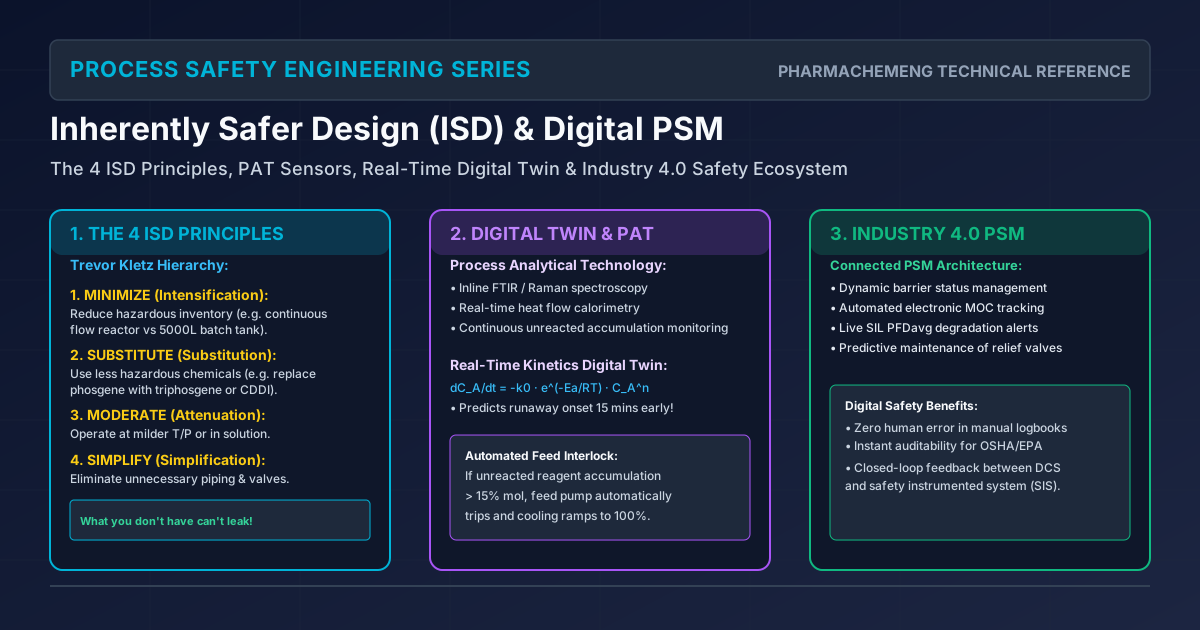
Traditionally, process safety has been treated as an "add-on" activity—a formal HAZOP review conducted late in detailed engineering to add instrumented interlocks, relief devices, and procedural rules around an already committed design.
As process safety pioneer Trevor Kletz famously stated: "What you don't have, can't leak." True process safety excellence requires Inherently Safer Design (ISD) applied early during synthetic route selection and conceptual engineering, paired with an Integrated Digital Process Safety Ecosystem that connects data across the full facility lifecycle.
In pharmaceutical process development, where highly active intermediates and exothermic reactions are common, applying ISD early in the R&D stage prevents expensive late-stage engineering redesigns during technology transfer. This guide outlines how process safety design integrates into every stage of the API manufacturing lifecycle.
# 1. The Four Core Inherently Safer Design (ISD) Strategies
ISD categorizes safety controls into a four-tier hierarchy:
[ 1. MINIMISE ] ──> [ 2. SUBSTITUTE ] ──> [ 3. MODERATE ] ──> [ 4. SIMPLIFY ]
 (Reduce Inventory)   (Lower-Hazard Reagent) (Attenuate Conditions)  (Error-Proof Design)
| ISD Strategy | Definition | Pharmaceutical API Example | Engineering Benefit |
|---|---|---|---|
| 1. Minimise | Reduce the quantity of hazardous material present at any instant | Convert batch nitration ( mixed acid) to continuous microfluidic flow () | Reduces blast/toxic footprint by |
| 2. Substitute | Replace a hazardous reagent or solvent with a less hazardous alternative | Replace toxic phosgene gas with dimethyl carbonate () or carbonyldiimidazole () | Eliminates acute toxic gas release hazard completely |
| 3. Moderate | Use hazardous materials under less severe temperatures, pressures, or diluted states | Perform hydrogenations at using high-activity catalysts instead of | Reduces vessel strain and leak discharge rates |
| 4. Simplify | Design equipment and piping to eliminate complexity and human error potential | Use gravity flow transfers instead of pressure-drum transfers; key-locked valves | Eliminates single-operator procedural mistakes |
# 2. R&D to Production: Step-by-Step Lifecycle Safety
# 2.1. Raw Material (RM) Storage, Handling, and Charging
- Hazard: Storing large bulk volumes of flammable solvents (e.g., Toluene, Acetone) and manually dumping solid API intermediates. Open-bag solid charging generates dust clouds, creating static ignition risks.
- ISD Application (Minimize & Moderate):
- Closed Vacuum Transfer: Replace manual solid charging through the reactor manway with closed vacuum pneumatic transfer systems, keeping dust contained.
- Bulk Storage Attenuation: Store bulk solvents in outdoor tanks equipped with double-containment concrete dykes (bunds) and automated nitrogen blanketing, minimizing internal vapor accumulation.
# 2.2. Reaction Control & Monitoring
- Hazard: Exothermic runaway reactions. High reaction enthalpies can exceed jacket cooling capacities if raw materials are charged in a single batch.
- ISD Application (Moderate & Simplify):
- Semi-Batch Dosing Control: Design reactions as dosing-controlled (semi-batch). The inventory of unreacted material is kept low (Minimize) by linking the dosing pump feed rate directly to the reactor temperature via a Safety Instrumented System (SIS). If cooling is lost, dosing stops, terminating heat generation within seconds.
- Redundant Monitoring: Install redundant temperature transmitters (TT-101A and TT-101B in a 1oo2 interlock loop) and off-gas flow indicators to monitor gas evolution rates during reactions.
# 2.3. Material of Construction (MOC) and Chemical Compatibility
- Hazard: Corrosion-induced vessel failure. Incompatible chemicals can corrode reactor shells or cause elastomer seals to leak toxic vapors.
- ISD Application (Simplify & Substitute):
- Corrosion-Resistant MOC: Specify Glass-Lined Reactors (GLR) or Hastelloy C-276 vessels for acidic or chlorination steps.
- Compatibility Verification: Conduct spark testing (at 10 kV) on glass linings to detect microscopic cracks before chemical feed. Ensure gaskets are chemically resistant (e.g., USP Class VI PTFE or Hastelloy-wound graphite gaskets).
# 2.4. Distillations
- Hazard: Thermal degradation of products and solvent boiling under high temperature, leading to overpressure.
- ISD Application (Moderate):
- Vacuum Distillation: Operate distillation columns under deep vacuum to lower the solvent's boiling point, reducing the operating temperature and thermal stress on heat-sensitive APIs.
- Dry-Out Prevention: Install redundant liquid level switches in the reboiler to prevent dry-out, which could create hot surfaces and ignite vapors.
# 2.5. Filtration & Cake Washing
- Hazard: Operator exposure to toxic solvents and APIs during filter cake handling.
- ISD Application (Simplify & Minimize):
- Agitated Nutsche Filter Dryers (ANFD): Replace open plate filters or centrifuges with enclosed ANFD units. The filtration, washing, and drying occur inside a single sealed vessel, eliminating intermediate powder handling and reducing VOC emissions.
# 2.6. Inertization Protocols
- Hazard: Flammable vapor space inside reactors or dryers.
- ISD Application (Moderate):
- Automated Nitrogen Blanketing: Maintain an inert nitrogen blanket inside all solvent vessels. Install continuous oxygen analyzers to trip and purge the system if the oxygen concentration rises above 5% (well below the Minimum Oxygen Concentration - MOC limit required for ignition).
# 2.7. Scale-Up Parameters
- Hazard: The reduction in the surface-area-to-volume ratio (A/V) as reactor sizes scale up, trapping reaction heat.
- ISD Application (Moderate):
- Heat Dissipation Limits: Limit batch scale sizes based on the vessel cooling area, or design external loop heat exchangers to bypass jacket surface limitations.
- Reaction Criticality (MTSR): Ensure that the Maximum Temperature of the Synthesis Reaction (MTSR) remains below the boiling point of the solvent and the onset temperature of secondary decomposition.
# 2.8. Drying Operations
- Hazard: Ignitable dust clouds and solvent vapor release during active drying.
- ISD Application (Moderate & Simplify):
- Vacuum Drying: Dry solvents below their flash point using vacuum cone or tray dryers, maintaining an inert nitrogen atmosphere.
- Grounding Audits: Confirm all metal filter housings and dryer shells are grounded (resistance to ground less than 10 Ohms) to discharge static electricity.
# 2.9. Discharging of Solvent or Products
- Hazard: Toxic dust exposure to operators and static accumulation during powder packing.
- ISD Application (Minimize):
- Split Butterfly Valves (SBV): Use SBVs for solid product discharge into storage drums, achieving high containment (OEB 4/5 rating) and minimizing airborne dust exposure.
- Conductive Liners: Utilize static-dissipative drum liners with continuous grounding straps during packaging.
# 3. The 4-Gate Engineering Lifecycle Governance Model
To ensure process safety is an input to design rather than a late output, engineering organizations use a 4-gate review model:
[Gate 1: Conceptual] ──> [Gate 2: Basic Eng.] ──> [Gate 3: Detailed Eng.] ──> [Gate 4: Pre-Startup]
 (ISD Scorecard Signed)   (Area Class & What-If)   (Full HAZOP / LOPA / DIERS)   (PSSR & As-Built Verification)
- Gate 1 (Conceptual Basic Engineering): ISD Scorecard Deliverable. Requires documented comparison of at least two synthetic route alternatives on ISD grounds before process concept sign-off.
- Gate 2 (Basic Detailed Engineering): Preliminary What-If / HAZOP review against preliminary P&IDs and 3D layout models to catch siting/spacing issues before structural steel is committed.
- Gate 3 (Detailed Engineering Construction): Hard Stop Gate. Full HAZOP, LOPA, and DIERS relief sizing calculations signed off on issued-for-construction drawings.
- Gate 4 (Construction Operations): Pre-Startup Safety Review (PSSR) confirming physical as-built installation matches the HAZOP-reviewed P&IDs.
# 4. The Digital Process Safety Management (PSM) Ecosystem
Modern multi-site API facilities manage process safety through an integrated digital software architecture rather than disconnected paper binders:
                      [ Process Safety Information (PSI) Database ]
                                           |
     +-----------------+-------------------+-------------------+-----------------+
     |                 |                   |                   |                 |
[ PHA / HAZOP ]   [ LOPA & SIL ]   [ Dispersion Model ]   [ DIERS Relief ]  [ MOC Workflow ]
 (Open-PHA /       (exSILentia)       (PHAST / ALOHA)      (SuperChems /       (Digital MOC)
  PHAWorks)                                                  PRV2SIZE)
# Key Tool Categories & Applications
- PSI & Document Management: Centralized, version-controlled database storing equipment specs, P&IDs, area classification drawings, and SDS hazard data.
- PHA Facilitation Platforms (Open-PHA, PHAWorks, Sphera): Digital HAZOP worksheets linking deviations directly to P&ID tags and action item tracking.
- SIL/SIS Lifecycle Software (exSILentia): Automated SIL verification calculations against IEC 61511 architecture and proof-test interval tracking.
- Consequence & Dispersion Modeling (PHAST, SAFETI, ALOHA): Quantitative modeling of toxic gas release plumes (, ) and vapor cloud explosions ().
- DIERS Two-Phase Relief Tools (SuperChems for DIERS, PRV2SIZE): Multicomponent reaction kinetics modeling and two-phase flashing flow relief sizing.
# 5. Industrial Case Studies: ISD & Digital PSM in Action
To understand the practical engineering execution of Inherently Safer Design and Digital PSM ecosystems, we examine two comprehensive industrial benchmarks: a Greenfield New API Facility engineered with ISD from day zero, and a Brownfield Modernization of a 25-Year-Old Legacy Multi-Purpose Plant upgraded to world-class safety integrity.
+──────────────────────────────────────────────────────────────────────────────+
│                   TWO PARADIGMS OF PROCESS SAFETY EXCELLENCE                 │
+──────────────────────────────────────┬───────────────────────────────────────+
│ CASE STUDY 1: GREENFIELD FACILITY    │ CASE STUDY 2: BROWNFIELD RETROFIT     │
│ (New High-Potency Oncology API Plant)│ (25-Yr-Old Multi-Purpose Bulk Plant)  │
├──────────────────────────────────────┼───────────────────────────────────────+
│ • Front-End ISD Route Selection      │ • Inherently Safer Hazard Attenuation │
│ • Continuous Flow Chemistry (Micro)  │ • Open-Centrifuge -> Closed ANFD      │
│ • Fully Enclosed Isolator Robotics   │ • Manual Charging -> Vacuum Powder PTS│
│ • Integrated Digital Twin / SIL-3    │ • Relay Interlocks -> IEC 61511 SIS   │
│ • Blast Overpressure Decoupling      │ • Paper Binders -> Central PSI & MOC  │
+──────────────────────────────────────┴───────────────────────────────────────+
# Case Study 1: Greenfield Facility — High-Potency Oncology API Plant
# 1. Facility Context & Baseline Hazard Profile
A multinational pharmaceutical manufacturer designed a ₹980 Crore (< 0.1 \ \mu\text{g/m}^3\Delta H_{rxn} = -340 \ \text{kJ/mol}\Delta T_{ad} > 165 \ \text{K}$).
# 2. Front-End ISD Implementation Matrix
| Life Cycle Area | Conventional Baseline Practice | Inherently Safer Design (ISD) Solution | Primary ISD Principle | Measurable Safety & Operational Impact |
|---|---|---|---|---|
| Synthetic Chemistry | batch cryogenic lithiation () using n-butyl lithium in THF. | Continuous flow micro-reactor with turbulent micromixing ( active holdup volume, ). | Minimise & Moderate | Reaction inventory reduced by . Refrigeration energy cut by . Eliminates BLEVE and thermal runaway catastrophic risks. |
| Diazotization Step | Semi-batch sodium nitrite dosing with unstable diazonium intermediate (). | Continuous tubular plug-flow loop with in-situ quenching into stable intermediate; residence time . | Minimise & Moderate | Active diazonium inventory at any point (vs. in a stirred vessel). Decomposition hazard decoupled from operator presence. |
| Material Containment | Manual powder scoops and split-butterfly valve isolators. | Fully automated split-butterfly vacuum transfer with automated CIP/WIP containment isolators and automated robotic drum decanting. | Simplify & Minimize | Airborne dust exposure reduced from to (well within OEB 5 limits). Zero worker skin contact. |
| Solvent Selection | Dichloromethane () and Diethyl Ether (flash point , autoignition ). | Substituted with 2-Methyltetrahydrofuran (2-MeTHF) and Ethyl Lactate. | Substitute | Flammable envelope moderated; toxic chlorinated solvent emissions eliminated; bio-based solvent sustainability compliance achieved. |
| Relief & Venting | High-pressure bursting discs routed to roof vent stacks. | DIERS-designed dual-phase rupture discs routed to a high-capacity cyclonic knockout drum with water deluge scrubber and flare header. | Moderate & Simplify | Zero atmospheric toxic gas release. Overpressure containment verified for full 2-phase flashing frothy churn flow. |
# 3. Digital PSM Ecosystem Architecture
- Virtual Process Twin (Aspen Plus Dynamics & gPROMS): Dynamic model coupled with reaction kinetics validated reaction MTSR () and runaway trajectories before steel procurement, optimizing jacket heat removal areas.
- Integrated Safety Lifecycle Management (exSILentia): All SIFs (Safety Instrumented Functions) designed from day one to IEC 61511 standards. The flow reactor feeds were protected with SIL-2 independent shutdown loops utilizing 2oo3 voting pressure and temperature sensors with partial stroke testing (PST) actuated valves.
- Digital PSI & 3D Model Spatial Verification: P&IDs tied via intelligent tag databases to Hexagon SmartPlant 3D models. Escape paths, safety shower zones, blast wall standoffs, and gas detector cone-of-vision dispersion overlays were verified computationally before civil layout pour.
# 4. Outcome & Performance Metrics
- Total Incident Rate (TRIR): over 4 years of commercial operation.
- Solvent Recovery & Green Metric: Process Mass Intensity (PMI) dropped from (pilot batch) to (commercial continuous).
- Capital Cost Saving: Eliminating the need for thick-walled cryogenic Hastelloy C-276 vessels and massive blast bunkers saved ₹122 Crore in structural Capex.
# Case Study 2: Brownfield Modernization — 25-Year-Old Multi-Purpose Bulk API Plant
# 1. Facility Context & Baseline Hazard Profile
An operating multi-product API site commissioned in 1999 faced severe operational vulnerabilities:
- Manual solids charging through open reactor manways causing frequent solvent vapor flammability excursions.
- High-volume batch hydrogenation ( at with pyrophoric Raney Nickel catalyst).
- Open bottom-discharge centrifuges producing airborne VOC concentrations and static discharge hazards during cake scraping.
- Disconnected legacy safety documentation: paper P&IDs with red-line drifts, non-standardized MOC binders, and relay-based emergency shutdown systems lacking SIL verification.
# 2. Brownfield Modernization: From High-Risk to Best-in-Class
+-----------------------------------------------------------------------------------+
| LEGACY (1999) VS MODERNIZED (2026) ENGINEERING MATRIX |
+------------------------------------------+----------------------------------------+
| ❌ Open manway manual chemical dumping | ✅ Closed vacuum pneumatic dense-phase |
| | transfer system (PTS) with inerting |
| ❌ Open-basket centrifuge cake scraping | ✅ Fully enclosed Agitated Nutsche |
| | Filter Dryer (ANFD) with automated CIP|
| ❌ High-pressure batch hydrogenation | ✅ High-activity heterogeneous loop |
| () | reactor (, low holdup)|
| ❌ Hardwired relay safety interlocks | ✅ IEC 61511 compliant SIL-2 certified |
| | Safety PLC with dual 1oo2 transmitters|
| ❌ Redline paper binders & manual MOC | ✅ Centralized Cloud PSI database with |
| | automated change impact analysis |
+------------------------------------------+----------------------------------------+
# 3. Step-by-Step Modernization Execution Plan
# Step A: Elimination of Open Manway Operations (ISD Strategy: Moderate & Simplify)
- Pneumatic Transfer System (PTS): Installed vacuum dense-phase powder transfer systems directly over reactor charging nozzles. Solid API intermediates are transferred under closed nitrogen recirculation, eliminating worker airborne exposure () and static accumulation.
- Continuous Oxygen Monitoring: Interlocked reactor inerting loops with optical paramagnetic analyzers. Reactor charge valves are physically interlocked until the head space oxygen content drops below (safety margin under limiting oxygen concentration).
# Step B: Solid-Liquid Separation Overhaul (ISD Strategy: Minimise & Simplify)
- Decommissioned 6 Open Centrifuges: Replaced with two Hastelloy C-22 Agitated Nutsche Filter Dryers (ANFD).
- Process Intensification: Filtration, displacement cake washing, vacuum drying, and automated side-discharge packing now occur within a single hermetically sealed unit. Solvent emissions reduced by , and operator solvent vapor exposure dropped to undetectable levels ().
# Step C: Hydrogenation Pressure & Inventory Attenuation (ISD Strategy: Moderate)
- Upgraded hydrogenation technology from a high-pressure stirred autoclave () to an external venturi-loop gas-induction reactor operating at with a sponge nickel catalyst carrier.
- The higher gas-liquid mass transfer rate () halved the reaction batch cycle time from to while lowering the operating pressure by , significantly moderating vessel stress and leak release rates.
# Step D: Digital PSM & Instrumentation Modernization
- As-Built Laser Scanning & Digital P&ID Reconciliation: The 25-year-old facility underwent 3D terrestrial LiDAR scanning to produce millimeter-accurate as-built digital twins, reconciling 380+ undocumented legacy field piping changes.
- Safety Instrument Systems (SIS) Upgrade: Legacy electrical relay interlocks replaced with a redundant SIL-2 certified Triconex Safety PLC with fiber-optic segregation from the Emerson DeltaV DCS. All critical runaway reaction interlocks were upgraded with dual 1oo2 temperature transmitters and quick-acting fail-closed emergency isolation valves (EIV) featuring stroke speed.
- Enterprise MOC Workflow Platform: Disconnected paper binders replaced with an Enterprise Digital MOC portal. Any proposed piping, valve, or chemistry change automatically triggers:
- Chemical compatibility matrix check.
- Relief valve capacity delta check.
- Electrical area classification validation.
- Mandatory PSSR sign-off protocol before maintenance work permit release.
# 4. Outcome & Performance Metrics
- Process Safety Incidents: Zero Tier 1/2 process safety events across 36 months post-revamp.
- Cycle Time Reduction: Overall API synthesis batch cycle time decreased by .
- Insurance Premiums: Third-party underwriters re-rated the facility from Moderate Hazard to Highly Protected Risk (HPR), yielding an annual insurance premium reduction of ₹3.5 Crore (\approx \420,000$).
- Payback Period: Total modernization capital expenditure of ₹70 Crore achieved full financial payback within 3.2 years through yield increases, reduced cycle times, and zero regulatory shutdown citations.
# 6. Key Takeaways: Greenfield vs. Brownfield Decision Framework
| Decision Dimension | Greenfield New Facility Approach | Brownfield Facility Retrofit Approach |
|---|---|---|
| Primary Lever | Synthetic route selection & equipment architecture (Minimise & Substitute). | Engineered containment, condition moderation & automation (Moderate & Simplify). |
| Cost Influence | Maximum influence at minimal cost during Conceptual/Basic Design ( Capex impact). | Moderate-to-high cost per modification; requires phased shutdowns and strict MOC governance. |
| Technology Options | Continuous micro-reactors, isolator robotics, process analytical technology (PAT). | ANFD retrofits, vacuum PTS systems, high-efficiency loop reactors, digital twins. |
| Regulatory Risk | Validated natively to modern cGMP, FDA, and OSHA PSM 1910.119 standards. | Eliminates chronic audit non-compliances, FDA 483 warnings, and legacy equipment degradation. |
# 7. OT/IT Integration & Cybersecurity (IEC 62443)
Connecting process safety dashboards and digital twin platforms to the plant Operational Technology () network introduces cybersecurity risks.
Per IEC 62443 and IEC 61511:
- Safety Instrumented Systems () must remain physically and logically segregated from Basic Process Control Systems () and enterprise networks via a Demilitarized Zone ().
- Data flow must be one-way (read-only) from historians to business dashboards, preventing external network interference with safety interlocks.
# 8. Reference Standards & Codes
- CCPS Inherently Safer Chemical Processes: A Life Cycle Approach (Center for Chemical Process Safety).
- IEC 61511 / ISA-84: Functional safety - Safety instrumented systems for the process industry sector.
- IEC 62443: Industrial Communication Networks - IT Security for Networks and Systems.
- US FDA 21 CFR Part 211: Current Good Manufacturing Practice for Finished Pharmaceuticals.
- EU GMP Annex 1: Manufacture of Sterile Medicinal Products.
- ISPE Baseline Pharmaceutical Engineering Guide (Vol 1-7): Bulk Active Pharmaceutical Ingredients.