# HAZOP Study: A Practical Guide for Process Engineers
# Executive Summary & Engineering Scope
In chemical, Active Pharmaceutical Ingredient (API), and specialty chemical manufacturing, a Hazard and Operability (HAZOP) Study is the foundational, regulatory-mandated Process Hazard Analysis (PHA) technique (OSHA 29 CFR 1910.119(e), CCPS, and IEC 61882).
A HAZOP is a structured, systematic brainstorming methodology executed by a multidisciplinary engineering team. By applying standard guidewords to process parameters across defined P&ID nodes, the team identifies potential process deviations, unmitigated consequences, existing Independent Protection Layers (IPL), and actionable engineering recommendations.
This comprehensive guide details:
- Multidisciplinary HAZOP team roles and workshop responsibilities.
- Step-by-step P&ID node boundary isolation and Design Intent specification.
- The complete Guideword × Parameter Matrix for continuous and batch units.
- The standard 5 × 5 Risk Ranking Matrix (Severity vs. Likelihood).
- A detailed, multi-node 5,000 L Jacketed Batch Reactor HAZOP Case Study complete with IPL credits and recommendations.
- The integration bridge between qualitative HAZOP findings, semi-quantitative LOPA, and SIL Allocation (IEC 61511 / ISA 84).
# 1. Multidisciplinary HAZOP Team Composition
A successful HAZOP depends on the collective expertise of the workshop team. No single engineer possesses complete knowledge of process chemistry, control philosophy, and physical maintenance:
| Team Role | Primary Responsibility in Workshop | Required Background & Output |
|---|---|---|
| HAZOP Chairman / Facilitator | Guides systematic deviation review, maintains workshop pace, ensures unbiased challenge of safeguards. | Independent certified PHA Lead (TÜV / CCPS certified); non-project team member. |
| HAZOP Scribe / Secretary | Records deviations, causes, consequences, safeguards, risk ranks, and recommendations in real time. | Chemical / Safety engineer experienced in PHA software (Open-PHA, PHA-Pro). |
| Process Design Lead | Explains design intent, P&ID topology, thermophysical properties, relief sizing, and operating envelopes. | Lead Chemical / Process Design Engineer for the project. |
| Operations Manager / Specialist | Evaluates practical operator intervention, manual valve alignment, batch charging steps, and SOP routines. | Senior Plant Operations Manager / Shift Supervisor with field experience. |
| Instrumentation & Control (I&C) | Details DCS/PLC control loops, interlocks, alarm response times, transmitter failure modes, and valve fail-safe states. | Senior Automation & Control Systems Engineer. |
| Maintenance & Mechanical Lead | Assesses equipment mechanical integrity, seal failures, corrosion limits, pipe vibration, and strainer clogging. | Lead Mechanical / Reliability Engineer. |
| EHS / Process Safety Lead | Verifies environmental release limits, toxic exposure risks, fire safety, and regulatory compliance. | Site Environmental, Health & Safety Specialist. |
# 2. Step-by-Step P&ID Node Boundary Definition
A Node is a discrete section of process piping or equipment with a specific, uniform Design Intent (e.g., "Transfer 100 L/min of Toluene at 25°C and 2.0 bar g from V-101 to R-101").
# The Node Isolation Workflow:
P&ID Review ──► Define Node Boundaries ──► Document Design Intent ──► Apply Guidewords ──► Evaluate Risk ──► Assign Actions
# Node Marking Guidelines:
- Piping Nodes (Lines): Start at the source connection (e.g., storage tank outlet nozzle) and follow the fluid flow through pumps, strainers, and control valves up to the vessel inlet flange.
- Equipment Nodes (Vessels): Cover the internal volume of the vessel, agitator, internal coils, jacket, disengagement headspace, and vent nozzles.
- Utility Nodes: Treat utility supply headers (Steam, Chilled Water, Nitrogen, Vacuum) as separate nodes feeding process equipment.
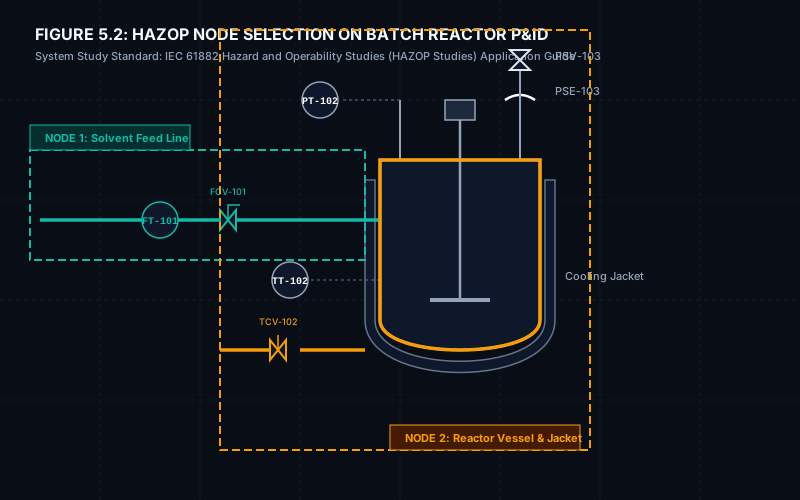
- Node 1 (Teal Boundary): Solvent feed supply line from tank farm to reactor inlet (FT-101, FCV-101, check valves).
- Node 2 (Orange Boundary): 5,000 L SS316L Reactor vessel body, jacket cooling loop (TT-102, PT-102, TCV-102, agitator).
- Node 3 (Purple Boundary): Overhead vapor riser, shell-and-tube condenser, and vent scrubber connection (PSV-103, PSE-103, PCV-104).
# 3. Comprehensive Guidewords & Process Parameters Matrix
Deviations are generated by systematically combining Process Parameters with standard ISO/IEC 61882 Guidewords:
| Guideword | Deviation Meaning | Process Application Example |
|---|---|---|
| NO / NONE | Complete negation of design intent | No flow in cooling jacket when reaction is active |
| MORE / HIGH | Quantitative increase in parameter | High pressure, high temperature, high flow rate |
| LESS / LOW | Quantitative decrease in parameter | Low nitrogen blanketing pressure, low agitator RPM |
| AS WELL AS | Qualitative addition to design intent | Impurities present, air ingress, water in solvent |
| PART OF | Qualitative subtraction from fluid | Loss of key reactant component in feed mixture |
| REVERSE | Flow in opposite direction to intent | Reaction mass backing up into raw solvent header |
| OTHER THAN | Complete substitution or invalid operation | Wrong solvent charged (e.g., Acetone instead of Water) |
| EARLY / LATE | Timing deviation (Batch operations) | Catalyst added too early before mass reached 60°C |
# 4. Standard 5 × 5 Risk Assessment Matrix
To prioritize recommendations, unmitigated consequences are scored using a standard 5 × 5 Risk Matrix:
# Severity Categories (1 to 5):
- Minor: First aid injury; zero environmental release; negligible equipment damage.
- Moderate: Minor medical treatment; localized minor spill contained on site; minor downtime (< 2 hours).
- Serious: Lost-time injury; off-site environmental reportable release; significant equipment damage.
- Major: Single fatality or severe permanent disability; major off-site environmental impact.
- Catastrophic: Multiple fatalities; extensive off-site community toxic cloud or explosion impact.
# Likelihood Categories (A to E):
- A (Rare): < 10^-4 / year (Unlikely during plant lifetime).
- B (Unlikely): 10^-4 to 10^-3 / year (May occur once in industry).
- C (Possible): 10^-3 to 10^-2 / year (Might occur once in plant lifetime).
- D (Probable): 10^-2 to 10^-1 / year (Occurs several times in plant lifetime).
- E (Frequent): > 10^-1 / year (Occurs multiple times per year).
# Risk Matrix Table:
| Likelihood \ Severity | 1 (Minor) | 2 (Moderate) | 3 (Serious) | 4 (Major) | 5 (Catastrophic) |
|---|---|---|---|---|---|
| E (Frequent) | Medium | High | High | CRITICAL | CRITICAL |
| D (Probable) | Low | Medium | High | High | CRITICAL |
| C (Possible) | Low | Low | Medium | High | High |
| B (Unlikely) | Low | Low | Low | Medium | High |
| A (Rare) | Low | Low | Low | Low | Medium |
# 5. Comprehensive 5,000 L Batch Reactor HAZOP Case Study
# Node 1: Toluene Solvent Charge Line (Tank Farm to Reactor R-101 Inlet)
- Design Intent: Transfer 4,000 L of Toluene solvent at 100 L/min at 25°C and 2.0 bar g header pressure.
| Item | Deviation | Potential Causes | Unmitigated Consequences | S | L | Risk Rank | Existing Safeguards (IPL) | Recommendations / Action Items | Action Owner |
|---|---|---|---|---|---|---|---|---|---|
| 1.1 | No Flow | 1. Inlet manual block valve closed. 2. Transfer pump P-101 trips. 3. FCV-101 fails closed. | Dry stirring of solid reactant heel in reactor R-101; static discharge ignition hazard; batch loss. | 3 | C | Medium | Low flow alarm FAL-101 on DCS. | Install software interlock to prevent agitator start if solvent flow FAL-101 is verified zero. | Process Eng |
| 1.2 | More Flow | 1. FCV-101 fails 100% open. 2. Batch totalizer meter fails. | Overcharging toluene solvent (> 4,500 L); vessel overfilling; toluene liquid spill into exhaust vent. | 4 | C | High | 1. High level LAH-102. 2. Reactor weight load cells. | Install automated SIL-2 emergency shut-off valve XV-101 tied to high-high level switch LSHH-102. | Instrument Eng |
| 1.3 | Reverse Flow | 1. Reactor R-101 pressure exceeds solvent header (> 2.5 bar g). 2. Check valve CV-101 fails open. | Flammable reaction mass backs up into clean toluene storage tank V-101; bulk tank contamination. | 3 | B | Medium | Dual check valves CV-101 / CV-102 in series. | Install automated siphon break valve and high-pressure interlock to trip XV-101 if PT-102 > 1.5 bar g. | Operations |
| 1.4 | Other Than | 1. Wrong solvent line connected at manifold (DCM instead of Toluene). | Violent exothermic reaction with incompatible batch heel; rapid overpressurization. | 5 | B | High | Unique key-locked hose coupling connections. | Implement strict barcode scanning on solvent manifold selection prior to pump authorization. | EHS / QA |
# Node 2: 5,000 L Jacketed Batch Reactor Body (R-101)
- Design Intent: Contain reaction mass, maintain reaction temperature at 65.0°C (± 2.0°C) via jacket steam/cooling, and maintain pressure below vessel MAWP (6.0 bar g).
| Item | Deviation | Potential Causes | Unmitigated Consequences | S | L | Risk Rank | Existing Safeguards (IPL) | Recommendations / Action Items | Action Owner |
|---|---|---|---|---|---|---|---|---|---|
| 2.1 | High Temp | 1. Jacket cooling water valve TCV-102 fails closed. 2. Exothermic runaway reaction. 3. Agitator trip. | Rapid thermal runaway; solvent boiling exceeds condenser capacity; vessel overpressurization. | 5 | C | CRITICAL | 1. High temp alarm TAH-102. 2. Independent RTD probe. | Install SIL-2 Safety Instrumented System (SIS) to trip feed dosing pump P-102 and deluge jacket with chilled water on TSHH-102 (> 85°C). | Safety Lead |
| 2.2 | High Press | 1. Uncontrolled thermal runaway. 2. Scrubber off-gas vent valve closed. 3. N2 purge regulator failure. | Vessel pressure exceeds MAWP (6.0 bar g); catastrophic structural rupture and explosion. | 5 | C | CRITICAL | 1. Rupture Disk PSE-103 (5.0 bar g). 2. Safety Relief Valve PSV-103 (5.5 bar g). | Perform DIERS two-phase relief sizing audit to confirm PSV discharge throat area for runaway vapor-liquid mass. | Safety Eng |
| 2.3 | Low Press / Vacuum | 1. N2 blanket valve fails closed during cold batch discharge. 2. Rapid cooling of hot vapor space. | Implosion and structural collapse of 5 KL reactor vessel due to external atmospheric pressure. | 4 | C | High | Mechanical vacuum breaker valve NVR-104 (0.05 bar vacuum). | Install low-pressure alarm PAL-102 on DCS and N2 automatic makeup valve PCV-102. | Instrument Eng |
| 2.4 | No Agitation | 1. Agitator motor drive P-102 trips. 2. Impeller shaft shear pin failure. | Phase separation; unreacted reagent accumulation followed by sudden explosive reaction upon restart. | 5 | C | CRITICAL | Agitator motor current feedback IT-102. | Interlock reagent feed pump P-102 to trip immediately if agitator speed ST-102 drops below 40 RPM. | Automation Eng |
# Node 3: Overhead Vapor Riser & Condenser Relief System
- Design Intent: Condense 400 kg/h of solvent vapor at 64.7°C and route non-condensables safely to off-gas scrubber.
| Item | Deviation | Potential Causes | Unmitigated Consequences | S | L | Risk Rank | Existing Safeguards (IPL) | Recommendations / Action Items | Action Owner |
|---|---|---|---|---|---|---|---|---|---|
| 3.1 | Less Cooling | 1. CTW cooling water pump trip. 2. Condenser tubes fouled with polymer scale. | Solvent vapor carryover through scrubber to atmosphere; toxic & flammable vapor cloud release. | 4 | C | High | High temp alarm TAH-105 on distillate outlet. | Install automated flow switch FSL-105 on cooling water return; trip reactor steam supply on low flow. | Plant Maintenance |
| 3.2 | High Press | 1. Vent scrubber isolation valve mistakenly closed. 2. Flame arrestor blinded with condensate. | Overpressurization of disengagement space; backpressure buildup in reactor R-101. | 4 | C | High | Differential pressure switch DPIT-105 across flame arrestor. | Install Car-Seal Open (CSO) program on all manual isolation valves in relief path. | Operations Lead |
# 6. Qualitative HAZOP to Semi-Quantitative LOPA & SIL Alignment
A common gap in process safety is treating HAZOP as a standalone exercise. In modern IEC 61511 / ISA 84 standards, high-risk HAZOP scenarios feed directly into Layer of Protection Analysis (LOPA):
HAZOP Hazard Identification ──► Target Mitigation (ALARP) ──► Identify IPLs (LOPA) ──► Determine PFD_avg ──► Allocate SIL (SIL 1/2/3)
| HAZOP Risk Scenario | Unmitigated Initiating Event Frequency (fi) | Required PFD (PFD_avg) | Allocated Independent Protection Layers (IPL) | Target SIL Rating |
|---|---|---|---|---|
| Reactor Exothermic Runaway (High Temp) | 1 × 10^-1 / year (TCV failure) | 1 × 10^-3 | 1. BPCS High Temp Alarm + Operator Action (PFD = 0.1) 2. Dedicated SIL-2 SIF Loop (PFD = 0.01) | SIL 2 |
| Vessel Rupture due to Overpressure | 1 × 10^-2 / year (Runaway boiling) | 1 × 10^-4 | 1. ASME Certified Mechanical PSV-103 (PFD = 0.01) 2. Primary Rupture Disk PSE-103 (PFD = 0.01) | Mechanical IPL |
# 7. Best-Practice HAZOP Checklist for Process Leads
To maximize workshop efficiency and maintain audit readiness:
- Freeze P&IDs at Rev 0: Never conduct a formal HAZOP on draft P&IDs; ensure pipe diameters, valve tags, and utility lines are finalized.
- Verify Operating Envelopes: Ensure maximum temperature, pressure, flow rate, and chemical concentrations are explicitly documented in node design intents.
- Audit Human Factors: Evaluate manual charging steps, hose connections, operator response times, and clarity of local indication gauges.
- Track Action Closure: Every HAZOP recommendation must have a designated single owner, target completion date, and formal sign-off before plant commissioning.
# Technical Conclusion
A well-executed HAZOP study transforms raw P&IDs into a robust, inherently safer chemical process. By systematically evaluating deviations, scoring risks, and linking safeguards to LOPA and SIL targets, process engineers protect plant personnel, environment, and capital assets.
# Applicable Engineering Standards & Codes Used
The engineering methodologies, design correlations, and safety criteria detailed in this article adhere to the following international standards and industry codes:
- OSHA 29 CFR 1910.119: Process Safety Management of Highly Hazardous Chemicals
- NFPA 654: Standard for the Prevention of Fire and Dust Explosions from Combustible Particulate Solids
- NFPA 68: Standard on Explosion Protection by Deflagration Venting
- NFPA 69: Standard on Explosion Prevention Systems
- ACGIH Industrial Ventilation: A Manual of Recommended Practice for Design (30th Edition): ACGIH Industrial Ventilation: A Manual of Recommended Practice for Design (30th Edition)
- ISO 28121: Industrial Ventilation and Dust Collection Systems Safety