# Combustible Dust Explosions in API Manufacturing: Explosion Pentagon, KSt Sizing & Imperial Sugar Case Study
Organic pharmaceutical compounds—both active pharmaceutical ingredients () and excipients—are predominantly processed in finely divided dry powder form. Downstream operations such as jet milling, micronization, fluid-bed drying, spray drying, and dry blending generate suspended dust clouds inside equipment and processing rooms.
When a combustible organic dust cloud is ignited within a confined space, the resulting deflagration generates a rapid pressure surge (), high thermal energy, and destructive overpressure. Statistically, the pharmaceutical industry suffers a disproportionate share of combustible dust explosions globally due to the combination of ultra-fine particle sizes (), low minimum ignition energies (), and dry powder transfers.
This guide provides chemical engineers, EHS leads, and plant managers with an engineering framework for dust explosion physics, explosibility testing (), secondary dust explosion mechanics, the Imperial Sugar Explosion Case Study, and NFPA 68/69 engineering controls.
# 1. The Dust Explosion Pentagon
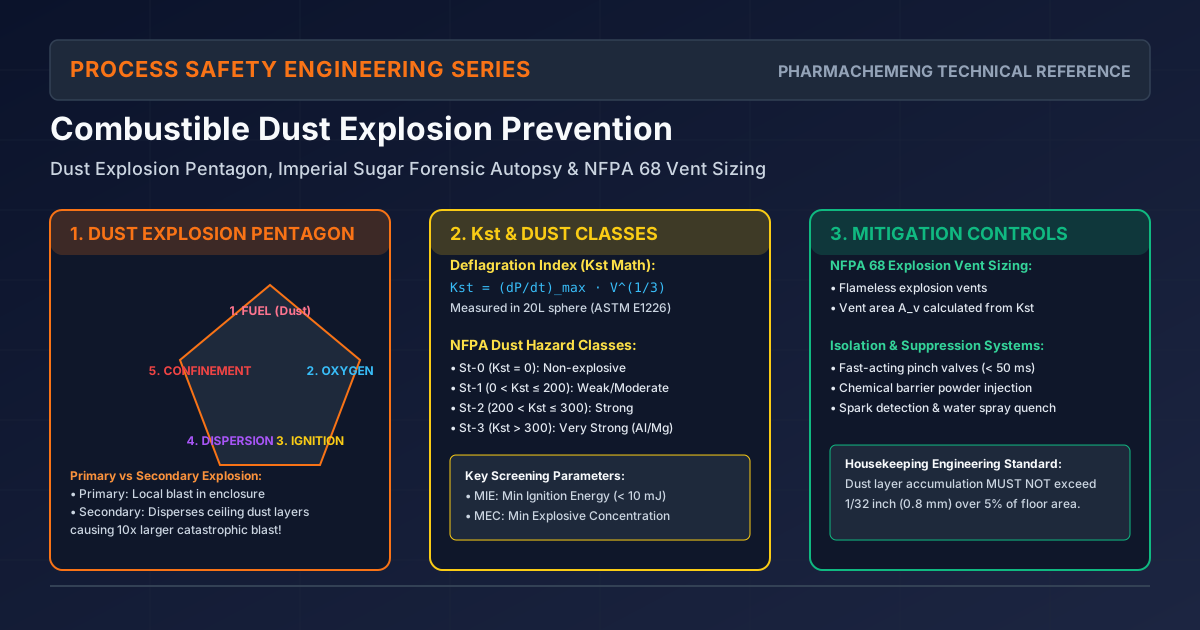
While a conventional fire requires three elements (Fuel, Oxygen, Ignition), a dust explosion requires five simultaneous conditions—the Dust Explosion Pentagon:
                  [ 1. COMBUSTIBLE DUST ]
                           / \
                          /   \
  [ 2. OXYGEN (AIR) ] ---/-----\--- [ 3. IGNITION SOURCE ]
                         \     /
                          \   /
      [ 5. CONFINEMENT ] ---\/--- [ 4. DISPERSION (CLOUD) ]
- Combustible Dust (Fuel): Finely divided organic solid suspended in air at concentrations above the Minimum Explosible Concentration ().
- Oxygen (Oxidizer): Ambient atmospheric oxygen ().
- Ignition Source: Static electrical discharge, mechanical friction/impact spark, hot surface (overheated bearing/steam line), or electrical fault delivering energy exceeding the Minimum Ignition Energy ().
- Dispersion: The dust must be suspended in air to form a cloud within the explosive concentration range.
- Confinement: Enclosure (dryer vessel, mill, hopper, cyclone, duct, or processing room) that traps gas expansion and allows pressure to accumulate.
# 2. Key Dust Explosibility Parameters & Standard Testing
Dust explosion hazards are quantified using standardized 20L sphere and 1m³ vessel test methods (ASTM E1226, ASTM E1491, EN 14034):
Where is the maximum rate of pressure rise () and is vessel volume ().
| Explosibility Parameter | Symbol | Standard Test Method | Typical API / Excipient Range | Engineering Application |
|---|---|---|---|---|
| Deflagration Index | ASTM E1226 (20L Sphere) | Determines Dust St Class; primary input for NFPA 68 vent sizing | ||
| Maximum Explosion Pressure | ASTM E1226 | Dictates vessel structural design pressure () | ||
| Minimum Explosible Conc. | ASTM E1515 | Sets upper limit for dust extraction & dilution ventilation | ||
| Minimum Ignition Energy | ASTM E2019 | Mandates anti-static grounding () & bonding | ||
| Limiting Oxygen Conc. | ASTM E2931 | Establishes Nitrogen purging target () | ||
| Autoignition Temp (Cloud) | ASTM E1491 (BAM Furnace) | Maximum surface temperature rating for electrical equipment |
# 2.1 Deflagration Severity Classes
+----------------------------------------------------------------------------+
|                       KSt EXPLOSION SEVERITY CLASSES                       |
|                                                                            |
|  St-0 Class: KSt = 0 bar·m/s -------------> Non-explosive                  |
|  St-1 Class: 0 < KSt ≤ 200 bar·m/s -------> Weak to Moderate Deflagration  |
|  St-2 Class: 200 < KSt ≤ 300 bar·m/s -----> Strong Deflagration (Most APIs)|
|  St-3 Class: KSt > 300 bar·m/s -----------> Very Strong (Micronized Powders)|
+----------------------------------------------------------------------------+
# 3. Primary vs. Secondary Dust Explosions: The Catastrophic Cascade
The vast majority of dust explosion fatalities do not occur inside processing equipment during the primary explosion; they occur from secondary dust explosions across the processing building.
[ Primary Blast Inside Jet Mill / Dust Collector ]
                        |
                        v
[ Shock Wave Propagates into Mill Suite & Lofted Dust Layers ]
                        |
                        v
[ Secondary Explosion Cloud Ignited by Primary Fireball ]
                        |
                        v
[ Total Building Collapse & Structural Destruction ]
# 3.1 The 0.8 mm Dust Layer Layer Rule (NFPA 654)
Under NFPA 654, a layer of combustible dust as thin as (1/32 inch) covering just of the floor area in a room is sufficient to generate a destructive secondary dust cloud throughout the entire room volume if lofted by a primary shock wave!
# 4. Case Study Autopsy: Imperial Sugar Explosion (Port Wentworth, GA, 2008)
# 4.1 Incident Summary & Disaster Chain
On 7 February 2008, a devastating combustible dust explosion at the Imperial Sugar refinery killed 14 workers, injured 38 others, and completely demolished the packaging facility.
+----------------------------------------------------------------------------+
|                IMPERIAL SUGAR DISASTER CAUSAL TREE                         |
|                                                                            |
| 1. Enclosed Sugar Belt Conveyor ---> 2. Bearing Overheats & Ignites Dust   |
|                                                  |                         |
| 4. Total Facility Destruction   <--- 3. Primary Blast Lofts Years of       |
|    (14 Deaths, 38 Injuries)            Overhead Dust Layers                  |
+----------------------------------------------------------------------------+
# 4.2 Causal Factors & Lessons for API Milling Suites
- Unvented Enclosure: Steel cover plates were installed over sugar belt conveyors to protect product from contamination, creating an unvented confinement zone.
- Ignition Source: An unmonitored conveyor bearing overheated past the Minimum Cloud Ignition Temperature of sugar.
- Chronic Housekeeping Failures: Massive sugar dust layers had accumulated over years on overhead roof trusses, light fixtures, and cable trays.
- API Plant Parallel: Pharmaceutical jet milling, micronizing, and tablet compression suites handle powders with far lower () than sugar. Unsealed drop ceilings, ungrounded flexible hoses, and flat ductwork surfaces present identical secondary explosion hazards.
# 5. Engineering Controls Hierarchy (NFPA 68 / NFPA 69)
# 5.1 Active & Passive Protection Systems
                              [ DUST HAZARD MITIGATION ]
                                           |
         +---------------------------------+---------------------------------+
         |                                 |                                 |
[ NFPA 68: Venting ]            [ NFPA 69: Inerting ]           [ Isolation Valves ]
 (Flameless Vents /              (N2 Purge: O2 < LOC-2%)         (High-Speed Pinch Valves
  Rupture Panels)                                                 Response < 50 ms)
- Inert Gas Blanketing (NFPA 69): Maintain nitrogen purge on closed micronizers and spray dryers to keep (typically ).
- NFPA 68 Deflagration Venting: Size explosion vent panels or flameless vents using the empirical NFPA 68 vent area equation:
Where:
- = Required explosion vent area ()
- = Enclosure internal surface area ()
- = Maximum allowable reduced pressure ()
- = Vent deployment static burst pressure ()
- High-Speed Isolation Barriers: Install fast-acting chemical suppression canisters (HRD sodium bicarbonate injection) or mechanical pinch valves ( activation time) on inlet/outlet ducts to prevent flame propagation to adjacent rooms.
- Anti-Static Grounding Audits: All conductive plant equipment, metal hoppers, filter bags (with stainless steel grounding wires), and personnel footwear must be bonded and grounded to maintain resistance to ground .
# 6. Applicable Engineering Standards & Codes
- NFPA 68: Standard on Explosion Protection by Deflagration Venting.
- NFPA 69: Standard on Explosion Prevention Systems.
- NFPA 654: Standard for the Prevention of Fire and Dust Explosions from the Manufacturing, Processing, and Handling of Combustible Particulate Solids.
- ATEX Directive 2014/34/EU: Equipment Intended for Use in Potentially Explosive Atmospheres.
# Historical Background & Foundation
# Dust Explosion Hazard in Pharma Solid Dose Manufacturing
In pharmaceutical solid dose manufacturing, many raw materials, active pharmaceutical ingredients (APIs), and excipients are combustible organic powders. Operations like milling, sifting, blending, and tableting generate fine dust clouds. If a dust cloud is exposed to an ignition source inside a confined space, a devastating dust explosion can occur.
This guide outlines the critical elements of the Dust Explosion Pentagon, provides a practical list of engineering Do's and Don'ts, and reviews historical case studies to help process engineers design inherently safer powder handling systems.
# 1. The Dust Explosion Pentagon
While a standard fire requires three elements (the Fire Triangle: Fuel, Oxygen, Heat), a dust explosion requires five elements to occur. These are represented by the Dust Explosion Pentagon:
- Combustible Dust (Fuel): The organic powder must be finely divided, dry, and capable of rapid combustion. The smaller the particle size, the larger the specific surface area, which increases the deflagration index (Kst).
- Oxidizer (Oxygen in Air): Ambient air provides the oxygen required to support combustion.
- Ignition Source (Heat): Can include electrostatic sparks (often from ungrounded operators or equipment), mechanical friction hot spots (e.g., failed bearings in a hammer mill), open flames, or hot surfaces.
- Dispersion: The dust particles must be suspended in the air to create a dust cloud. If the dust remains as a static layer on a flat floor, it can burn as a flash fire but will not explode.
- Confinement: The dust cloud must be suspended within a confined space (such as a cleanroom, spray dryer chamber, bin hopper, or transfer duct). Confinement traps the heated gases, causing a rapid pressure rise that ruptures the vessel or structure.
                   [ Combustible Dust ]
                      /            \
                     /              \
            [ Oxidizer ]          [ Confinement ]
                 |                      |
                 \                      /
             [ Dispersion ] --- [ Ignition Source ]
# 2. Powder Sieving and Static Safety Controls
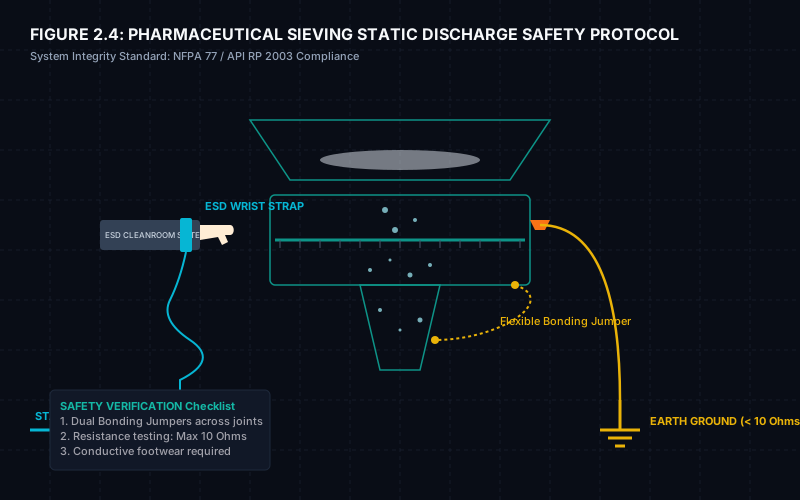
During sieving (sifting) operations, electrostatic charge generation increases dramatically because particles collide rapidly with the metal mesh screen. To prevent a static discharge spark inside the confined sieve hopper, grounding and bonding controls must be strictly implemented as illustrated below.
# 3. Key Explosibility Parameters
To design protective systems, engineers must determine these critical dust characteristics through laboratory testing:
- Kst (Deflagration Index): Measures the relative explosibility of a dust cloud. It represents the maximum rate of pressure rise in a closed 1-cubic-meter vessel. Dusts are classified into classes: ST-1 (Kst <= 200, weak/moderate), ST-2 (Kst 201-300, strong), and ST-3 (Kst > 300, very strong).
- Pmax (Maximum Explosion Pressure): The maximum pressure generated during a dust explosion in a closed vessel (typically 7 to 10 bar g).
- MEC (Minimum Explosible Concentration): The minimum concentration of dust in air required to propagate an explosion (typically 30 to 100 g/m³).
- MIE (Minimum Ignition Energy): The minimum electrical or electrostatic spark energy required to ignite the dust cloud. Many APIs are highly sensitive, with MIE < 3 mJ, meaning a simple static charge can trigger ignition.
# 4. Engineering Do's and Don'ts
# Do's:
- DO ensure complete electrical bonding and grounding (resistance to ground < 10 Ohms) for all metallic chutes, valves, storage drums, and transfer pipelines.
- DO install independent local exhaust ventilation (LEV) hoods at bag dumping and powder dispensing areas to capture dust at the source before dispersion occurs.
- DO design equipment with smooth internal surfaces (such as electropolished 316L Stainless Steel) and round corners to prevent dust accumulation.
- DO use explosion isolation valves on powder feed lines to prevent primary explosions inside mills from propagating upstream to storage bins.
- DO specify "dust-tight" electrical enclosures (IP6X or Class II, Division 1 rating) in cleanrooms where combustible powders are exposed to the atmosphere.
# Don'ts:
- DON'T blow down settled dust on beams, ledges, or light fixtures using compressed air. Doing so creates a highly explosive dispersed dust cloud in the room.
- DON'T bypass or jump temperature sensors on mill bearings. Failed bearings are a primary source of hot surface ignition.
- DON'T use plastic bags or non-conductive liners to transfer powder unless they are explicitly certified anti-static or static-dissipative.
- DON'T locate baghouse dust collectors inside the cleanroom suite. They should be positioned outdoors or in isolated bunkers equipped with explosion vent panels venting to a safe area.
# 5. Case Studies: Historical Devastating Explosions
# Case Study A: The West Pharmaceutical Services Explosion (Kinston, North Carolina - 2003)
- The Event: A massive dust explosion destroyed the West Pharmaceutical facility, killing 6 workers and injuring 38.
- The Cause: The plant manufactured rubber drug-delivery components. Fine polyethylene powder was used as a batch release agent. Over years, powder drifted up into the ceiling space, accumulating as a thick layer on top of acoustic ceiling tiles.
- The Mechanism: A minor localized fire or mechanical disturbance dispersed the dust layer in the ceiling headspace. A light fixture ignited the suspended dust cloud, initiating a devastating secondary explosion that brought down the roof. The incident highlighted the danger of hidden dust accumulation on overhead surfaces.
# Case Study B: The Imperial Sugar Refinery Explosion (Port Wentworth, Georgia - 2008)
- The Event: A series of dust explosions killed 14 workers and injured 36, leveling the sugar packaging facility.
- The Cause: A steel cover plate was installed over a belt conveyor transporting sugar, confining the conveyor space. A sugar buildup clogged the chute, dispersing dust within the enclosed conveyor. A hot bearing provided the ignition source.
- The Mechanism: The primary explosion inside the enclosed conveyor ruptured the casing. The resulting pressure wave traveled through the packaging buildings, shaking down sugar dust from floors, walls, and beams. This generated massive secondary dust clouds that ignited sequentially, destroying the entire refinery.
# 6. Reference Standards Used
- NFPA 652: Standard on the Fundamentals of Combustible Dust.
- NFPA 654: Standard for the Prevention of Fire and Dust Explosions from the Manufacturing, Processing, and Handling of Particulate Solids.
- ISO 6184: Explosion Protection Systems - Determination of Explosion Indices.
# Applicable Engineering Standards & Codes Used
The engineering methodologies, design correlations, and safety criteria detailed in this article adhere to the following international standards and industry codes:
- OSHA 29 CFR 1910.119: Process Safety Management of Highly Hazardous Chemicals
- NFPA 654: Standard for the Prevention of Fire and Dust Explosions from Combustible Particulate Solids
- NFPA 68: Standard on Explosion Protection by Deflagration Venting
- NFPA 69: Standard on Explosion Prevention Systems
- ACGIH Industrial Ventilation: A Manual of Recommended Practice for Design (30th Edition): ACGIH Industrial Ventilation: A Manual of Recommended Practice for Design (30th Edition)
- ISO 28121: Industrial Ventilation and Dust Collection Systems Safety