# Digitalizing HAZOP & LOPA with Minimal Overhead: A Practical Chemical Engineering Guide to Open-Standard Process Hazard Analysis
In chemical, Active Pharmaceutical Ingredient (API), and petrochemical manufacturing, the Process Hazard Analysis (PHA) / Hazard and Operability (HAZOP) study is the regulatory cornerstone of process safety (OSHA 29 CFR 1910.119(e), CCPS, and IEC 61511 / ISA 84).
Yet, in hundreds of operating plants and engineering design offices, the day-to-day execution of HAZOPs remains plagued by antiquated, high-friction workflows:
+---------------------------------------------------------------------------------------------------+
| THE THREE CLASSICAL PAIN POINTS OF TRADITIONAL HAZOP WORKFLOWS                                    |
+---------------------------------------------------------------------------------------------------+
|                                                                                                   |
| 1. SPREADSHEET CHAOS (EXCEL):                                                                     |
|    - Multiple disconnected workbook versions floating in email threads.                           |
|    - Broken formulas, accidental row deletions, and zero relational integrity between causes,     |
|      consequences, safeguards, and recommendations.                                               |
|    - 5-Year OSHA PSM revalidations become a nightmare of manual copy-pasting.                     |
|                                                                                                   |
| 2. LEGACY ON-PREMISE DESKTOP SOFTWARE VENDOR LOCK-IN:                                             |
|    - Opaque, proprietary binary file formats that lock safety data into walled gardens.           |
|    - Expensive per-seat licensing, complex IT license servers, hardware dongles, and hefty        |
|      maintenance contracts that discourage broad team participation.                              |
|                                                                                                   |
| 3. POST-STUDY REPORT ASSEMBLY TIME SINK:                                                          |
|    - Facilitators spend 2 to 5 days manually copying worksheet tables into Microsoft Word,        |
|      building tables of contents, re-formatting risk matrices, and cross-referencing action logs.|
|    - Once published as a static PDF, safety data sits unread in an archive until the next audit.  |
|                                                                                                   |
+---------------------------------------------------------------------------------------------------+
The industry is rapidly shifting toward minimal-setup, open-standard digital PHA platforms—spearheaded by tools such as Kenexis® Open-PHA® and cloud-native safety databases.
This guide explores how process engineers, safety managers, and EPC consultants can transition from spreadsheet chaos to modern, automated, open-data HAZOP & LOPA workflows without heavy enterprise software overhead.
# 1. The Core Architecture of Open-Standard HAZOP Digitalization
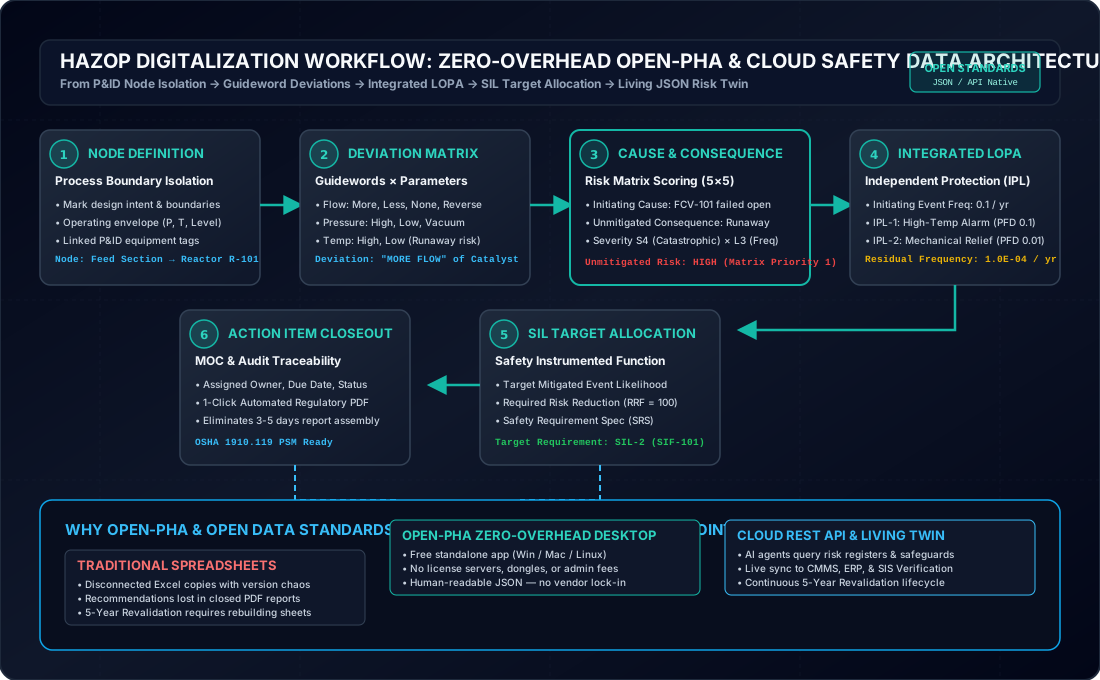
A truly modern digital HAZOP platform replaces proprietary black-box databases with open, human-readable structured data formats (JSON / open SQLite).
The diagram below outlines the streamlined digital progression from initial P&ID markup to living risk registers:
# 2. Step-by-Step Digital HAZOP & LOPA Methodology
# Step 1: P&ID Node Definition & Scope Isolation
A digital HAZOP begins by establishing clear, indisputable boundary limits on process piping and instrumentation diagrams (P&IDs):
- Design Intent: Fluid composition, operating flow, normal operating pressure (), design pressure (), and operating temperature ().
- Boundary Isolation: Defining exact battery limits (e.g., from Reagent Feed Pump P-101 discharge flange through Control Valve FCV-101 to Reactor R-101 inlet dip-pipe).
- Equipment & Instrumentation Tag Indexing: Automatically associating tags (PT-101, TT-101, TCV-101, PSV-101) directly with the active node.
# Step 2: Guideword & Parameter Deviation Matrix
Rather than typing freeform text in Excel, digital platforms enforce a rigorous, standardized deviation matrix:
| Parameter | Standard Guidewords Applied | Typical Hazardous Deviations Evaluated |
|---|---|---|
| Flow | More, Less, None, Reverse, Misdirected | Reagent overfeed (runaway), starvation (dry stirring), backflow into utility lines |
| Pressure | High, Low, Vacuum | Overpressure exceeding MAWP, vacuum implosion on steam-condensed vessel |
| Temperature | High, Low | Exothermic runaway, solvent boiling, localized freezing/viscosity stall |
| Level | High, Low | Vessel overfill to scrubber vent, liquid carryover to vacuum pump, heater uncovery |
| Composition | As Well As, Part Of, Wrong, Contamination | Wrong raw material charge, water ingress into Grignard / moisture-reactive reagent |
| Phase / State | More, Less | Vapor lock in pump suction, two-phase foaming during emergency depressurization |
# Step 3: Cause Consequence Safeguard Relational Linking
In spreadsheets, a single cause might have multiple consequences, leading to copy-pasted duplicate rows and unlinked safeguards. In an open digital data model like Open-PHA®, the relational hierarchy links every cause to its severity-scored consequences, certified safeguards (IPLs), and assigned recommendations:
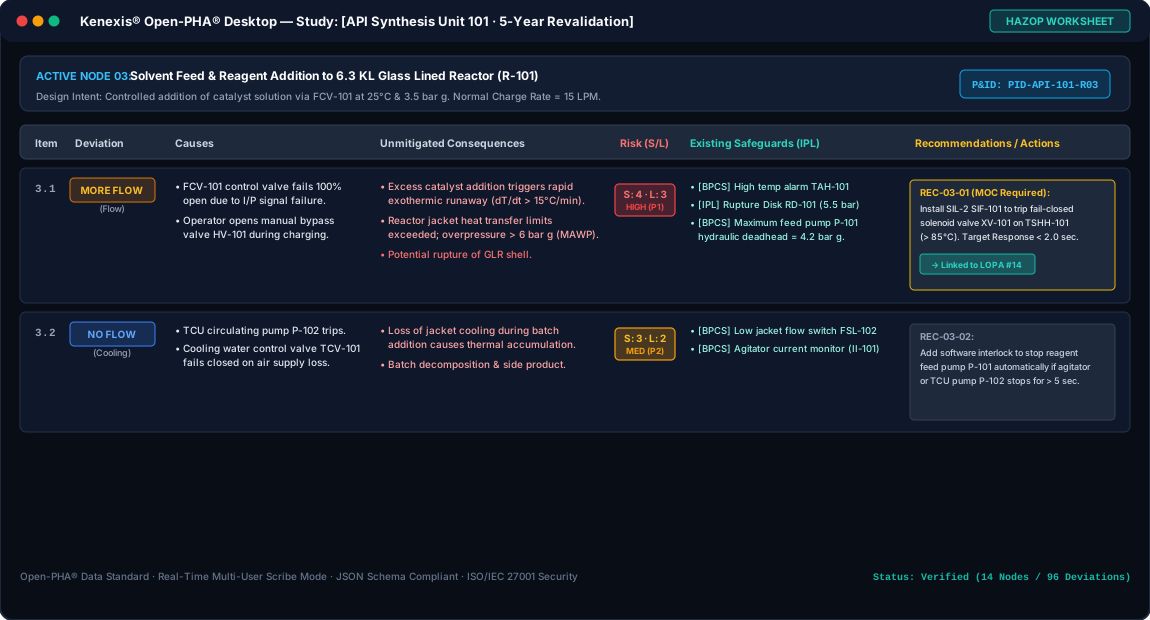
As illustrated in the Open-PHA® HAZOP Worksheet interface above:
- Dynamic Node Association: Node 03 captures design intent and links to P&ID drawings.
- Standardized Deviation: Guideword "MORE FLOW" evaluates the exact physical cause ("FCV-101 fails 100% open").
- Risk Matrix Scoring: Unmitigated consequence of exothermic runaway is scored as Severity 4 × Likelihood 3 (HIGH Priority 1).
- Independent Safeguards: Distinguishes between Basic Process Control (BPCS alarms) and safety-critical relief (Rupture Disk RD-101).
- Direct LOPA Bridge: High-risk scenarios link directly to Scenario #14 in the integrated LOPA module.
# 3. Integrating Layer of Protection Analysis (LOPA) & SIL Allocation
One of the largest advantages of modern digital tools like Kenexis® Open-PHA® is the seamless bridge between qualitative HAZOP and semi-quantitative LOPA (IEC 61511 / ISA 84).
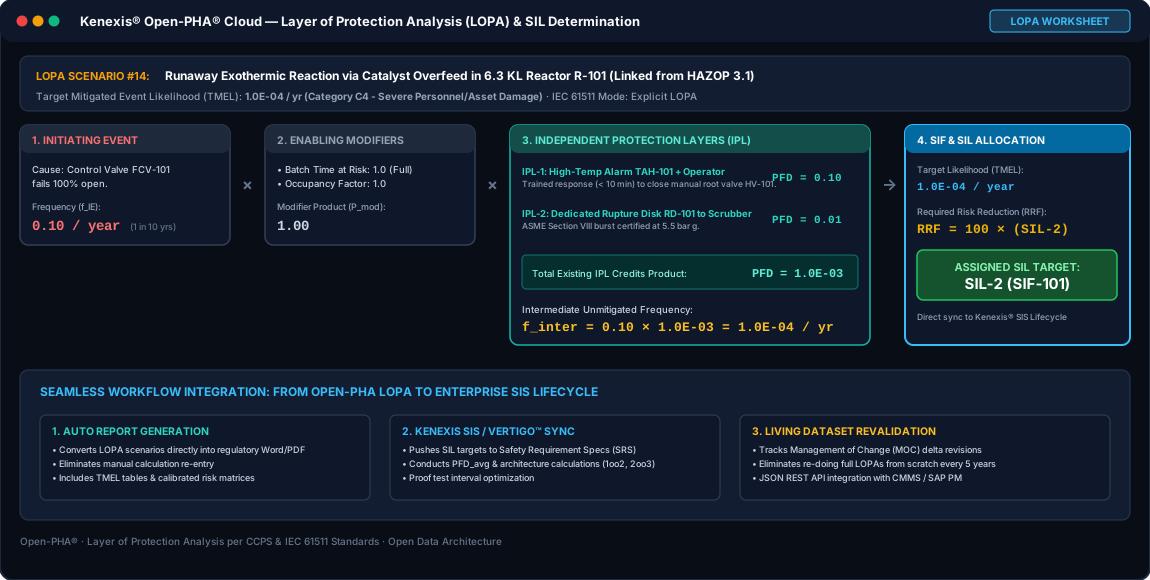
As shown in the Open-PHA® LOPA Worksheet above, the semi-quantitative risk reduction engine calculates:
+---------------------------------------------------------------------------------------------------+
| LOPA MATHEMATICAL ENGINE: RESIDUAL FREQUENCY & SIL DETERMINATION                                  |
+---------------------------------------------------------------------------------------------------+
|                                                                                                   |
| 1. INITIATING EVENT FREQUENCY (f_IE):                                                             |
|    - Control valve failure open: f_IE = 0.10 / year (1 in 10 years)                               |
|                                                                                                   |
| 2. TARGET MITIGATED EVENT LIKELIHOOD (TMEL):                                                      |
|    - Critical API Exothermic Runaway / Toxic Release: TMEL = 1.0E-04 / year                       |
|                                                                                                   |
| 3. INDEPENDENT PROTECTION LAYER PROBABILITY OF FAILURE ON DEMAND (PFD_avg):                       |
|    - IPL-1 (High-Temp Alarm with 10 min operator action): PFD_1 = 0.10 (1 Credit)                 |
|    - IPL-2 (Dedicated Mechanical Rupture Disk to Scrubber): PFD_2 = 0.01 (2 Credits)              |
|                                                                                                   |
| 4. RESIDUAL RISK CALCULATION:                                                                     |
|    f_residual = f_IE * (PFD_1) * (PFD_2)                                                          |
|    f_residual = (0.10) * (0.10) * (0.01) = 1.0E-04 / year                                         |
|                                                                                                   |
| 5. RISK REDUCTION FACTOR (RRF) & SAFETY INTEGRITY LEVEL (SIL):                                    |
|    RRF_required = f_unmitigated / TMEL = 100                                                      |
|    - Target Assignment: SIL-2 Safety Instrumented Function (SIF-101 on TSHH-101)                 |
|                                                                                                   |
+---------------------------------------------------------------------------------------------------+
In traditional Excel studies, LOPA is conducted in a separate tab or software, causing data desynchronization. In digital PHA platforms, selecting a high-risk consequence instantly populates the LOPA worksheet, auto-fetching the initiating cause frequency and available IPL credits.
# 4. Why Open Standards (JSON) Outperform Legacy Proprietary Formats
Traditional PHA software vendors store safety records in proprietary binary or encrypted formats. If your software license lapses or you switch vendors, your historical study data becomes inaccessible or requires thousands of dollars in migration services.
# The Power of Open-PHA JSON Architecture
Kenexis® Open-PHA® utilizes an open, text-based JSON data standard:
{
  "node": "Node 02: Catalyst Addition & Jacketed Reactor R-101",
  "deviation": "More Flow",
  "parameter": "Flow",
  "guideword": "More",
  "scenarios": [
    {
      "scenario_id": "SC-101-04",
      "cause": "Reagent feed control valve FCV-101 fails 100% open due to I/P transducer failure",
      "unmitigated_consequence": "Uncontrolled reagent charging triggers rapid exothermic runaway (dT/dt > 15°C/min), overpressuring reactor vessel beyond MAWP (6 bar g)",
      "unmitigated_risk": {
        "severity": 4,
        "likelihood": 3,
        "rank": "HIGH"
      },
      "safeguards": [
        { "type": "BPCS", "tag": "TAL-101", "description": "High temperature alarm on jacket return", "pfd": 0.1 },
        { "type": "Relief", "tag": "RD-101", "description": "100 mm Rupture Disk set at 5.5 bar g", "pfd": 0.01 }
      ],
      "lopa": {
        "initiating_freq": 0.1,
        "tmel": 1e-4,
        "residual_freq": 1e-4,
        "required_sil": "SIL-1",
        "sif_tag": "SIF-101"
      },
      "recommendation": {
        "action_id": "REC-04",
        "description": "Install independent high-high temperature interlock (TSHH-101) to trip automated emergency feed shut-off valve XV-101 in < 2.0 seconds",
        "owner": "Lead Instrumentation Engineer",
        "target_date": "2026-11-30",
        "status": "OPEN"
      }
    }
  ]
}
# Why This Matters for Chemical Engineers & IT:
- AI & LLM Agent Compatibility: Modern AI agents can parse the structured JSON to audit HAZOP quality, identify missing safeguards (e.g., checking if all exothermic runaway scenarios have thermal relief sizing), and cross-reference P&IDs automatically.
- Enterprise Integration: REST APIs feed open risk data directly into plant Computerized Maintenance Management Systems (CMMS / SAP PM), ensuring proof test intervals for IPLs are scheduled automatically.
- Zero Vendor Lock-In: Complete ownership of your process safety records for the 30+ year lifecycle of the plant.
# 5. Industrial Comparison: Spreadsheet vs. Legacy Desktop vs. Open-PHA Cloud
The table below provides an objective engineering comparison across the three primary PHA execution models:
| Evaluation Criteria | Excel Spreadsheets | Legacy Proprietary Desktop (PHA-Pro, etc.) | Modern Open Digital (Kenexis® Open-PHA®) |
|---|---|---|---|
| Initial Setup Overhead | None (Immediate) | High (License servers, dongles, IT approval) | Zero (Free Desktop App or instant Cloud URL) |
| Licensing Cost | 2,000 – $6,000+ per user seat / year | Free Desktop / Transparent low-cost Cloud | |
| Data Format | Disconnected .xlsx | Closed proprietary binary | Open structured JSON / SQLite |
| Integrated LOPA & SIL | Manual formulas (Error-prone) | Add-on modules | Built-in Explicit & Implicit LOPA |
| Multi-User Collaboration | High conflict risk (version chaos) | Limited network sharing | Real-time cloud multi-user workshops |
| Report Generation Time | 2 to 5 Days (Copy-paste to Word) | 1 to 2 Days | 1-Click Automated PDF / Word Export (< 2 min) |
| 5-Year Revalidation | Must rebuild or copy sheets | Cumbersome delta tracking | Living dataset with revision management |
| AI / API Integrations | Complex VBA macros | Closed APIs (or none) | Full REST API & LLM Agent Ready |
# 6. Real-World Case Study: Modernizing a 10 KL Hydrogenation Plant HAZOP
# Plant Background
A commercial pharmaceutical active ingredient manufacturer operating a 10 KL high-pressure catalytic hydrogenation suite (50 bar g, ) conducted their 5-year OSHA PSM revalidation.
# Legacy Baseline (Prior 2021 Study in Excel)
- Study duration: 14 workshop days (84 engineering hours).
- Post-study report writing: 4.5 days spent by the senior facilitator manually formatting tables and cross-referencing action logs.
- Action items tracked in disconnected email spreadsheets: 31% of recommendations lacked formal closeout documentation during corporate EHS audit.
# Digitalized Revalidation (2026 Study with Open-PHA)
- P&ID Node Isolation: 12 operational nodes established with linked instrumentation tags (PIT-101, LIT-102, H2 Mass Flow Controller MFC-101).
- Real-Time Scribing & LOPA: Workshop team evaluated 84 deviations. 16 high-consequence scenarios seamlessly transitioned into integrated LOPA worksheets, identifying 3 critical Safety Instrumented Functions requiring SIL-2 verification (Kenexis® SIS Lifecycle).
- Instant 1-Click Reporting: Complete 148-page regulatory compliance report generated in 3 minutes directly from the verified template.
- Outcome:
- Total workshop & documentation time cut by .
- action item traceability with automated notification triggers.
- Zero findings during subsequent regulatory and insurance safety audits.
# 7. Practical Implementation Roadmap for Process Safety Teams
To transition your engineering department or plant site to minimal-overhead digital HAZOPs:
- Step 1: Download & Standardize Open-PHA Desktop: Equip facilitators and scribes with the Free Open-PHA Desktop Version to eliminate software licensing barriers for sub-contractors and remote plant sites.
- Step 2: Define Standard Risk Matrices & Guidewords: Configure corporate risk matrices, severity criteria, and guideword picklists once in template JSON format.
- Step 3: Establish the LOPA Ruleset: Define Target Mitigated Event Likelihoods (TMEL) (e.g., for severe environmental/personnel hazards) and standard IPL PFD credits ( for operator alarms, for ASME relief devices).
- Step 4: Enable Automated Action Tracking: Integrate PHA action items with plant MOC and maintenance work management systems.
- Step 5: Maintain Living Safety Data: Update nodes dynamically as Management of Change (MOC) projects are approved, transforming 5-year revalidations into effortless continuous reviews.
# 8. Official Open-PHA & Process Safety Resources
Explore the official Kenexis tools and portals referenced in this article:
- Kenexis® Open-PHA® Official Overview & Features — Main product hub and documentation.
- Kenexis® Open-PHA® Free Desktop Download — Unlimited free download for Windows, macOS, and Linux.
- Kenexis® Integrated Safety Suite (KISS) Cloud Login — Collaborative cloud platform for multi-user PHA & LOPA sessions.
- Kenexis® Open-PHA® Cloud 12-Month License Store — Transparent cloud subscription pricing.
- Kenexis® SIS Lifecycle & SIL Verification — Direct sync from PHA/LOPA scenarios to SIF validation.
- Kenexis® Quantitative Bowtie Analysis — Visual barrier risk management.
# 9. Summary & Key Takeaways
- Eliminate Spreadsheet Risk: Excel lacks relational data integrity, leading to version chaos, broken IPL calculations, and lost action items.
- Break Free from Vendor Lock-In: Open-data JSON architectures (such as Kenexis® Open-PHA®) ensure process safety data remains a transparent, accessible enterprise asset rather than an unreadable archived PDF.
- Reclaim Weeks of Engineering Time: Automated reporting turns 2–5 days of manual Word formatting into 1-click generation, saving over a month of working time annually per facilitator.
- Seamless HAZOP LOPA SIL Alignment: Integrated semi-quantitative LOPA bridges the gap between qualitative hazard identification and functional safety lifecycle compliance (IEC 61511 / ISA 84).
# Applicable Engineering Standards & Codes Used
The engineering methodologies, design correlations, and safety criteria detailed in this article adhere to the following international standards and industry codes:
- OSHA 29 CFR 1910.119: Process Safety Management of Highly Hazardous Chemicals
- NFPA 654: Standard for the Prevention of Fire and Dust Explosions from Combustible Particulate Solids
- NFPA 68: Standard on Explosion Protection by Deflagration Venting
- NFPA 69: Standard on Explosion Prevention Systems
- ACGIH Industrial Ventilation: A Manual of Recommended Practice for Design (30th Edition): ACGIH Industrial Ventilation: A Manual of Recommended Practice for Design (30th Edition)
- ISO 28121: Industrial Ventilation and Dust Collection Systems Safety