# Spray Drying Engineering & Amorphous Solid Dispersions (ASDs): Atomization, Psychrometrics & Scale-Up
# Atomizer Droplet Breakup, Psychrometric Mass Balances, Evaporative Residence Times, and Glass Transition () Management
Over of newly synthesized active pharmaceutical ingredients in drug discovery pipelines are classified as BCS Class II or IV compounds—possessing extremely poor aqueous solubility that severely limits oral bioavailability.
The premier continuous industrial manufacturing technique to overcome this bioavailability hurdle is converting crystalline drug into an Amorphous Solid Dispersion (ASD) via Spray Drying. Dissolving the active drug together with hydrophilic polymeric carriers (PVP-VA, HPMC-AS, Soluplus, Eudragit) in organic solvents and flash-drying converts crystalline active into a kinetically trapped amorphous glass, boosting dissolution rates by .
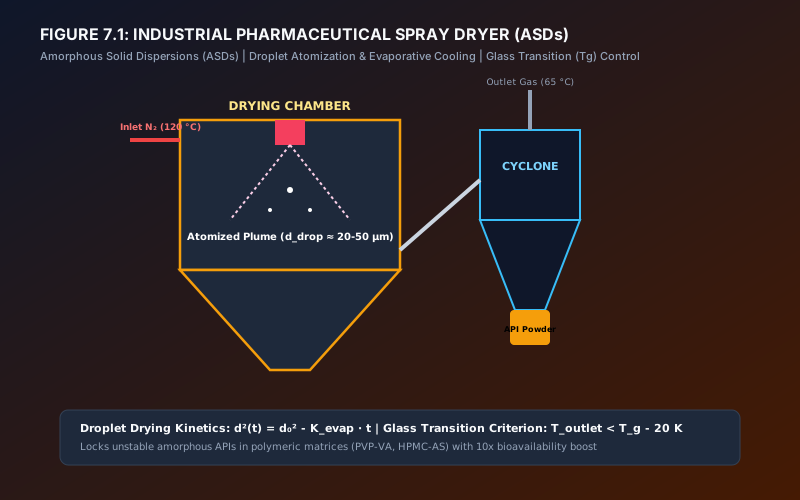
# 1. Atomization Physics: Droplet Size Distribution & Sauter Mean Diameter
Atomization transforms bulk feed liquid into a high-surface-area cloud of micro-droplets (), generating thousands of square meters of heat transfer area per cubic meter of spray.
                  THE 3 PHARMACEUTICAL ATOMIZATION PLATFORMS
   Two-Fluid Nozzle (Pneumatic)     Rotary Disc Atomizer             Pressure Swirl Nozzle
  ◄──────────────────────────────┼────────────────────────────────┼──────────────────────────────►
   Compressed N2 shears liquid.   Centrifugal wheel (15k-30k rpm). Hydraulic pressure (50-200 bar).
   Optimal for ASDs & small       High throughput (100 - 1000 kg/h) Coarse particles (> 100 µm).
   batches (20 - 50 µm).          Narrow droplet distribution.     Zero atomizing gas needed.
# 1.1. Two-Fluid Pneumatic Nozzle Sizing
The Sauter Mean Diameter () for external-mixing two-fluid gas atomizers is governed by the Lefebvre empirical correlation:
Where:
- : Gas-to-liquid mass ratio (maintained at for fine pharmaceutical powders).
- : Relative gas-to-liquid exit velocity ().
- : Liquid surface tension (N/m).
# 2. Droplet Drying Kinetics & Particle Morphology (The Péclet Number)
Once atomized into hot nitrogen, solvent evaporates from the droplet surface following the classical -law:
Where is the evaporation rate constant:
                     PÉCLET NUMBER & PARTICLE MORPHOLOGY
        Pe < 1.0 (Diffusion Dominates)           Pe > 1.0 (Evaporation Dominates)
  ┌───────────────────────────────────────┐   ┌───────────────────────────────────────┐
  │                                       │   │             ┌─────────┐               │
  │               ● ● ● ●                 │   │          ● ●│ (Void)  │● ●            │
  │             ● ● ● ● ● ●               │   │         ● ● └─────────┘ ● ●           │
  │               ● ● ● ●                 │   │           ● ● ● ● ● ● ● ●             │
  │                                       │   │                                       │
  │     Dense Solid Microsphere           │   │    Hollow Shell / Wrinkled Donut      │
  │  Uniform rapid internal diffusion     │   │ Early crust forms, vapor blows hollow │
  └───────────────────────────────────────┘   └───────────────────────────────────────┘
The dimensionless Péclet Number () dictates final particle shell structure:
- If : Dissolved drug and polymer diffuse back into the core faster than the boundary recedes Dense, solid spherical particles.
- If : Solute accumulates at the receding droplet surface forming an early semi-solid skin Hollow shells or collapsed dimpled donuts.
# 3. Glass Transition Temperature () & Sticky Chamber Prevention
The most critical operational failure mode during spray drying of amorphous APIs is wall deposition and chamber caking.
Amorphous materials transition from an elastic glass to a sticky viscoelastic rubber above their Glass Transition Temperature ():
# 3.1. Gordon-Taylor Equation for Binary ASD Formulations
Residual solvent acts as an aggressive plasticizer, drastically lowering :
Where the Gordon-Taylor constant is .
# 4. Comprehensive Worked Case Study: Sizing a 100 kg/h ASD Spray Dryer
# Problem Statement:
A poorly soluble API () is formulated as a ratio with HPMC-AS () in pure Acetone:
- Liquid feed rate: ( total solids).
- Solid production rate: .
- Acetone evaporation rate: ().
- Nitrogen inlet temperature: .
- Target nitrogen outlet temperature: (safely below of ).
- Latent heat of Acetone: , .
- Nitrogen heat capacity: .
# Step 1: Heat Balance & Nitrogen Mass Flow Rate
- Evaporative Thermal Duty:
- Accounting for chamber heat losses:
- Required Nitrogen Circulation Rate ():
- Volumetric gas flow at outlet conditions ():
# Step 2: Drying Chamber Diameter & Volume Sizing
- Maximum allowable downward gas velocity to prevent premature settling: .
- Required chamber cross-sectional area:
- Chamber Internal Diameter ():
- Minimum droplet flight residence time: .
- Cylindrical Height (), plus a bottom cone ( depth), providing total volume .
# Step 3: Closed-Loop Condenser Sizing
- Condensing Acetone vapor at chilled brine:
# 5. Operational Troubleshooting & Plant Failure Modes
| Problem | Root Cause | Underlying Mechanism | Corrective Engineering Action |
|---|---|---|---|
| Sticky Chamber Wall Deposition | Outlet temperature too close to plasticized | Atomizer spray angle touches the cylindrical wall before solvent flash-evaporates | 1. Increase Atomizing Gas-to-Liquid Ratio () from to narrow the spray cone. 2. Install air broom / pneumatic wall knockers or chilled dehumidified air sweep around upper chamber walls. |
| Low Powder Yield () in Cyclone | Particle size distribution too small () | Cyclone cut-point () is higher than droplet size | 1. Lower atomization pressure from to increase mean droplet diameter (). 2. Add a secondary reverse-pulse HEPA cartridge baghouse filter. |
| Residual Acetone in Powder | Fast drying creates dense crust trapping core solvent | Kinetic diffusion barrier inside amorphous matrix | Add a secondary continuous fluidized bed vacuum post-dryer (FBD) or vacuum tray dryer at to strip residual solvent below ICH Q3C limits (). |
# 6. Industrial Techno-Economic OPEX Case Study: Downstream Particle Engineering Routes
Process development and manufacturing leadership frequently evaluate whether to invest in single-step closed-loop spray drying versus traditional two-step crystallization-isolation routes (ANFD filtration & drying followed by micronization).
To quantify the operational expenditure (OPEX), cycle times, and utility burdens, this case study models a commercial campaign producing of finished, micronized / engineered API powder (, or amorphous solid dispersion) across three distinct engineering platforms.
                  THE THREE DOWNSTREAM API PROCESSING PATHWAYS
  Pathway 1: Conventional Multi-Step
  [ Crystallizer Slurry ] ──► [ ANFD (Filter & Dry: 20h) ] ──► [ Spiral Air Jet Mill (N2: 12h) ] ──► [ Finished API ]

  Pathway 2: Direct Single-Step Closed-Loop
  [ Solution / Dispersion ] ──► [ Inert Closed-Loop Spray Dryer (Condenser Chilled Brine: 12h) ] ──► [ Finished ASD/API ]

  Pathway 3: High-Efficiency Fluid Bed Opposed-Jet
  [ Crystallizer Slurry ] ──► [ ANFD (Filter & Dry: 20h) ] ──► [ Fluidized Bed Rotojet Mill (N2: 8h) ] ──► [ Finished API ]
# 6.1. Standardized Economic & Utility Tariffs
All three routes are evaluated using standardized commercial Indian pharmaceutical manufacturing utility and labor benchmarks:
- Electrical Power:
- High-Purity Inert Nitrogen (): (delivered via cryogenic bulk liquid tank and vaporizer)
- Chilled Brine (CHB, to ): ()
- Low-Pressure Clean Steam / Heating: ()
- Skilled Cleanroom Operator Labor: (fully loaded cleanroom operating cost)
# 6.2. Detailed Engineering Breakdown of the Three Routes
# Route 1: Conventional ANFD (Filtration + Vacuum Contact Drying) followed by Once-Through Nitrogen Spiral Air Jet Mill
- Step 1: Agitated Nutsche Filter Dryer (ANFD, filtration area):
- Feed: slurry ( crystalline product + mother liquor/wash liquor).
- Cycle Duration: Pressurized filtration () Displacement cake wash () Vacuum contact drying with heated agitated paddle blades at () Cooling and side discharge () = .
- Power: Agitator hydraulic power pack ( avg), dry screw vacuum pump (), hot water circulation pump (), condenser service pump () Avg effective load: ().
- Nitrogen: Vessel inerting, cake differential pressure blowing, mechanical seal purges, vacuum breaking = ().
- Heating: Low-pressure steam to hot water skid for jacket heating ( residual solvent hold-up evaporation) = ().
- Chilled Brine: Primary vacuum exhaust solvent condenser ( chilled water / brine) = ().
- Labor: 2 dedicated cleanroom operators ().
- Intermediate Staging & QC Transfer:
- Drum discharge, gross taring, sampling, LOD testing, cleanroom transfer = (, ).
- Step 2: Spiral Air Jet Mill ( disc chamber, once-through nitrogen):
- Throughput: feed rate for hard crystalline API to attain .
- Cycle Duration: active milling setup, line clearance & cleaning = .
- Nitrogen: High-pressure grinding nozzles and venturi feed nozzle () consume once-through gas. Active milling () + isolator/hopper purging () = ().
- Power: Vibratory screw feeder, rotary airlock, reverse-pulse baghouse filter, induced draft blower = ().
- Labor: 2 operators monitoring feed hopper, nitrogen manifold & receiver drum = ().
- Route 1 Core Totals: Total Lead Time: | Power: () | Nitrogen: () | Utilities: | Labor: () Direct Machine OPEX: ₹42,833 / 100 kg (₹428.33 / kg).
- Product Status Out of Mill: Directly compliant with ICH residual solvent limits (); market-ready crystalline powder.
# Route 2: Closed-Loop Inert Nitrogen Spray Dryer (with Chilled Brine Condenser)
Step 1: Primary Spray Drying Unit Operation:
- Feed: API/polymer dissolved in organic solvent (Acetone, total solids liquid feed, containing solvent to be flash-evaporated).
- Throughput: Evaporation rate solvent continuous drying run pre-inertization, stabilization, and CIP = .
- Nitrogen (): Closed-loop recycled circuit. Initial oxygen displacement () + dynamic rotary valve seals & filter pulse makeup () = ().
- Power: Hermetic recirculation blower (), high-pressure feed pump (), chilled brine booster pumps (), rotary airlock and auxiliary controls () ().
- Chilled Brine ( on closed-loop condenser): Condensing Acetone () + sensible cooling of recirculating () ().
- Steam / Process Gas Heating: Heating closed-loop dry nitrogen from to inlet temperature: ().
- Labor: 2 operators supervising automated continuous drying, online solvent recovery, and baghouse collection = ().
- Primary Machine Subtotal: ₹13,536 (₹135.36 / kg).
Step 2: Mandatory Secondary Vacuum Post-Drying (VTD / Vacuum FBD):
- Required to strip trapped core acetone from down to .
- Cycle Duration: at under vacuum.
- Power: Vacuum pump and hot water skid () = .
- Heating: Low-pressure steam to hot water coil () = .
- Labor: Loading trays, sampling, LOD testing, discharge (1 operator ) = .
- Secondary Drying Subtotal: +₹5,660.
Step 3: Off-Line Spent Solvent Distillation & Handling:
- condensed acetone processed through recovery packed distillation column:
- Steam Duty (reboiler at reflux ratio): = .
- Column power, cooling water pumps, and recovery labor: .
- Solvent Recovery Subtotal: +₹3,000.
Step 4: Incidental Solvent Loss & Consumables:
- Solvent loss: unrecovered handling and purge loss ( Acetone @ ) = .
- Consumables & Sensor Maintenance: Frequent oxygen analyzer electrochemical cell calibration/replacement, rupture discs, PTFE filter bag changeouts amortized per batch = .
- High-Bay Cleanroom HVAC Electrical Load ( dedicated AHU runtime differential): .
- Losses & Consumables Subtotal: +₹3,890.
Route 2 Full Lifecycle Totals:
- Total Lead Time: ( spray drying secondary post-drying).
- True Unbiased OPEX: ₹26,086 / 100 kg batch (₹260.86 / kg finished ASD).
# Route 3: ANFD followed by Opposed Fluidized Bed Rotojet Milling (with Dynamic Classifier)
- Step 1: Agitated Nutsche Filter Dryer (ANFD):
- Identical to Route 1: cycle time.
- Power: () | Nitrogen: () | Steam: () | Chilled Brine: () | Labor: ().
- Intermediate Staging & QC Transfer:
- Identical to Route 1: (, ).
- Step 2: Fluidized Bed Opposed Rotojet Mill (with Integrated High-Speed Dynamic Classifier Wheel):
- Why Rotojet outperforms Spiral Jet Milling: Opposed high-velocity gas nozzles intersect at the fluid bed core, causing pure particle-on-particle impact with zero wall attrition. The integrated dynamic classifier wheel () rejects oversize material back to the bed, immediately extracting on-spec fines ().
- Grinding rate increases to (vs on spiral mills).
- Cycle Duration: active milling prep/cleaning = .
- Nitrogen: Three opposed nozzles operating at consume . Active milling () + housing purge & pulsing () = ().
- Power: Dynamic classifier wheel motor (), volumetric feeder, pulse-jet exhaust fan = ().
- Labor: 2 operators ().
- Minor liner & seal maintenance amortized per batch: .
- Route 3 Totals: Total Lead Time: | Power: () | Nitrogen: () | Utilities: | Labor: () | Maintenance: Total OPEX: ₹30,967 / 100 kg batch (₹309.67 / kg).
- Product Status Out of Mill: Directly compliant with ICH residual solvent limits; market-ready crystalline powder with narrow span.
# 6.3. The Two-Tiered Comparison: Vendor Battery-Limit vs. Real-World Plant OPEX
To clearly contrast the naive "vendor brochure" view against the harsh reality of pharmaceutical plant operations, the comparison is split into two distinct tiers:
# Tier 1: Battery-Limit Machine Operations (Idealized View)
| Cost Component | Route 1: ANFD + Spiral Jet Mill | Route 2: Spray Dryer (Primary Machine Only) | Route 3: ANFD + Rotojet Mill |
|---|---|---|---|
| Machine Cycle Time | 36.0 Hours | 12.0 Hours | 32.0 Hours |
| Power Cost | ₹2,590 | ₹1,596 | ₹2,324 |
| Nitrogen () Cost | ₹18,400 | ₹1,800 | ₹8,600 |
| Chilled Brine Cost | ₹63 | ₹1,440 | ₹63 |
| Steam / Heating Cost | ₹180 | ₹1,500 | ₹180 |
| Direct Machine Labor | ₹21,600 | ₹7,200 | ₹19,200 |
| Apparent Direct OPEX / 100 kg | ₹42,833 (₹428.33/kg) | ₹13,536 (₹135.36/kg) | ₹30,367 (₹303.67/kg) |
| Apparent Savings vs Route 1 | Baseline | -68.4% (Vendor Claim) | -29.1% |
# Tier 2: Real-World Plant-Wide Fully Loaded OPEX (Unbiased Lifecycle Reality)
| Lifecycle Parameter & Cost Element | Route 1: ANFD + Spiral Jet Mill | Route 2: Closed-Loop Spray Dryer (Fully Loaded) | Route 3: ANFD + Rotojet Mill |
|---|---|---|---|
| True Total Lead Time to Finished API | 36.0 Hours | 28.0 Hours () | 32.0 Hours |
| Primary Unit Ops Cost | ₹42,833 | ₹13,536 | ₹30,367 |
| Secondary Vacuum Post-Drying Cost | Not Required () | +₹5,660 (Power + Steam + Labor) | Not Required () |
| Spent Solvent Distillation OPEX | Mother liquor standard recovery | +₹3,000 ( Acetone redistillation) | Mother liquor standard recovery |
| Make-Up Solvent Loss (2.5%) | Minimal | +₹1,190 ( Acetone @ ₹65/kg) | Minimal |
| Consumables & O2 Sensor Cells | ₹500 | +₹1,500 (O2 sensors, rupture discs, bags) | ₹600 |
| Cleanroom HVAC Electrical Differential | ₹1,000 | +₹1,200 (High-bay tower cleanroom AHU) | ₹1,000 |
| True Total OPEX per 100 kg Batch | ₹44,333 | ₹26,086 | ₹31,967 |
| True Total OPEX per kg Finished API | ₹443.33 / kg | ₹260.86 / kg | ₹319.67 / kg |
| Actual OPEX Reduction vs Route 1 | Baseline () | (Real Savings) | (Real Savings) |
| Estimated Equipment CAPEX Skid | ₹1.8 – 2.4 Crores | ₹5.2 – 7.5 Crores ( higher) | ₹2.2 – 2.8 Crores |
| Building Height Requirement | Standard single-floor () | Requires 2-Story High Bay () | Standard single-floor () |
| Cleaning Validation Complexity | Moderate (ANFD CIP + Mill clean) | Extremely high (Drying chamber, cyclone, ductwork) | Moderate (ANFD CIP + Mill clean) |
# 6.4. The Senior Chemical Engineer's Verdict: When Does Spray Drying Actually Make Sense?
                         UNBIASED TECHNOLOGY SELECTION MATRIX
  Does the API suffer from poor solubility (BCS Class II/IV) requiring Amorphous Dispersion?
  ├──► YES ──► Route 2: Closed-Loop Spray Drying
  │            (Mandatory investment. Unmatched 20x bioavailability boost. No milling route can achieve this.)
  │
  └──► NO (The compound crystallizes well and is stable in crystalline polymorph)
        │
        ├──► Is CAPEX budget constrained (< ₹3 Crores) or existing cleanroom height < 5 meters?
        │     └──► Route 3: ANFD + Opposed Fluidized Bed Rotojet Mill
        │          (Winner on Total Cost of Ownership. Saves 53% N2, ₹320/kg OPEX, low CAPEX, no secondary drying.)
        │
        └──► Do you already own a legacy Spiral Jet Mill?
              └──► Retrofit to closed-loop N2 recirculation or upgrade to Rotojet to stop bleeding ₹18k/batch in gas.
- The Realistic Savings are ~41%, NOT 68%:
Once secondary post-drying, solvent recovery distillation, solvent makeup, and cleanroom HVAC are factored into the balance sheet, spray drying costs ₹261/kg, not ₹135/kg. The savings over conventional spiral jet milling are approximately (primarily by reclaiming nitrogen and reducing cake manipulation), rather than the exaggerated claimed in vendor whitepapers. - ANFD + Rotojet Mill is the Real-World Workhorse for Crystalline APIs:
Comparing Route 2 (₹261/kg) with Route 3 (₹320/kg) reveals an operational difference of only ₹59/kg. However, an inert closed-loop spray dryer costs ₹3 to ₹5 Crores more in CAPEX, demands an two-story cleanroom ceiling, and carries intense cleaning validation burdens for multi-product facilities. For crystalline APIs, ANFD + Opposed Rotojet Milling delivers the highest return on invested capital (ROIC). - When Spray Drying is Irreplaceable:
Spray drying is not just a drying technique; it is a formulation delivery engine. If a BCS Class II compound fails clinical Phase I trials due to poor dissolution, no amount of jet milling or ANFD optimization can convert it into an amorphous glass. In that scenario, spray drying is uniquely justified regardless of capital cost.
# Applicable Engineering Standards & Codes Used
- NFPA 68: Standard on Explosion Protection by Deflagration Venting.
- NFPA 69: Standard on Explosion Prevention Systems (Limiting Oxygen Concentration ).
- ASME BPE: Hygienic Bioprocessing Equipment Design for Cleanrooms.
- ICH Q3C(R8): Impurities: Guideline for Residual Solvents.
- ISO 14644-1: Cleanrooms and Associated Controlled Environments.