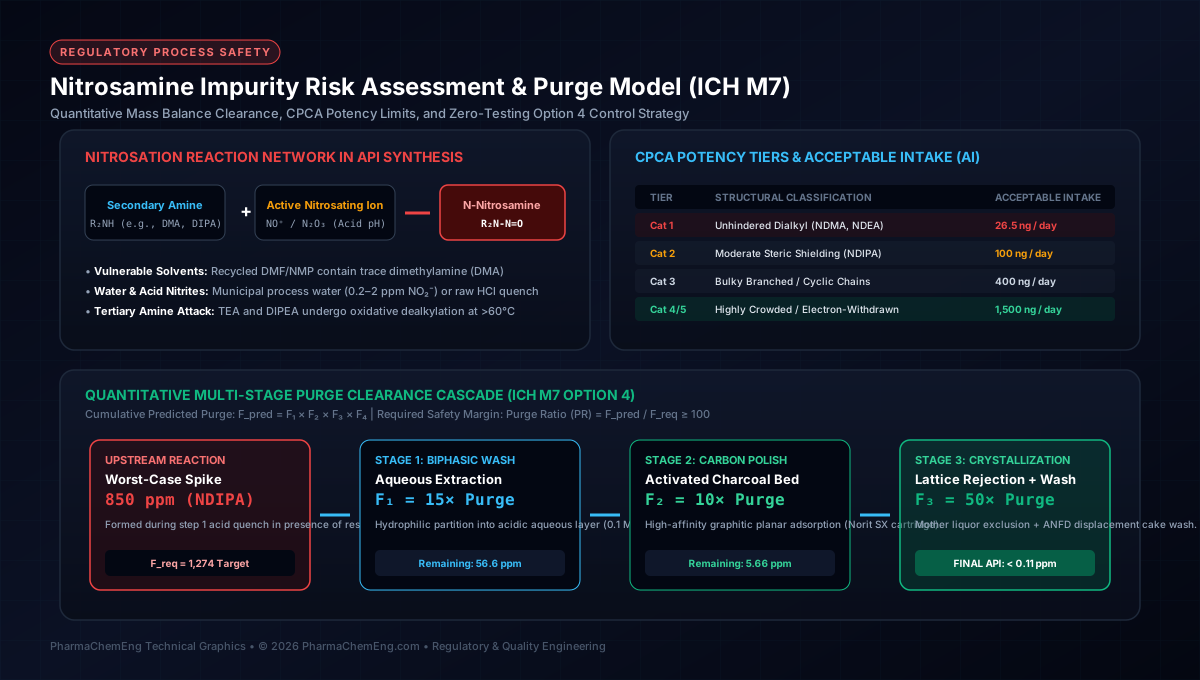
# Nitrosamine Impurity Risk Assessment (ICH M7) & Purge Calculations: An Engineering Guide to Zero-Risk API Synthesis
# A Quantitative Chemical Engineering Framework for Evaluating Risk, Calculating Theoretical Purge Factors, and Eliminating Mutagenic Hazards in API Manufacturing
# Executive Summary
The global discovery of -nitrosamine impurities (such as NDMA, NDEA, NMBA, and complex Nitrosamine Drug Substance-Related Impurities [NDSRIs]) in common angiotensin II receptor blockers (sartans), ranitidine, and metformin triggered the most extensive regulatory crisis in modern pharmaceutical manufacturing. Regulators including the US FDA, EMA, Health Canada, and PMDA have mandated comprehensive 3-step risk assessment protocols across all commercial and investigational drug substances.
Under ICH M7(R2) guidelines (Assessment and Control of DNA Reactive (Mutagenic) Impurities in Pharmaceuticals to Limit Potential Carcinogenic Risk), nitrosamines are classified as "Cohort of Concern" compounds—high-potency mutagens and suspected human carcinogens requiring strict lifetime intake limits often measured in tens of nanograms per day.
For process development chemists and chemical engineers, the primary technical challenge is transitioning from fear-based over-testing to rigorous, predictive, physics-based purge evaluations. By applying quantitative mass balances, chemical reaction equilibria, phase partitioning thermodynamics, and crystallization rejection physics, engineers can mathematically prove that an upstream nitrosamine risk is reliably purged below the threshold of toxicological concern—often eliminating the need for expensive routine release testing by LC-MS/MS.
This engineering guide provides:
- The organic reaction kinetics of nitrosation pathways.
- The Carcinogenic Potency Categorization Approach (CPCA) for establishing Acceptable Intake (AI).
- The mathematical Predicted Purge Factor () vs. Required Purge Factor () framework.
- Quantitative purge mechanisms across unit operations (distillation, phase extraction, crystallization, carbon treatment).
- A fully worked industrial API synthesis case study demonstrating regulatory compliance.
# 1. The Chemistry of Nitrosamine Formation in Drug Substance Syntheses
Nitrosamines () do not generate spontaneously; their formation requires the concurrent presence of a vulnerable amine and a nitrosating agent under favorable thermodynamic and kinetic conditions.
 Secondary / Tertiary Amine ──┐
                              ├─► [ Acidic / Elevated Temp Conditions ] ──► N-Nitrosamine (Mutagenic Cohort of Concern)
 Nitrosating Species (NO+) ───┘
# 1.1 Vulnerable Amine Precursors
- Secondary Amines: Most reactive. Examples: Dimethylamine (DMA, common impurity in DMF), Diethylamine (DEA), Diisopropylamine (DIPA), Morpholine, Piperidine.
- Tertiary Amines: Undergo oxidative nitrosative dealkylation at elevated temperatures (): Triethylamine (TEA), Diisopropylethylamine (DIPEA / Hünig's base).
- Quaternary Ammonium Salts: Phase-transfer catalysts (TBAF, TBAB) can undergo Hofmann-type thermal degradation yielding secondary amine precursors.
# 1.2 Nitrosating Species
The active nitrosating electrophile depends heavily on solution pH:
- Acidic Aqueous Conditions (): Nitrite salts () form nitrous acid (, ), which dehydrates to dinitrogen trioxide () or the nitrosonium ion ():
- Organic / Anhydrous Media: Alkyl nitrites (e.g., isoamyl nitrite, -butyl nitrite) or residual nitrosyl chloride () from chlorinating agents.
- Trace Nitrites in Excipients and Utilities: Potable and demineralized process water can contain of dissolved nitrites (), sufficient to generate parts-per-billion levels of NDMA in high-volume API washes.
# 2. Regulatory Limits: The CPCA Framework & Acceptable Intake (AI)
In 2023, the FDA and EMA harmonized the Carcinogenic Potency Categorization Approach (CPCA), establishing 5 potency categories based on structural features (such as -hydrogen count and steric hindrance):
| CPCA Category | Structural Features | Acceptable Intake (AI) Limit |
|---|---|---|
| Category 1 | Highly unhindered, high-potency mutagens (e.g., NDMA, NDEA) | |
| Category 2 | Moderately unhindered dialkylnitrosamines | |
| Category 3 | Bulky substituents, moderate steric shielding | |
| Category 4 | Substantial steric crowding or electron-withdrawing groups | |
| Category 5 | Non-mutagenic in Ames test or highly deactivated |
# 2.1 Translating AI to API Concentration Limit ()
The maximum allowable concentration of a nitrosamine in the finished drug substance is derived from the Maximum Daily Dose (MDD) of the API:
Example: For an API with a Maximum Daily Dose of and a Category 1 nitrosamine ():
# 2.2 Step-by-Step CPCA Potency Score Calculation Algorithm
Under the 2023 FDA/EMA CPCA guidance, when compound-specific rodent carcinogenicity () data is absent, toxicologists and process engineers assign nitrosamines to potency categories using a standardized scoring flowchart:
- Count -Hydrogens ():
- Both sides have zero (e.g., di-tert-butylnitrosamine): Category 5 () (Cannot form diazonium ion).
- One or two with sterically hindered -branches: .
- Four unhindered (e.g., NDMA, NDEA): Score Category 1 ().
- Deactivating Functional Groups (Shielding):
- Carboxylic acid group () on molecule: (Facilitates rapid renal excretion).
- Electron-withdrawing groups (carbonyl, ester, amide, sulfone) in -position: .
- Ring Size Corrections:
- 5- or 6-membered saturated rings (Nitrosopyrrolidine, Nitrosopiperidine): Potency is elevated relative to bulky acyclic amines.
# 3. The Quantitative Purge Factor Framework (ICH M7 Option 4)
ICH M7 provides four control options for mutagenic impurities. Option 4 allows manufacturers to avoid testing intermediate and final API batches if the inherent physicochemical clearance capacity of the downstream process exceeds the maximum potential risk by a significant safety margin.
[Upstream Worst-Case Ingrowth] ──► [Downstream Unit Operations: Distillation, Washes, Crystallization] ──► [Final Drug Substance]
           C_worst                                          Total Purge Capacity (F_pred)                              C_final < Limit
# 3.1 The Fundamental Purge Equation
The cumulative Predicted Purge Factor () across all remaining downstream steps is the product of individual step factors:
The Required Purge Factor () is defined as:
# 3.2 The Safety Margin (Purge Ratio)
- If : Control Option 4 is robustly justified. Regulatory agencies generally accept that the impurity is purged by process design, and no routine analytical testing of commercial batches is required.
- If : Control Option 3 or 2 is applied, typically requiring periodic intermediate or end-product testing.
- If : Process redesign or active purge intervention is strictly mandatory.
# 3.3 The 4 ICH M7 Regulatory Control Strategies Compared
ICH M7 provides four distinct regulatory pathways to demonstrate safety compliance in regulatory submissions (IND, NDA, ANDA, DMF):
| Control Option | Description | Testing Location | Specification Limit | Regulatory Burden |
|---|---|---|---|---|
| Option 1 | Test final drug substance (API) release batches. | Finished API release certificate | (Acceptance Criteria) | High: Routine batch testing by high-sensitivity LC-MS/MS required indefinitely. |
| Option 2 | Test intermediate where impurity forms or is introduced. | Upstream Intermediate Release | Medium: Routine intermediate testing required. | |
| Option 3 | Test intermediate with an in-process limit based on downstream purge. | Upstream In-Process Control (IPC) | In-process limit | Low: Routine intermediate testing with generous analytical limits (). |
| Option 4 | Purge-based clearance by process design. | ZERO routine testing required | Predicted Purge exceeds Required Purge () | Zero Testing: Process understanding and scientific risk assessment replace testing. |
# 4. Engineering Purge Mechanisms Across Unit Operations
To evaluate individual values scientifically without relying on blind guesswork, engineers score individual process steps based on four fundamental physicochemical properties:
                      ┌──────────────────────────────────────────────┐
                      │    Physicochemical Purge Score (Fi)          │
                      └──────────────────────┬───────────────────────┘
                                             │
      ┌──────────────────┬───────────────────┴───────────────────┬──────────────────┐
      ▼                  ▼                                       ▼                  ▼
 [Volatility (Pv)] [Solubility / Extraction (LogP)]   [Chemical Reactivity]   [Crystallization / Rejection]
# 4.1 Volatility & Distillation Purge ()
Evaluated by comparing the boiling point and vapor pressure of the nitrosamine against the solvent being evaporated or stripped:
| Condition | Relative Volatility Score () | Rationale |
|---|---|---|
| Nitrosamine boiling point is higher than solvent; solvent evaporated to dry heel | 10 to 100 | Impurity remains trapped in concentrated residue; volatile distillate contains zero nitrosamine. |
| Co-evaporation / Azeotropic stripping occurs | 1 to 10 | Partial entrainment occurs during high-vacuum distillation. |
| Solvent evaporated, product is volatile distillate | 100 to 1000 | Distillate product collection leaves non-volatile nitrosamines in bottoms reboiler. |
# 4.2 Liquid-Liquid Phase Partitioning ()
When an aqueous wash is performed, the partition coefficient of the nitrosamine dictates phase distribution:
Where .
- Hydrophilic Nitrosamines (NDMA, ): Rapidly partition into aqueous waste streams during water, caustic, or acid washes ().
- Lipophilic Nitrosamines (NDPA, NDBA, ): Retain strongly in organic phases (, minimal aqueous purge).
# 4.3 Crystallization & Solid Rejection ()
During API crystallization, solute molecules are incorporated into the ordered crystal lattice, while dissimilar impurities are excluded into the mother liquor.
- If the nitrosamine is structurally unrelated to the API: .
- If the nitrosamine is an NDSRI (derived directly from the drug substance structure): Risk of co-crystallization or surface inclusion is high ().
- Displacement cake washing on an Agitated Nutsche Filter Dryer (ANFD) enhances clearance:
# 5. Worked Industrial Case Study: 4-Step API Synthesis Purge Evaluation
# 5.1 Scenario & Process Details
- API Product: Cardiovascular Intermediate "Compound X" ().
- Target Nitrosamine: -Nitrosodiisopropylamine (NDIPA, CPCA Category 2, ).
- Origin of Risk: Step 1 uses Diisopropylamine (DIPA) as an acid scavenger. Residual DIPA undergoes trace nitrosation due to nitrite in commercial hydrochloric acid used during quenching.
- Measured Ingrowth at Step 1 Crude: Worst-case spike of NDIPA detected in Step 1 crude cake: ().
Step 1: Reaction & Quench ──► Step 2: Aqueous Extraction ──► Step 3: Carbon Treatment ──► Step 4: Final Crystallization
[NDIPA Ingrowth: 850 ppm]       [Biphasic Wash (Fi = 15)]       [Norit Filter (Fi = 10)]    [Heptane / IPA (Fi = 50)]
# 5.2 Calculating Required Purge Factor ()
- Calculate maximum allowable concentration in final API:
- Calculate :
# 5.3 Step-by-Step Predicted Purge Scoring ()
- Step 2 (Aqueous Biphasic Extraction): The crude organic layer (Toluene) is washed twice with (). Given NDIPA's moderate polarity and salt interactions:
- Calculated (Empirical batch testing confirmed ).
- Step 3 (Activated Carbon / Cuno Filter Polishing): Toluene solution circulated through an activated charcoal (R-type Norit) cartridge at :
- Nitrosamines exhibit strong non-specific adsorption onto microporous graphitic planes ().
- Conservative assigned factor: (Empirical testing confirmed ).
- Step 4 (Final Crystallization & Filtration): Compound X is crystallized from Toluene / -Heptane, filtered on an ANFD, and washed with cold -Heptane ( bed volumes):
- NDIPA is highly soluble in heptane/toluene mother liquors (), while API has low solubility ().
- Assigned rejection factor: .
# 5.4 Purge Ratio Calculation & Regulatory Conclusion
# 6. Analytical Testing Pitfalls: Preventing Artifact Formation in LC-MS/MS
Developing validated trace-level nitrosamine assays () presents formidable analytical chemistry hurdles:
- Heated GC-MS Injector Port Hazard (250°C): Residual free amine (e.g. DMA) + trace residual nitrite (NO₂⁻) in the presence of hot metal surfaces generates in-situ artifact nitrosamines, causing massive false-positive results.
Best Practice Guideline:
- Mandate Liquid Chromatography High-Resolution Mass Spectrometry (LC-HRMS / LC-MS/MS) using Atmospheric Pressure Chemical Ionization (APCI) rather than electrospray ionization (ESI) to minimize matrix ion suppression.
- Add an in-situ nitrite scavenger ( Sulfamic Acid or Ascorbic Acid) to sample dissolution diluents during sample preparation to immediately neutralize residual nitrites and prevent artifact ingrowth during testing.
# 7. Engineering Controls & Plant-Wide Contamination Prevention Checklist
To eliminate nitrosamine formation at the root source:
- Dedicated vs. Shared Equipment Campaigns: When running multi-product campaigns in glass-lined reactors, trace tertiary amine washes (e.g., TEA) can form cross-contaminating nitrosamines if followed by an acidic nitration/oxidation batch. Validate Cleaning Validation limits (MACO) for vulnerable amines below .
- Scavenger Engineering (Inhibitors): Add of ascorbic acid, sulfamic acid, or -tocopherol to acidic aqueous reaction mixtures. These scavengers react with active species faster than secondary amines, completely suppressing nitrosation kinetics:
- Recovered Solvent Verification: Recycled solvents (DMF, DCM, Toluene) sent to external recovery columns can undergo thermal cracking, concentrating DMA and nitrites in overheads. Implement per-lot LC-MS/MS nitrosamine screening for all recycled solvent batches.
- Nitrite Testing in Potable & Purified Water: Establish a continuous water monitoring specification for nitrites () at points of use entering process vessels.