# Material of Construction (MOC) Selection & Corrosion Coupon Testing in Chemical & Pharma Manufacturing: Reactors, Vessels, Centrifuges & Dryers
# Engineering the Metallurgical Envelope for Extreme Chemical Aggressiveness, High Mechanical Stress, and Zero Contamination
Selecting the correct Material of Construction (MOC) for process equipment in chemical synthesis and Active Pharmaceutical Ingredient (API) manufacturing is one of the most critical decisions a chemical engineer will ever make.
A metallurgical misjudgment does not just result in premature equipment retirement—it triggers catastrophic containment loss, flammable solvent vapor release, violent toxic leaks, and severe product batch contamination with heavy metal ions that violate global regulatory limits (e.g., ICH Q3D Elemental Impurities).
While published corrosion handbooks and thermodynamic tables provide general guidance, they frequently fail in real-world pharmaceutical processes.
Standard handbook data are based on single-component, ultra-pure synthetic solutions under static laboratory conditions. In contrast, commercial multi-step API processes involve dynamic multiphase reaction mixtures, fluctuating temperatures, localized pH swings, halogenated acids (HCl, HBr, SOCl₂), phase-transfer catalysts, abrasive suspended crystalline slurries, dynamic fluid shear from high-speed impellers, and high centrifugal hoop stress.
The only definitive, scientifically bulletproof method to validate MOC selection prior to multi-million-dollar capital expenditure is an In-Situ Corrosion Coupon Study.
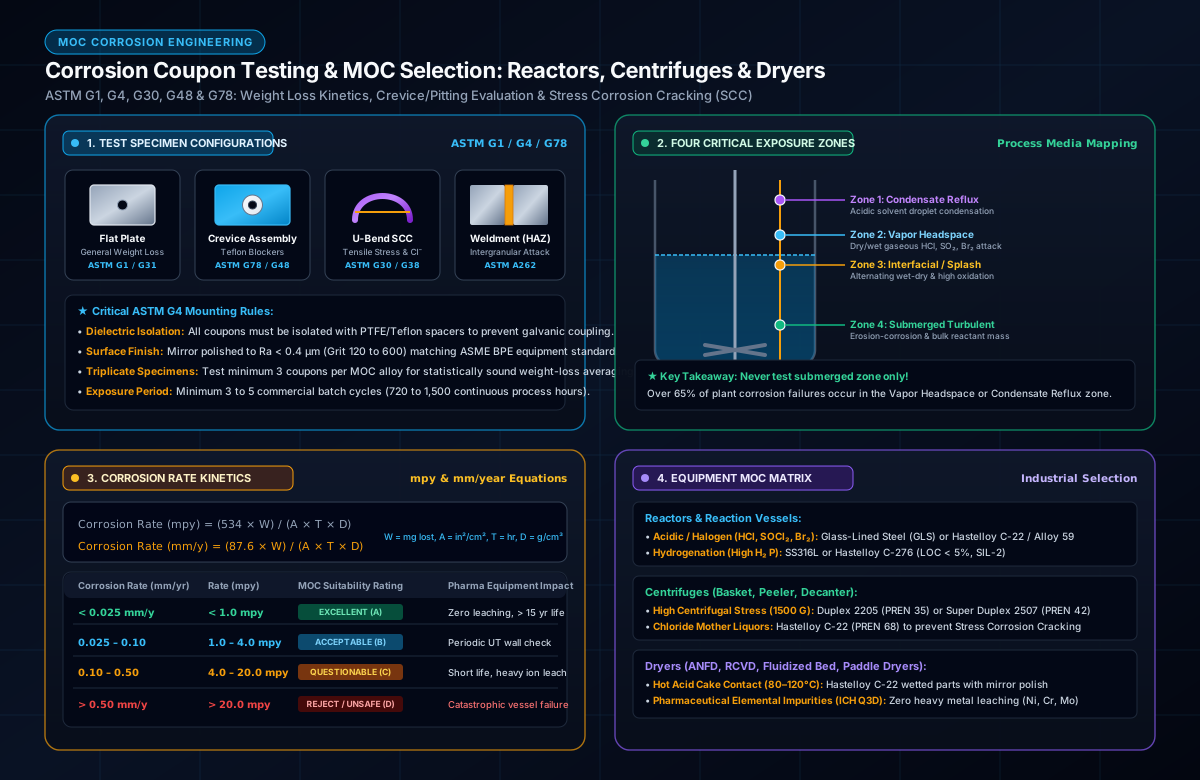
# 1. The Six Primary Corrosion Mechanisms in Pharma & Fine Chemical Plants
Before deploying a coupon test assembly, engineers must understand the exact degradation modes operating within process equipment:
# A. General (Uniform) Corrosion
- Mechanism: Electrochemical dissolution occurring uniformly over the entire exposed metallic surface area.
- Metric: Measured as wall thickness loss per unit time: Mils Per Year (mpy) or Millimeters Per Year (mm/year).
- Risk Level: Predictable and quantifiable through routine Non-Destructive Ultrasonic Thickness (UT) testing.
# B. Localized Pitting Corrosion
- Mechanism: Breakdown of the microscopic passive chromium oxide (Cr₂O₃) or molybdenum-enriched protective film by halogen ions (especially Cl⁻ and Br⁻), resulting in deep, microscopic cavities that penetrate through reactor walls while the surrounding metal remains pristine.
- Predictive Metric: Pitting Resistance Equivalent Number (PREN):
- Benchmark PREN Ratings:
- SS316L (UNS S31603): PREN ≈ 23 – 25 (High pitting risk in acidic chlorides > 50°C)
- Alloy 904L (UNS N08904): PREN ≈ 34 – 36 (Moderate chloride resistance)
- Duplex SS 2205 (UNS S32205): PREN ≈ 35 – 38 (Superior strength & pitting resistance)
- Super Duplex 2507 (UNS S32750): PREN ≈ 42 – 45 (Excellent seawater & chloride resistance)
- Hastelloy C-22 (UNS N06022): PREN ≈ 68 – 72 (Near-complete immunity to localized pitting)
# C. Crevice Corrosion
- Mechanism: Accelerated localized corrosion occurring in shielded, stagnant microscopic gaps (gasket-to-flange faces, underneath filter cloth retention rings in ANFDs, beneath PTFE agitator sleeve boots, and under bolt heads).
- Stagnant liquid inside the crevice becomes depleted of oxygen, preventing repassivation, while chloride ions migrate inward to balance charge, generating highly concentrated, boiling-point acidic metal chloride solutions (pH < 1).
# D. Stress Corrosion Cracking (SCC)
- Mechanism: The rapid, catastrophic propagation of brittle cracks through a ductile metal subjected to simultaneous sustained tensile stress and a specific corrosive environment (typically warm chlorides > 60°C for austenitic stainless steels).
- High-Risk Equipment: Centrifuge Baskets (experiencing severe centrifugal hoop stress), Agitator Impeller Hubs & Shafts, and Thin-Walled Bellows. Standard SS316L can shatter within days under SCC without showing any measurable weight loss.
# E. Intergranular Corrosion (Sensitization in HAZ)
- Mechanism: During welding or high-temperature heat treatment (450 – 850°C), carbon reacts with chromium at grain boundaries to precipitate chromium carbides (Cr₂₃C₆). This depletes chromium adjacent to grain boundaries below the 10.5% threshold required for passivity.
- Mitigation: Use Low-Carbon grades (e.g., SS316L with C ≤ 0.03%) or stabilized alloys (e.g., Hastelloy C-276 / C-22 / Alloy 59).
# F. Erosion-Corrosion & Cavitation
- Mechanism: The synergy between mechanical wear (impinging slurries, high tip-speed fluid shear) and electrochemical corrosion. The mechanical action continuously strips away the passive oxide film, exposing fresh reactive metal to acidic attack.
# 2. Corrosion Coupon Study Methodology: Specimen Types & Assembly Rules
An in-situ corrosion coupon test involves exposing carefully prepared, weighed metallurgical specimens inside operating chemical equipment across actual commercial synthesis batches.
# The 4 Standard Specimen Configurations (ASTM Standards)
Flat Rectangular / Disc Coupons (ASTM G1 / ASTM G31):
- Purpose: Measures general uniform weight loss and surface etching.
- Dimensions: Standard 50 mm × 25 mm × 3 mm (or 38 mm diameter circular discs).
Crevice Corrosion Assemblies (ASTM G78 / ASTM G48):
- Purpose: Evaluates susceptibility to shielded micro-gap attack.
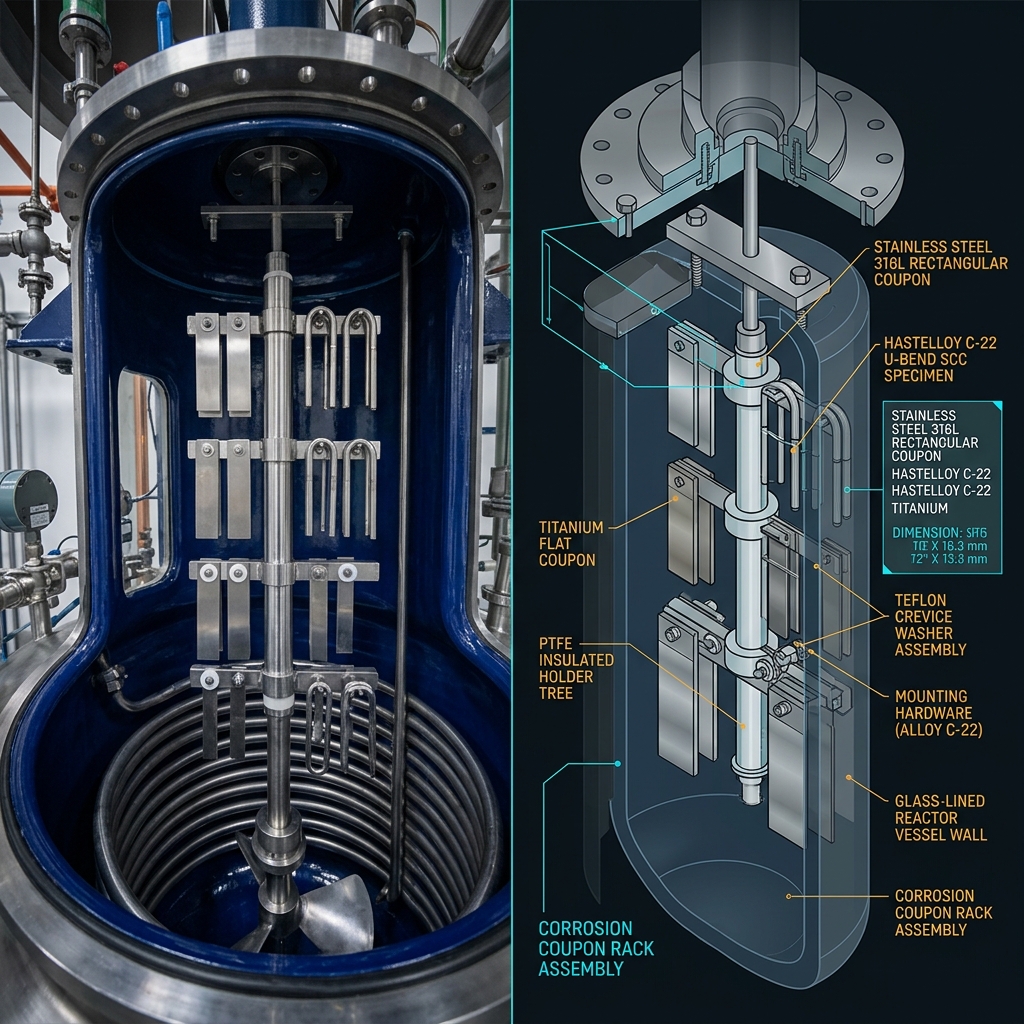
- Configuration: Flat coupon clamped between two serrated multi-crevice PTFE (Teflon) or PVDF washers torqued to a calibrated 1.5 – 2.0 N·m.
U-Bend & C-Ring Stress Specimens (ASTM G30 / ASTM G38):
- Purpose: Evaluates Stress Corrosion Cracking (SCC).
- Configuration: Metallic strip bent 180° into a U-shape and maintained under constant elastic/plastic tensile stress via an electrically insulated central bolt.
Welded Coupon Assemblies (ASTM A262 / ASTM A923):
- Purpose: Evaluates weld metallurgy, heat-affected zone (HAZ) sensitization, unmixed zones, and galvanic couples between base metal and filler wire.
# Seven Non-Negotiable ASTM G4 Mounting & Handling Rules
- Strict Dielectric (Galvanic) Isolation: Every coupon MUST be physically isolated from the support rack and adjacent coupons using virgin PTFE / PFA shoulder washers and spacer sleeves. Metallic contact between dissimilar alloys will trigger severe galvanic cell error.
- Standardized Surface Finish: Specimens must be precision ground and mirror-polished to Ra < 0.4 μm (Grit 120 to 600) followed by chemical pickling/passivation (ASTM A380 / ASTM A967) matching actual ASME BPE vessel internal finishes.
- Triplicate Testing: Always test a minimum of three identical coupons per MOC grade to eliminate statistical outliers.
- Pre-Exposure Precision Mass Balance: Weigh specimens on a calibrated analytical microbalance to 0.1 mg (0.0001 g) precision.
- Dimensional Surface Area Mapping: Precision measurement of all outer dimensions and mounting bolt holes using digital micrometers (± 0.01 mm) to compute total exposed surface area (A).
- Representative Exposure Time: Test exposure should encompass minimum 3 to 5 complete commercial batch cycles (720 to 1,500 continuous operating hours). Short exposures (< 48 hours) fail to capture incubation periods for localized pitting and SCC.
- Post-Exposure Cleaning (ASTM G1): Chemical cleaning using non-destructive inhibited acid solutions (e.g., Clark’s solution or ultrasonic citric acid) to remove process deposits and salts without stripping the base parent metal.
# 3. The Four Critical Reactor Exposure Zones: Why Single-Zone Testing Fails
A fatal flaw in many plant corrosion trials is submerging coupons only at the bottom of the vessel. In chemical reactors and distillation systems, corrosion rates vary by more than 10-fold across different elevation zones:
| Vessel Elevation Zone | Physical Environment & Stressors | Dominant Degradation Risk |
|---|---|---|
| Zone 1: Condensate Reflux Zone (Top Nozzles) | Sub-dewpoint acidic solvent droplets continuously condensed. | Maximum localized acid concentration, reflux acid washing. |
| Zone 2: Vapor Headspace Zone (Upper Dome) | Dry & wet gaseous HCl, SO₂, Br₂, volatile solvent vapors. | Oxygen-rich gas space, severe pitting & crevice corrosion. |
| Zone 3: Interfacial Splash / Slosh Zone (Liquid Level) | Dynamic, alternating wet-and-dry cycling from liquid agitation. | Highest oxidation rate, rapid evaporation salt crusting. |
| Zone 4: Submerged Turbulent Zone (Bottom Mass) | Bulk liquid chemistry, suspended slurry crystals, dissolved acids. | High fluid shear, cavitation, slurry erosion-corrosion. |
Key Process Engineering Lesson: In over 65% of industrial reactor failures, the primary breach occurs in Zone 1 (Condensate Reflux) or Zone 3 (Splash Interface), while the bottom liquid zone remains virtually untouched! Always mount a vertical Coupon Tree traversing all four zones.
# 4. Equipment-Specific MOC Selection & Coupon Protocols
| Equipment Category | Primary Operational Stressors | Dominant Failure Modes | Recommended Metallurgy / MOC Matrix |
|---|---|---|---|
| Batch Chemical Reactors | Hot acidic solvents (HCl, SOCl₂, HBr), high agitation shear, reflux cycling. | Pitting, crevice corrosion, glass-lining pinholes, thermal shock (ΔT > 100°C). | Glass-Lined Steel (GLS) for strong mineral acids; Hastelloy C-22 / Alloy 59 / Inconel 686 for versatile metal syntheses; Titanium Gr 2 / Tantalum for extreme oxidation/chlorides. |
| Centrifuges (Basket & Peeler) | Massive centrifugal hoop stress (1,000 – 2,500 G, rim speeds 60 – 90 m/s), chloride mother liquors. | Stress Corrosion Cracking (SCC), basket perforation, fatigue cracking near perforations. | Duplex SS 2205 (UNS S32205) or Super Duplex 2507 (UNS S32750) for mechanical strength; Hastelloy C-22 for total SCC immunity. Avoid standard SS316L in hot chlorides! |
| Dryers (ANFD, RCVD, Paddle Dryers) | Hot wet-acid cake contact (60 – 130°C), mechanical scraper blade abrasion, vacuum reflux. | Crevice corrosion under filter mesh rings, vapor dome condensation corrosion, blade wear. | Hastelloy C-22 wetted contact surfaces with electropolished mirror finish (Ra < 0.2 μm); PTFE/PFA coated non-contact components. |
| Storage Vessels & Receivers | Room temperature mother liquors, dilute solvent washes, static liquid storage. | Stagnant crevice corrosion, bottom sludge pitting, flange face corrosion. | SS316L / SS317L with regular passivation; Alloy 904L / Duplex 2205 for higher chloride thresholds. |
# 5. Quantitative Corrosion Rate Calculations & Acceptance Criteria
# The Fundamental Weight-Loss Equation
The corrosion rate is calculated from the net mass loss of the cleaned coupon according to ASTM G1:
# Formula in Mils Per Year (mpy):
Where:
- W = Mass loss in milligrams (mg)
- A = Total exposed surface area in square inches (in²)
- T = Total exposure time in operating hours (hr)
- D = Density of the test alloy in g/cm³
- K₁ = Unit conversion constant (534)
# Formula in Millimeters Per Year (mm/year):
Where:
- W = Mass loss in milligrams (mg)
- A = Total exposed surface area in square centimeters (cm²)
- T = Total exposure time in operating hours (hr)
- D = Density of the test alloy in g/cm³
- K₂ = Unit conversion constant (87.6)
# Standard Alloy Densities (D) for Calculations
| Alloy Material | UNS Number | Density (D) in g/cm³ | Standard PREN Rating |
|---|---|---|---|
| Stainless Steel 316L | UNS S31603 | 7.98 | 24 |
| Stainless Steel 317L | UNS S31703 | 8.00 | 29 |
| Alloy 904L | UNS N08904 | 8.05 | 35 |
| Duplex SS 2205 | UNS S32205 | 7.80 | 36 |
| Super Duplex 2507 | UNS S32750 | 7.80 | 43 |
| Hastelloy C-276 | UNS N10276 | 8.89 | 68 |
| Hastelloy C-22 | UNS N06022 | 8.69 | 70 |
| Alloy 59 | UNS N06059 | 8.60 | 72 |
| Titanium Grade 2 | UNS R50400 | 4.51 | 45 |
| Tantalum | UNS R05200 | 16.60 | 90 |
# Quantitative MOC Suitability & Acceptance Thresholds
| Wall Thickness Loss (mm/year) | Loss Rate (mpy) | MOC Suitability Rating | Practical Industrial & Pharma Impact |
|---|---|---|---|
| < 0.025 mm/year | < 1.0 mpy | CLASS A: EXCELLENT | Zero elemental ion leaching; > 15–20 year operational lifespan. |
| 0.025 – 0.10 mm/year | 1.0 – 4.0 mpy | CLASS B: ACCEPTABLE | Minor surface loss; 5–10 year lifespan; periodic UT wall thickness checks. |
| 0.10 – 0.50 mm/year | 4.0 – 20.0 mpy | CLASS C: QUESTIONABLE | Heavy metal ion leaching; frequent maintenance; unsuited for critical steps. |
| > 0.50 mm/year | > 20.0 mpy | CLASS D: REJECT | Hazardous; rapid thinning; catastrophic risk of pressure vessel breach. |
Special Rule for Localized Pitting & Crevice Attack: Regardless of an outstanding uniform weight-loss rate (< 1.0 mpy), if microscopic examination reveals pitting or crevice depth exceeding 0.05 mm (2 mils), or if the U-bend shows micro-cracking under 20× magnification, the alloy MUST BE REJECTED.
# Step-by-Step Worked Engineering Example
Scenario: An API manufacturer is synthesizing an intermediate involving toluene, methanol, and 2.5 wt% HCl at 85°C. Two coupon assemblies (SS316L vs. Hastelloy C-22) are placed in the reactor for 5 continuous batch cycles (T = 720 hours).
- Specimen Surface Area: A = 6.20 in² (40.0 cm²)
- SS316L Initial Mass: 54.2150 g, Final Mass: 52.8850 g → ΔW = 1,330 mg (D = 7.98 g/cm³)
- Hastelloy C-22 Initial Mass: 61.4520 g, Final Mass: 61.4390 g → ΔW = 13 mg (D = 8.69 g/cm³)
# 1. SS316L Corrosion Rate:
- Evaluation: CLASS D (REJECT). Rapid degradation; would fail a 6 mm vessel wall in < 10 years and heavily contaminate product with Fe, Ni, and Cr.
# 2. Hastelloy C-22 Corrosion Rate:
- Evaluation: CLASS A (OUTSTANDING). Virtually zero corrosion (< 0.2 mpy); total operational life > 30 years with zero heavy metal leaching.
# 6. Pharmaceutical Regulatory Compliance: ICH Q3D Elemental Impurities
In pharmaceutical manufacturing, selecting an MOC based purely on mechanical structural life is insufficient. Even a low corrosion rate of 1.5 mpy can leach ppm levels of heavy metal ions into the final active pharmaceutical ingredient (API), causing batch rejection under ICH Q3D:
| Leached Elemental Metal | ICH Q3D Toxicity Class | Parenteral PDE (μg/day) | Oral PDE (μg/day) | Primary Metallurgical Source |
|---|---|---|---|---|
| Nickel (Ni) | Class 2A | 20 | 220 | SS316L (10–14%), Hastelloy (> 55%), Inconel (> 60%) |
| Cobalt (Co) | Class 2A | 5 | 50 | Stellite hard-facing, high-temperature nickel alloys |
| Vanadium (V) | Class 2A | 10 | 100 | Titanium alloys (Ti-6Al-4V), tool steels |
| Chromium (Cr) | Class 3 | 1,100 | 11,000 | SS316L (16–18%), Hastelloy C-22 (20–22.5%) |
| Molybdenum (Mo) | Class 3 | 1,500 | 15,000 | SS316L (2–3%), Hastelloy C-22 (12.5–14.5%) |
| Copper (Cu) | Class 3 | 340 | 3,400 | Alloy 20 (3–4%), Monel 400 (28–34%), Brass fittings |
Best Practice Protocol: Always subject the mother liquors and finished isolated API crystals from the coupon exposure batches to ICP-MS (Inductively Coupled Plasma Mass Spectrometry) testing to confirm heavy metal concentration is well below the 30% Control Threshold of the permitted daily exposure.
# 7. International Engineering Standards & Testing References
When executing corrosion coupon testing, specifying MOC metallurgy, or designing pharmaceutical process vessels, the following international standards must be strictly adhered to:
# A. ASTM (American Society for Testing and Materials) Standards
- ASTM G1: Standard Practice for Preparing, Cleaning, and Evaluating Corrosion Test Specimens (Covers chemical cleaning, oxide removal, mass loss equations).
- ASTM G4: Standard Guide for Conducting Corrosion Tests in Field Applications (Defines coupon holder racks, spool assemblies, and plant exposure protocols).
- ASTM G30: Standard Practice for Making and Using U-Bend Stress-Corrosion Test Specimens (Defines stress-cracking evaluation under plastic strain).
- ASTM G31: Standard Guide for Laboratory Immersion Corrosion Testing of Metals (Standard protocol for benchtop reflux corrosion trials).
- ASTM G38: Standard Practice for Making and Using C-Ring Stress-Corrosion Test Specimens (SCC testing for tubular and cylindrical geometries).
- ASTM G46: Standard Guide for Examination and Evaluation of Pitting Corrosion (Visual rating, pit density, and depth measurement via optical microscopy).
- ASTM G48: Standard Test Methods for Pitting and Crevice Corrosion Resistance of Stainless Steels and Related Alloys by Use of Ferric Chloride Solution (CPT & CCT benchmark tests).
- ASTM G78: Standard Guide for Crevice Corrosion Testing of Iron-Base and Nickel-Base Stainless Alloys in Seawater and Other Chloride-Containing Aqueous Environments (Multiple-crevice PTFE washer assemblies).
- ASTM A262: Standard Practices for Detecting Susceptibility to Intergranular Attack in Austenitic Stainless Steels (Oxalic acid etch, Huey test, Streicher test).
- ASTM A380 / ASTM A967: Standard Practices for Cleaning, Descaling, and Chemical Passivation of Stainless Steel Parts and Equipment.
- ASTM A923: Standard Test Methods for Detecting Detrimental Intermetallic Phases in Duplex Austenitic/Ferritic Stainless Steels.
# B. NACE / AMPP & ISO Standards
- NACE SP0775 (formerly RP0775): Preparation, Installation, Analysis, and Interpretation of Corrosion Coupons in Oilfield and Industrial Operations.
- NACE TM0169 / ISO 15156: Laboratory Testing of Metals for Resistance to Specific Forms of Environmental Cracking.
- ISO 11845: Corrosion of Metals and Alloys — General Principles for Corrosion Testing.
- ISO 8407: Corrosion of Metals and Alloys — Removal of Corrosion Products from Corrosion Test Specimens.
# C. ASME & Pharmaceutical Bioprocessing Standards
- ASME BPE (Bioprocessing Equipment):
- Part MM (Metallic Materials): Defines low-carbon stainless steels (316L, 1.4435, 1.4404), Super Austenitics (AL-6XN, 904L), and Nickel Alloys (Hastelloy C-22).
- Part SF (Surface Finish): Establishes electropolishing and mechanical polish limits (Ra ≤ 0.51 μm for SF1; Ra ≤ 0.38 μm electropolished for SF4).
- Delta Ferrite Limits: Restricts delta ferrite content (< 0.5% in contact product zones) to prevent localized micro-pitting.
- ASME Boiler and Pressure Vessel Code (BPVC) Section VIII, Division 1 & 2: Design, fabrication, and maximum allowable stress values (S) for pressure vessel shells, heads, and nozzles.
# D. Glass-Lined Equipment & Regulatory Guidelines
- DIN EN ISO 28721 (formerly DIN 28062 / DIN 28105): Vitrified and Enamelled Lacquers — Glass-Lined Steel Equipment for Chemical and Pharmaceutical Plants (Defines spark testing voltages 10 – 20 kV, thermal shock envelopes, and allowable glass thickness 1.0 – 2.2 mm).
- ICH Q3D (Rev. 2): Guideline for Elemental Impurities in Pharmaceuticals (Establishes maximum Permitted Daily Exposures for metal catalysts and equipment leachables).
# 8. Interactive Online Corrosion Rate Calculator
Need to calculate the exact corrosion rate, PREN, and vessel service life for your plant coupon trials?
Launch the Interactive MOC Corrosion Rate & Coupon Study Calculator →
Compute instantaneous corrosion rates in mm/year and mpy, evaluate ASTM G1 / NACE SP0775 acceptance classifications, estimate vessel service life, and check ICH Q3D elemental leaching risks.
# Core Engineering Takeaway
Choosing an MOC by relying on catalog marketing claims or generic laboratory acid tables is an unforced engineering error.
A rigorous In-Situ Corrosion Coupon Study—conducted across all four vessel elevation zones with dielectric PTFE isolation, welded assemblies, and crevice washers—is the only empirical foundation that guarantees equipment safety, zero batch contamination, and multi-decade asset integrity.
# Applicable Engineering Standards & Codes Used
The engineering methodologies, design correlations, and safety criteria detailed in this article adhere to the following international standards and industry codes:
- ASME Boiler and Pressure Vessel Code (BPVC) Section VIII Division 1 & 2: ASME Boiler and Pressure Vessel Code (BPVC) Section VIII Division 1 & 2
- API 620 & API 650: Welded Tanks for Oil, Chemical and Liquid Storage
- TEMA Class R, C & B: Tubular Exchanger Manufacturers Association Standards
- DIN EN 13445: Unfired Pressure Vessels European Standard
- IS 2825: Code for Unfired Pressure Vessels (Bureau of Indian Standards)