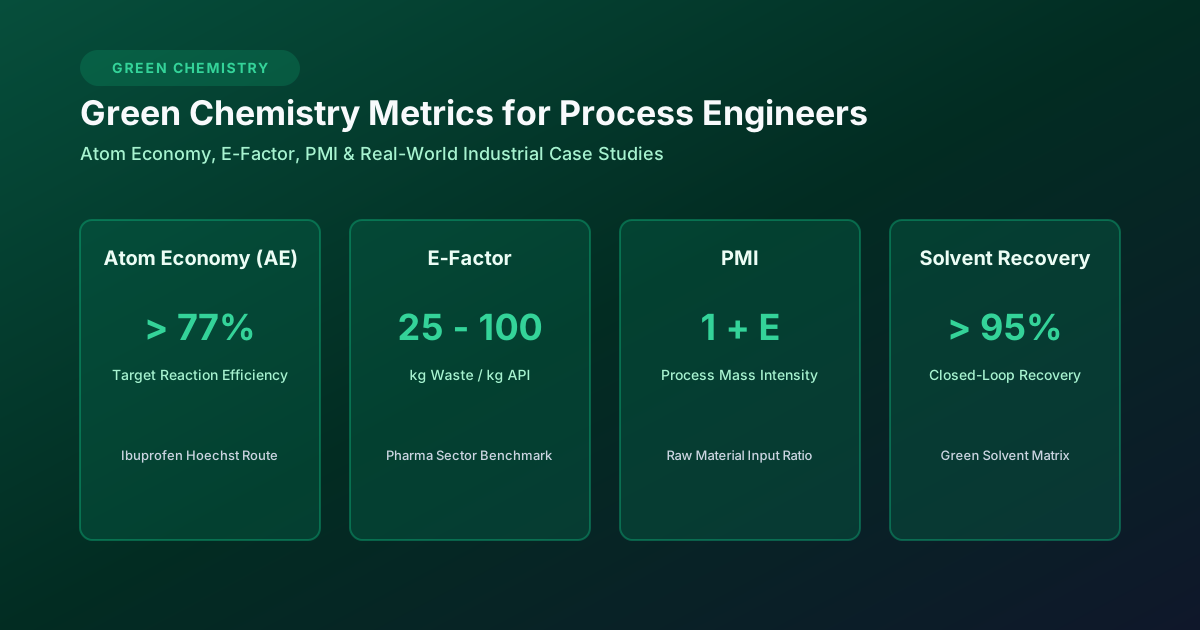
# Green Chemistry Metrics Every Process Engineer Should Know
# Executive Summary & Modern Process Scope
In modern Active Pharmaceutical Ingredient (API) synthesis, specialty chemical manufacturing, and fine chemical processing, chemical process design is no longer evaluated solely on stoichiometric chemical yield (%). Environmental impact, resource conservation, and waste management are critical performance indicators.
Process engineers must evaluate how efficiently carbon, nitrogen, and functional atoms in starting raw materials end up in the isolated product, and how much waste solvent, aqueous effluent, and byproduct sludge is generated per batch.
This engineering guide provides:
- Mathematical definitions and step-by-step formulas for the core Green Chemistry metrics: Atom Economy (AE), Reaction Mass Efficiency (RME), Environmental Factor (E-Factor), and Process Mass Intensity (PMI).
- A comprehensive industry benchmark comparison across oil refining, bulk chemicals, fine chemicals, and pharmaceuticals.
- Three Real-World Industrial Case Studies illustrating successful green process transformations:
- Case Study 1: The Green Catalytic Synthesis of Ibuprofen (Boots 6-Step vs. Hoechst-Celanese 3-Step Route).
- Case Study 2: Engineered Enzymatic Biocatalysis for Sitagliptin (Januvia®) (Merck & Codexis Transaminase Route).
- Case Study 3: Continuous Flow Chemistry & Solvent Recycling for Sertraline (Zoloft®).
- An actionable Solvent Selection Matrix and green alternative guide based on ACS Green Chemistry Institute (GCI) and ICH Q3C guidelines.
# 1. Core Green Chemistry Metrics & Formulas
Raw Materials + Solvents ──► Process Operations ──► Isolated Product + Waste Stream
                                                      │
                                                      ├── Atom Economy (Theoretical Route Efficiency)
                                                      ├── E-Factor (Waste Mass / Product Mass)
                                                      └── Process Mass Intensity (Total Mass Input / Product Mass)
# 1.1 Atom Economy (AE)
Pioneered by Barry Trost, Atom Economy evaluates the theoretical conversion efficiency of a chemical reaction. It measures how many atoms of the starting reactants are incorporated into the final desired molecule versus lost as stoichiometric waste byproducts:
# 1.2 Reaction Mass Efficiency (RME)
While Atom Economy is theoretical, Reaction Mass Efficiency (RME) accounts for actual chemical yield, molar excess of reagents, and incomplete conversion in the reactor:
# 1.3 Environmental Factor (E-Factor)
Pioneered by Roger Sheldon, the E-Factor quantifies the actual total mass of waste generated per kilogram of isolated final product:
- What constitutes waste? Everything except the target isolated product! This includes reaction byproducts, spent catalysts, decomposed reagents, lost solvents, wash waters, acid/base neutralizations, and distillation bottoms.
| Industry Sector | Annual Production Volume (Tons) | Typical E-Factor () | Primary Waste Contributors |
|---|---|---|---|
| Oil Refining / Petroleum | < 0.1 | Gaseous emissions, heavy residues | |
| Bulk Petrochemicals | 1.0 – 5.0 | Unreacted gases, distillation heavy ends | |
| Fine Chemicals & Agrochemicals | 5.0 – 50.0 | Inorganic salts (, ), organic solvents | |
| Pharmaceuticals (API Synthesis) | 25.0 – 100.0+ | Mother liquors, wash solvents, aqueous extractions |
# 1.4 Process Mass Intensity (PMI)
Promoted by the ACS Green Chemistry Institute Pharmaceutical Roundtable (GCI-PR), Process Mass Intensity (PMI) measures the total mass of all raw material inputs (including water and solvents) required to produce of API:
Mathematical relationship between PMI and E-Factor:
# 2. Industrial Case Study 1: The Green Synthesis of Ibuprofen
The commercial synthesis of the anti-inflammatory drug Ibuprofen is the textbook benchmark for green chemistry transformation.
# 2.1 The Traditional Boots 6-Step Stoichiometric Route (1960s)
The original synthesis developed by Boots Pure Drug Company required 6 sequential stoichiometric batch steps:
Isobutylbenzene ──► Friedel-Crafts Acetylation ──► Darzens Glycidic Ester ──► Oxime Formation ──► Dehydration ──► Hydrolysis
- Stoichiometric Waste: Used stoichiometric aluminum chloride () which reacted to form useless aluminum hydroxide sludge, along with chloroacetic acid, hydroxylamine, and organic byproducts.
- Atom Economy (AE): 40.0% (60% of the combined mass of all starting atoms ended up as toxic waste).
- E-Factor: .
# 2.2 The Green Catalytic Hoechst-Celanese 3-Step Route (1990s)
BHC (now BASF) redesigned the synthesis into a 3-step catalytic continuous process:
- Step 1 (Anhydride Acetylation): Isobutylbenzene + Acetic Anhydride -Isobutylacetophenone + Acetic Acid.
- Step 2 (Catalytic Hydrogenation): -Isobutylacetophenone + 1-(-Isobutylphenyl)ethanol.
- Step 3 (Carbonylation): Alcohol + Ibuprofen.
Isobutylbenzene + Acetic Anhydride + H2 + CO ──[Catalytic HF / Ni / Pd]──► IBUPROFEN + Acetic Acid (Recovered)
# Comparative Metrics: Boots vs. Hoechst-Celanese
| Performance Metric | Traditional Boots Route (6 Steps) | Green Hoechst-Celanese Route (3 Steps) | Engineering Impact & Improvement |
|---|---|---|---|
| Number of Synthetic Steps | 6 Batch Steps | 3 Catalytic Steps | 50% reduction in plant equipment footprint |
| Atom Economy (AE) | 40.0% | 77.4% (99.0% with Acetic Acid recovery) | Nearly doubled theoretical atomic efficiency |
| Primary Reagent Mode | Stoichiometric (, ) | True Catalytic (, , ) | catalyst recovered at > 99.9% efficiency |
| Process E-Factor | < 3.0 kg/kg | > 88% reduction in total mass waste | |
| Byproduct Recovery | Solid waste disposal | Acetic Acid co-product recovered for reuse | Closed-loop byproduct integration |
# 3. Industrial Case Study 2: Enzymatic Biocatalysis for Sitagliptin (Januvia®)
Sitagliptin is a dipeptidyl peptidase-4 (DPP-4) inhibitor developed by Merck for type 2 diabetes.
# 3.1 Traditional Chemical Route
The initial commercial manufacturing process relied on a high-pressure asymmetric hydrogenation:
- Catalyst System: Rhodium-Josiphos metal complex catalyst ( / Josiphos).
- Operating Conditions: High hydrogen pressure (), specialized high-pressure Hastelloy hydrogenation reactors.
- Limitations: Required heavy metal removal via carbon adsorption, multiple crystallization steps to achieve enantiomeric excess (), and large volumes of dichloromethane () and methanol.
- Process Mass Intensity (PMI): 125 kg input / kg Sitagliptin.
# 3.2 Engineered Transaminase Biocatalytic Route (Merck & Codexis)
Merck partnered with Codexis to evolve a custom (R)-selective Transaminase enzyme capable of directly converting prositagliptin ketone to Sitagliptin in an aqueous-organic mixture:
Prositagliptin Ketone + Isopropylamine ──[Engineered Transaminase Enzyme]──► SITAGLIPTIN + Acetone
# Engineering & Sustainability Benchmarks:
| Performance Metric | Traditional Asymmetric Metal Route | Engineered Biocatalytic Route | Engineering Advantage |
|---|---|---|---|
| Catalyst Type | Rhodium-Josiphos Heavy Metal | Custom Engineered Transaminase | Eliminates toxic heavy metal contamination |
| Operating Pressure | 250 psig () | Atmospheric Pressure () | Eliminates high-pressure hydrogen safety hazards |
| Enantiomeric Purity | 97.0% (requires recrystallization) | > 99.95% (Direct) | Zero optical purification steps needed |
| Overall Isolated Yield | 82.0% | 92.0% | 10% absolute yield increase |
| Process Mass Intensity (PMI) | 125 kg/kg | 45 kg/kg | 64% reduction in overall material input |
| Waste Productivity Impact | High waste treatment cost | 53% decrease in total waste stream | Significant operational cost saving |
# 4. Industrial Case Study 3: Continuous Flow Chemistry for Sertraline (Zoloft®)
Sertraline hydrochloride (Zoloft®) is a widely prescribed antidepressant.
# 4.1 Traditional Multi-Step Batch Synthesis
The classic batch process involved forming an imine intermediate by reacting tetralone with methylamine in the presence of titanium tetrachloride ():
- Severe Operating Hazard: reacts violently with moisture, generating dense gas and generating heavy titanium dioxide () hydrated sludge.
- High E-Factor: The sludge required repeated aqueous washes, emulsion separations, and batch phase cuts.
- Batch E-Factor: > 85.0 kg waste / kg Sertraline.
# 4.2 Modern Continuous Flow & Solvent Recovery Route
Pfizer redesigned the process by combining 3 batch steps into a continuous flow microreactor system:
- Step 1 (Continuous Imine Formation): Dehydrative condensation of tetralone and methylamine in Ethanol/Solvent over a packed-bed solid acid catalyst column (eliminating entirely).
- Step 2 (Continuous Catalytic Reduction): Imine stream flows directly into a continuous fixed-bed palladium catalyst reactor for stereoselective reduction.
- Step 3 (Continuous In-Line Crystallization): Salt formation and continuous filtration.
Tetralone + Methylamine ──[Packed Bed Solid Acid]──► Imine ──[Continuous H2 / Pd Column]──► Sertraline Base ──► In-Line HCl Salt
# Key Green Engineering Metrics Improvements:
| Performance Metric | Traditional Batch Route | Continuous Flow & Recycle Route | Process Engineering Impact |
|---|---|---|---|
| Reagent Hazards | Stoichiometric (Fuming liquid) | Solid Packed-Bed Acid Catalyst | Zero titanium sludge; zero toxic off-gas |
| Solvent Utilization | 5 Different Batch Solvents | Single Alcohol Solvent System | Eliminates inter-step solvent exchanges |
| In-Line Solvent Recycle | 0% (Single use) | > 92% Closed-Loop Recovery | Solvent recycled continuously via distillation |
| Process E-Factor | > 85.0 kg/kg | 12.0 kg/kg | 85.8% reduction in waste generation |
| Volumetric Productivity | Batch Reactors | Continuous Skid | smaller equipment footprint |
# 5. Green Solvent Selection Guide & Chemically Safer Alternatives
Because solvents account for up to 90% of total process mass intensity (PMI), solvent substitution is the primary tool for process engineers to improve plant green metrics:
| Banned / High-Hazard Class 1 Solvents (ICH Q3C) | Primary Environmental & Toxicity Hazard | Preferred Green Alternative Solvent | Recommended Engineering Application |
|---|---|---|---|
| Dichloromethane (DCM) | Ozone depletion; toxic inhalation; carcinogen hazard | 2-Methyltetrahydrofuran (2-MeTHF) / Ethyl Acetate | Extraction, organometallic reactions, biphasic cuts |
| Dimethylformamide (DMF) | Reproductive toxin; difficult to incinerate; high BP () | Acetonitrile / Water / Gamma-Valerolactone (GVL) | Solid-phase synthesis, coupling reactions |
| Hexane | Peripheral neuropathy; high flammability; aquatic toxicity | Heptane / Cyclohexane | Crystallization, hydrophobic extractions |
| Diethyl Ether | Extremely low flash point (); severe peroxide formation | Cyclopentyl Methyl Ether (CPME) / MTBE | Grignard reactions, ether extractions |
| Benzene / 1,2-Dichloroethane | Class 1 Human Carcinogen (Strictly Banned) | Toluene / Anisole | High-temperature aromatic reactions |
# 6. Actionable Implementation Checklist for Process Leads
To drive green chemistry metrics into capital projects and technology transfers:
- Track PMI Early: Calculate baseline Process Mass Intensity (PMI) during initial Kilo Lab and Pilot Plant campaigns.
- Target High-PMI Steps: Identify operations where PMI exceeds ; target solvent volumes, wash cuts, and crystallization volumes.
- Design Internal Recovery Loops: Integrate closed-loop solvent recovery distillations into mass balances during PFD and P&ID development.
- Replace Hazardous Reagents: Swap stoichiometric reagents (, , ) for heterogeneous heterogeneous catalysts (, , enzymes).
- Audit Aqueous Effluents: Evaluate COD/BOD loads and salt formation (, ) in aqueous wash streams.
# Technical Conclusion
Green Chemistry metrics—Atom Economy, E-Factor, and Process Mass Intensity (PMI)—are essential design parameters for modern chemical process engineers. As demonstrated by commercial transformations in Ibuprofen, Sitagliptin, and Sertraline, transitioning from stoichiometric batch pathways to catalytic, biocatalytic, and continuous flow processes slashes material costs, reduces E-Factors by up to , and establishes inherently safer chemical manufacturing.
# Applicable Engineering Standards & Codes Used
The engineering methodologies, design correlations, and safety criteria detailed in this article adhere to the following international standards and industry codes:
- ASME B31.3: Process Piping Code
- API RP 14E: Recommended Practice for Design and Installation of Offshore Production Platform Piping Systems
- Hydraulic Institute Standards (HI 1.3, HI 2.3) for Centrifugal and Positive Displacement Pumps: Hydraulic Institute Standards (HI 1.3, HI 2.3) for Centrifugal and Positive Displacement Pumps
- ISO 5167: Measurement of Fluid Flow by Means of Pressure Differential Devices