# Industrial Dust Collector System Design in Chemical & API Manufacturing: Baghouse Sizing, Air-to-Cloth Ratio, Duct Hydraulics & Safety
# Executive Summary & Regulatory Framework
In Active Pharmaceutical Ingredient (API) synthesis, solid formulation, and specialty chemical manufacturing, dust collection systems perform two vital functions:
- Occupational Health & Containment: Preventing operator exposure to potent pharmaceutical compounds (OEB 3 to OEB 5) and toxic chemical dusts to comply with OSHA 29 CFR 1910.94 and ACGIH Industrial Ventilation guidelines.
- Explosion & Deflagration Safety: Preventing catastrophic combustible dust explosions in compliance with NFPA 654 (Combustible Particulate Solids), NFPA 68 (Explosion Venting), and NFPA 69 (Explosion Prevention Systems).
A poorly designed dust collector causes filter blinding, duct dust settling, fan stalling, and explosive dust cloud accumulation inside process bays.
This engineering guide covers:
- Operating principles of Pulse-Jet Baghouse Collectors vs. Cartridge Collectors.
- Governing design performance equations ().
- A step-by-step numerical sizing example for a API powder processing train.
- NFPA 68 Explosion Vent Area Calculations for combustible dusts ().
- Filter Media Selection Matrix (Polyester, PTFE membrane, Antistatic SS scrim, Nomex).
- The downloadable Dust Collector System Design Excel Calculator Resource.
- Applicable Engineering Standards & Codes Used.
# 1. Dust Collector Operating Principles & Equipment Types
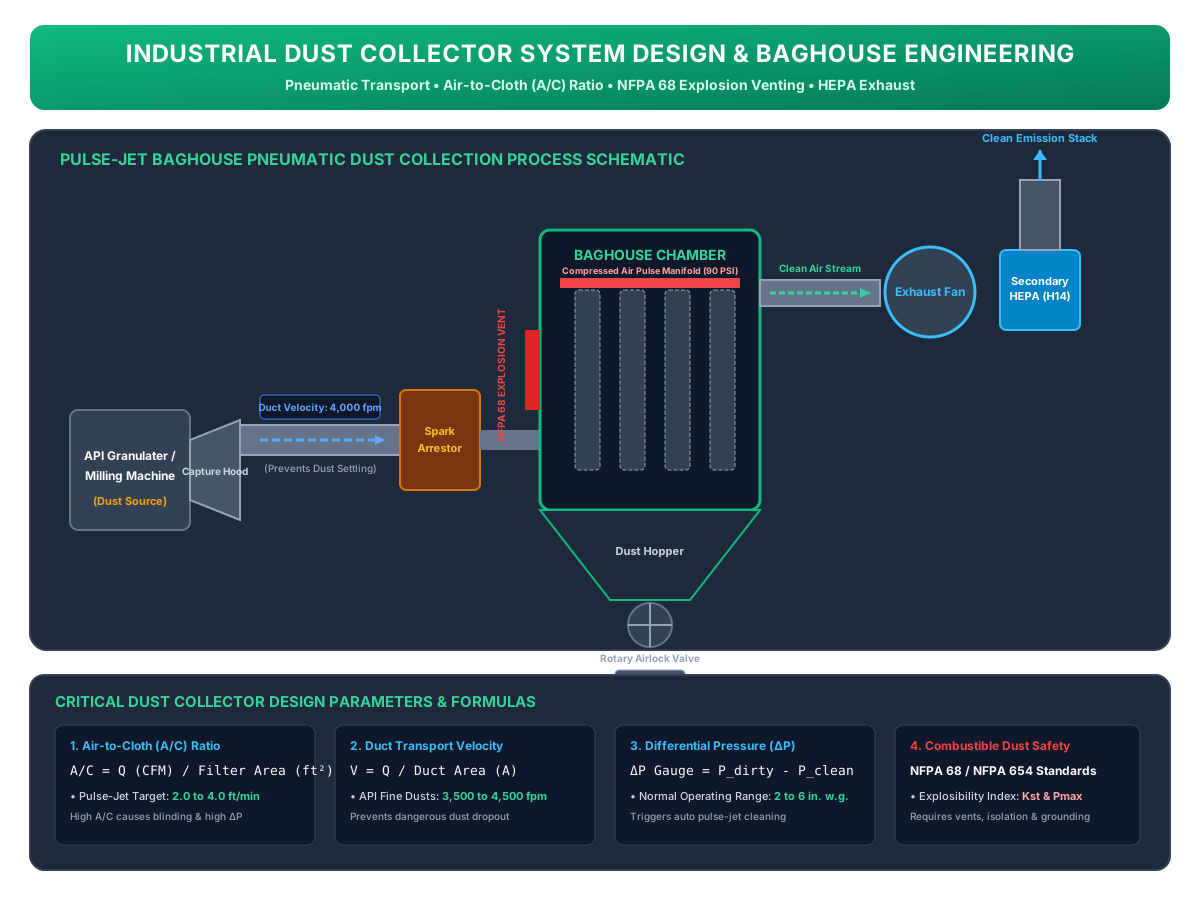
                            PULSE-JET BAGHOUSE SCHEMATIC
   Clean Air Outlet ◄──────────────────────────────────────────────┐
                                                                   │
                       Compressed Air Manifold & Pulse Valve      │
                                         │                         │
                                   ┌─────┴─────┐                   │
                                   │  BLOWPIPE │                   │
                                   └─────┬─────┘                   │
                                         ▼                         │
   Dirty Air Inlet ──► ┌────────────────────────────────────────┐  │
                       │             UPPER PLENUM               │──┘
                       ├────────────────────────────────────────┤
                       │             TUBE SHEET                 │
                       ├────────────────────────────────────────┤
                       │  ┌───┐   ┌───┐   ┌───┐   ┌───┐   ┌───┐ │
                       │  │   │   │   │   │   │   │   │   │   │ │
                       │  │ F │   │ F │   │ F │   │ F │   │ F │ │
                       │  │ I │   │ I │   │ I │   │ I │   │ I │ │ (Filter Bags & Cages)
                       │  │ L │   │ L │   │ L │   │ L │   │ L │ │
                       │  └───┘   └───┘   └───┘   └───┘   └───┘ │
                       ├────────────────────────────────────────┤
                       │          HOPPER / DISCHARGE            │
                       └──────────────────┬─────────────────────┘
                                          ▼
                                   Rotary Airlock Valve ──► Collected Dust Discharge
| Dust Collector Type | Operating Principle | Typical Air-to-Cloth Ratio | Best Suited Applications | Limitations & Disadvantages |
|---|---|---|---|---|
| Pulse-Jet Baghouse | Woven/non-woven fabric bags supported by wire cages; cleaned by high-pressure compressed air pulses (). | () | Heavy dust loading (), high temperature (), sticky/fibrous dusts. | Larger footprint than cartridge collectors. |
| Cartridge Collector | Pleated media cartridges providing high surface area per unit volume; pulse cleaned. | () | Fine API powders, compact indoor installations, light-to-moderate dust loads (). | Blinds quickly under high moisture or sticky dust. |
| Cyclone Separator | Centrifugal gas-solid separation without filter media. | N/A (Efficiency based on cut-diameter) | Primary pre-cleaner to drop coarse particles () before baghouse. | Low efficiency for fine respirable dust (). |
# 2. Governing Design Equations for Dust Collection Systems
# 2.1 Air-to-Cloth (A/C) Ratio & Filter Media Sizing
The Air-to-Cloth Ratio () represents the superficial velocity of gas passing through the filter media:
Where is airflow rate (), is A/C ratio (), and is required total filter area ().
# 2.2 Duct Transport Velocity ()
To prevent dust from settling out of the gas stream and creating an explosive dust layer inside horizontal duct headers, the gas velocity must exceed the saltation velocity ():
- Fine API Powder & Organic Dust: ().
- Coarse Heavy Granules & Abrasive Ore: ().
# 2.3 Can Velocity () & Re-entrainment Prevention
Can Velocity is the upward superficial gas velocity between the filter bags inside the housing. If is too high, dust dislodged during pulse cleaning cannot fall into the hopper and is instantly re-entrained onto adjacent bags:
- Maximum Allowable Can Velocity: () for fine API powders.
# 2.4 Filter Bag Pressure Drop ()
Where is clean bag resistance, is specific cake resistance, and is areal dust mass loading (). Normal operating ().
# 3. Step-by-Step Numerical Sizing Example
# A. Problem Statement
Design a pulse-jet baghouse dust collector for an API milling and micronization suite generating () of airborne powder. Standard filter bag geometry: Diameter (), Length . Recommended Air-to-Cloth ratio .
# B. Step-by-Step Calculations
# Step 1: Calculate Required Total Filter Area ()
# Step 2: Calculate Single Filter Bag Surface Area ()
# Step 3: Determine Required Bag Count ()
- Layout Selection: Select configured in a tube sheet grid array.
- Actual Installed Filter Area: .
- Actual Operating Air-to-Cloth Ratio:
# Step 4: Main Duct Sizing ()
Using target transport velocity :
- Select Commercial Duct Size: ().
- Actual Installed Duct Velocity:
# Step 5: Can Velocity Check ()
For a housing cross-section :
# 4. Combustible Dust Safety & Deflagration Protection (NFPA 68 / 69)
In API processing, organic powders (e.g., starch, cellulose, active drug substances) pose severe dust explosion hazards. Dust explosibility is categorized by the Deflagration Index ():
| Dust Explosion Class | Range () | Explosibility Level | Typical Pharma / Chemical Dust Examples |
|---|---|---|---|
| St-0 | Non-explosive | Silica, Calcium Carbonate, Titanium Dioxide. | |
| St-1 | Weak / Moderate | Lactose (), Paracetamol (), Aspirin (). | |
| St-2 | Strong | Epoxy resin, Cellulose powder, Fine Organic Pigments. | |
| St-3 | Very Strong | Aluminum powder, Magnesium dust, Fine Titanium powder. |
# 4.1 NFPA 68 Explosion Vent Area Sizing Formula
For a baghouse vessel volume (), reduced explosion pressure (), static burst pressure (), and value:
# 5. Filter Media & Material of Construction (MOC) Matrix
| Filter Media Material | Continuous Operating Temp (°C) | Chemical & Acid Resistance | Moisture & Hydrolysis Resistance | Primary Application & Strengths |
|---|---|---|---|---|
| Polyester (PE) Needle Felt | Good organic solvent resistance; poor strong acid. | Fair; susceptible to hydrolysis above . | Standard general-purpose ambient dust collection. | |
| PTFE Membrane on PE | Excellent surface filtration; cake releases easily. | High surface hydrophobic repellency. | Ultra-fine API powders (); high collection efficiency (). | |
| Antistatic Epitropic PE | Conductive stainless steel fibers woven into scrim. | Fair hydrolysis resistance. | Combustible dusts requiring static dissipation (). | |
| Nomex (Aramid) | Excellent high-temperature resistance. | Poor; hydrolyzes rapidly in presence of steam. | High-temperature dryer exhausts and spray dryer vents. | |
| Ryton (PPS) | Outstanding resistance to acids and sulphur oxides. | Excellent hydrolysis resistance. | Boiler flue gas and acidic chemical powder vents. |
# 6. Downloading the Dust Collector Sizing Excel Calculator Resource
Process and EHS engineers can download the pre-formatted Excel calculator resource (Dust_Collector_Design_Calculator.xlsx) from the Resources section.
It features:
- Sheet 1: Baghouse Filter Sizing: Automatic computation of , , actual A/C ratio, and Can Velocity ().
- Sheet 2: Duct Hydraulics & Transport Velocity: Computes transport velocity (), velocity pressure (), and total fan static pressure duty ().
- Sheet 3: NFPA 68 Explosion Vent Area Calculator: Calculates explosion vent area () based on , , and housing volume.
# Applicable Engineering Standards & Codes Used
The engineering methodologies, design correlations, and safety criteria detailed in this article adhere to the following international standards and industry codes:
- ACGIH Industrial Ventilation: A Manual of Recommended Practice for Design (30th Edition)
- NFPA 654: Standard for the Prevention of Fire and Dust Explosions from the Manufacturing, Processing, and Handling of Combustible Particulate Solids
- NFPA 68: Standard on Explosion Protection by Deflagration Venting
- NFPA 69: Standard on Explosion Prevention Systems
- OSHA 29 CFR 1910.94: Occupational Safety and Health Standards - Ventilation
- ISO 28121: Industrial Ventilation and Dust Collection Systems Safety
- EN 13861: Safety of Machinery - Guidance for the Application of Safety Standards in the Design of Dust Collectors
- VDI 3677: Filterable Dust Separators (Verein Deutscher Ingenieure)
# Technical Conclusion
Designing a robust industrial dust collection system requires integrating aerosol dynamics, fluid hydraulics, filter media chemistry, and deflagration safety. By enforcing proper Air-to-Cloth ratios (), maintaining duct transport velocities (), and implementing NFPA 68 explosion venting, chemical engineers ensure safe, compliant, and high-yield manufacturing operations.
# Applicable Engineering Standards & Codes Used
The engineering methodologies, design correlations, and safety criteria detailed in this article adhere to the following international standards and industry codes:
- OSHA 29 CFR 1910.119: Process Safety Management of Highly Hazardous Chemicals
- NFPA 654: Standard for the Prevention of Fire and Dust Explosions from Combustible Particulate Solids
- NFPA 68: Standard on Explosion Protection by Deflagration Venting
- NFPA 69: Standard on Explosion Prevention Systems
- ACGIH Industrial Ventilation: A Manual of Recommended Practice for Design (30th Edition): ACGIH Industrial Ventilation: A Manual of Recommended Practice for Design (30th Edition)
- ISO 28121: Industrial Ventilation and Dust Collection Systems Safety