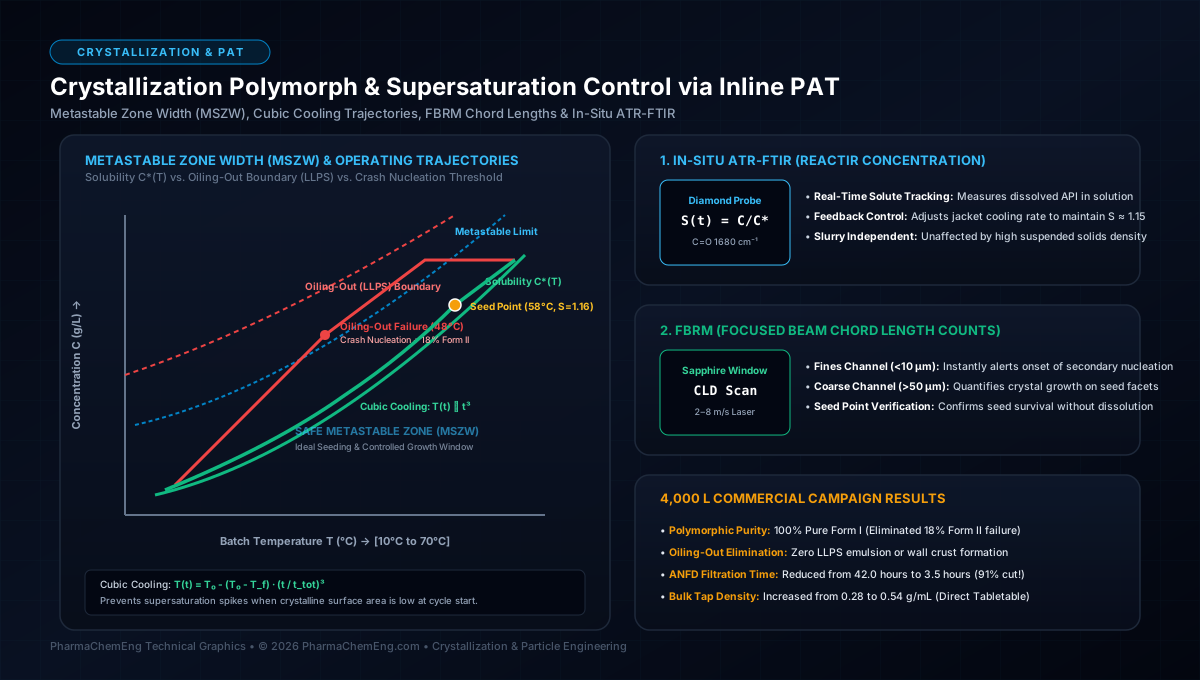
# Crystallization Polymorph & Supersaturation Control: Inline Process Analytical Technology (FBRM, PVM, ATR-FTIR) Engineering Guide
# Real-Time Supersaturation Tracking (), Metastable Zone Width (MSZW), Cubic Cooling Trajectories, and Polymorph Transformation Kinetics in Commercial API Crystallizers
# Executive Summary
In small-molecule drug development, industrial crystallization is not merely a separation and purification unit operation—it is the definitive process step that dictates the physical, solid-state, and biopharmaceutical properties of the final Active Pharmaceutical Ingredient (API).
A failure during commercial crystallization does not just result in off-specification chemical purity; it can derail entire commercial drug products:
- Polymorphic Inconsistency: As demonstrated by the famous Ritonavir disaster, spontaneous nucleation of an unforeseen, thermodynamically stable polymorph with low aqueous solubility can wipe out drug bioavailability, requiring complete reformulation.
- Liquid-Liquid Phase Separation (Oiling-Out / LLPS): Solute separates as a subcooled liquid oil rather than crystalline facets, trapping massive quantities of mother liquor impurities and forming sticky, unfilterable tar on vessel walls.
- Bimodal Particle Size Distribution (PSD): Excessive secondary nucleation produces an abundance of micro-fines (), stalling downstream Agitated Nutsche Filter Dryers (ANFD) and causing tablet die-capping during high-speed rotary compression.
Historically, crystallization was operated as a blind "recipe": charge solvent, heat, cool linearly over 6 hours, and pray.
Modern Quality-by-Design (QbD) biopharma engineering replaces blind recipes with closed-loop Process Analytical Technology (PAT): using In-Situ ATR-FTIR to track dissolved concentration, Focused Beam Reflectance Measurement (FBRM) to quantify particle counts and chord length distributions, and Particle Vision and Measurement (PVM) to visualize crystal morphology in real time.
This technical engineering guide provides the mathematical crystallization kinetics, PAT sensor integration architectures, cubic cooling derivations, and a fully worked 4,000 L commercial scale-up case study.
# 1. Fundamentals of Supersaturation & The Metastable Zone (MSZW)
Crystallization occurs only when a solution is supersaturated—i.e., when the actual dissolved solute concentration () exceeds the thermodynamic equilibrium solubility () at that temperature:
Concentration (C)
 ▲
 │                          Unstable (Labile) Zone
 │                     (Spontaneous Uncontrolled Crash Nucleation!)
 │         ------------------------------------------------- Metastable Limit Line
 │                    Metastable Zone Width (MSZW)
 │             (Ideal Controlled Growth & Seeding Window)
 │         ═════════════════════════════════════════════════ Equilibrium Solubility Line C*(T)
 │
 │                          Undersaturated Zone
 │                             (Dissolution)
 └──────────────────────────────────────────────────────────► Temperature (T)
# 1.1 The Kinetic Competition: Nucleation vs. Growth
Once supersaturation () is established, it is consumed by two competing kinetic pathways:
- Secondary Nucleation Rate ():
Typically, the nucleation order .
- Crystal Growth Rate ():
Typically, the growth order .
# 2. In-Situ PAT Sensor Suite for Crystallizers
                      ┌─────────────────────────────────────────┐
                      │ Jacketed Commercial Crystallizer (4 KL) │
                      └────────────────────┬────────────────────┘
                                           │
         ┌─────────────────────────────────┼─────────────────────────────────┐
         ▼                                 ▼                                 ▼
┌──────────────────┐             ┌──────────────────┐             ┌──────────────────┐
│  ATR-FTIR / NIR  │             │   FBRM Probe     │             │   PVM Imaging    │
│  (ReactIR)       │             │   (Particle Track│             │   (Real-Time     │
│                  │             │    G400)         │             │    Microscopy)   │
├──────────────────┤             ├──────────────────┤             ├──────────────────┤
│ Dissolved Solute │             │ Real-Time Chord  │             │ Video Images of  │
│ Concentration &  │             │ Length Counts    │             │ Crystals, Faces, │
│ Supersaturation  │             │ (Fine vs. Coarse)│             │ Oil Droplets     │
└──────────────────┘             └──────────────────┘             └──────────────────┘
         │                                 │                                 │
         └─────────────────────────────────┼─────────────────────────────────┘
                                           ▼
                 [ Closed-Loop Automated DCS / TCU Control ]
                 • Controls Jacket Cooling Ramp via S(t)
                 • Triggers Automated Seed Injection Window
# 2.1 In-Situ Attenuated Total Reflectance FTIR (ATR-FTIR)
Equipped with a diamond-composite insertion probe, ATR-FTIR measures the infrared absorption of the liquid phase directly.
- By calibrating the specific vibrational fingerprint absorbance of the API (e.g., carbonyl stretch at ), the DCS computes real-time solute concentration () independently of suspended solids.
- Directly outputs the instantaneous supersaturation ratio .
# 2.2 Focused Beam Reflectance Measurement (FBRM)
A high-velocity laser beam rotates through a sapphire window at . As the beam intersects suspended crystals, light is backscattered, measuring thousands of individual chord lengths per second:
- Fines Channel (): Instantly detects the onset of secondary nucleation or seed attrition.
- Coarse Channel (): Tracks macroscopic crystal growth and agglomeration.
# 2.3 Particle Vision and Measurement (PVM)
In-situ high-magnification illumination and CCD microscopy:
- Immediately detects liquid-liquid phase separation (oiling-out) before crystals nucleate.
- Identifies needle agglomeration, aspect ratio shifts, or dissolution of seed particles.
# 2.4 Mathematical Interpretation: Chord Length Distribution (CLD) vs. PSD
A Focused Beam Reflectance Measurement (FBRM) probe does not measure particle geometric diameter () directly; it measures chord lengths () as a rotating laser beam sweeps across suspended particles at velocity :
Rotating Laser Beam (vb = 2 m/s)
═══════════════► [ Particle ] ═══════════════►
├── Chord s ──┤
The chord length distribution is related to the true three-dimensional number particle size distribution via geometric probability convolution:
- Unweighted Chord Distribution: Dominated by particle numbers; ideal for detecting fine nuclei ().
- Square-Weighted () Chord Distribution: Proportional to particle volume/mass; tracks macroscopic batch yield and crystal facet enlargement.
# 3. Cooling Trajectory Optimization: Why Linear Cooling Destroys Batches
In standard batch plants, cooling is routinely set to a constant linear rate:
Linear vs. Cubic Cooling Trajectories:
  Temp (T)
  ▲
  │ \
  │  \ Linear: High ΔT at start when seed area is low → MASSIVE SUPERSATURATION SPIKE!
  │   \
  │    ───────
  │           \
  │            \ Cubic (Optimized): Slow ΔT initially, accelerating only when total surface area is massive!
  │             ──────
  └────────────────────► Time (t)
# 3.1 The Cubic Cooling Profile Derivation
At the start of crystallization immediately after seeding, the total crystalline seed surface area () is extremely small. Linear cooling creates an instantaneous supersaturation spike (), exceeding the metastable limit and triggering catastrophic spontaneous crash nucleation.
To maintain a constant, safe level of supersaturation (), the rate of desupersaturation by crystal growth must balance the rate of solubility decrease:
Because crystal mass accumulates with , the optimal cooling curve is cubic:
Where:
- : Temperature at seed point ()
- : Final target isolation temperature ()
- : Total scheduled crystallization batch time ()
# 3.2 Quantitative Seed Mass & Active Surface Area Sizing
The objective of seeding is to provide sufficient crystalline surface area () to consume incoming supersaturation via crystal growth, keeping :
Where:
- : Mass of dry seed crystals charged ()
- : Crystal skeletal density ()
- : Sauter mean diameter of milled seed particles ()
Worked Example: Charging () of seed crystals with mean size provides:
This immense growing surface immediately de-supersaturates the liquid phase, completely shutting down secondary nucleation pathways.
# 4. Polymorph Control & Solution-Mediated Phase Transformation (SMPT)
According to Ostwald's Rule of Stages, when a supersaturated solution nucleates, it does not precipitate the thermodynamically most stable crystal form first—it precipitates the least stable, metastable polymorph closest in free energy to the liquid state:
[ Supersaturated Solution ]
            │
            ▼ Fast Spontaneous Nucleation (Low Kinetic Barrier)
[ Metastable Polymorph II ] (Higher Solubility C*2, High Free Energy)
            │
            ▼ Dissolution of Form II Driven by (C*2 - C*1)
[ Solution Intermediary ]
            │
            ▼ Slow Growth on Nuclei of Stable Form
[ Stable Polymorph I ] (Lowest Solubility C*1, Low Free Energy)
# 4.1 Controlling the SMPT Kinetic Window
The transformation rate from Metastable Form II to Stable Form I is dictated by the solution-mediated phase transformation (SMPT) rate equation:
- If a batch is cooled too quickly, Metastable Form II nucleates and becomes trapped inside an overgrowth of Form I, creating an off-spec polymorphic blend.
- The Engineering Control Solution: Use inline ATR-FTIR / Raman to detect the exact solubility plateau of Form I, and seed exclusively with Form I crystals () at , while . This completely bypasses the nucleation kinetic barrier of the unwanted polymorph.
# 5. Worked Industrial Case Study: Eliminating Oiling-Out & Polymorphic Failures in a 4,000 L Crystallizer
# 5.1 Process Details & The Scale-Up Crisis
- Product: BCS Class II anti-diabetic API drug substance.
- Equipment: Hastelloy C-22 jacketed reactor equipped with dual 3-blade pitched hydrofoils () and TCU thermal fluid heating/cooling.
- Solvent System: Isopropanol (IPA) / Water ().
- Historical Baseline (Uncontrolled Linear Cooling):
- Solution heated to to dissolve crude API.
- Cooled linearly from to over 6 hours without seeding.
- Failure Symptom: Around , the batch turned into a cloudy, milky emulsion (oiling-out). At , sticky agglomerates coated the reactor walls and agitator blades.
- The final isolated cake contained of the unwanted Form II polymorph (failing release specs) and required 42 hours to de-liquor on the ANFD due to high fines content ().
Historical Failure:
[70°C Clear Solution] ──(Linear Cooling)──► [48°C Oiling-Out / Emulsion] ──► [Sticky Agglomerates & Form II Mix] (ANFD: 42h)
# 5.2 PAT Diagnostic Implementation
A Mettler-Toledo ReactIR (ATR-FTIR) probe and ParticleTrack G400 (FBRM) probe were installed directly through 2-inch top-head nozzles extending below the minimum liquid level.
- ATR-FTIR Calibration: Calibrated against known dissolved concentrations of API in IPA/Water across to , yielding continuous real-time supersaturation .
- Identification of Metastable Zone & Oiling-Out Boundary:
- At : Saturation concentration .
- Form I solubility at : .
- Oiling-Out Boundary (LLPS) occurs at .
# 5.3 The Remediated QbD Operating Protocol
- Controlled Seeding Window ():
- Cooled from down to . At this temperature, the solution is slightly supersaturated with respect to Form I (), but well below the oiling-out boundary ().
- Injected () dry-milled Form I seed crystals () slurried in cold IPA.
- Seed Aging Hold: Held at for 60 minutes. FBRM confirmed seed counts doubled via gentle surface growth while ATR-FTIR showed solute concentration decreasing steadily toward saturation ().
- Cubic Cooling Trajectory Implementation:
- Programmed the TCU PLC with the cubic cooling equation over 8 hours (, , ):
- In the first 4 hours, temperature dropped gently from to only (). In the final 2 hours, cooling accelerated to , when billions of square meters of crystal surface were available to consume supersaturation.
Remediated PAT-Controlled Process:
[70°C Dissolve] ──► [Cool to 58°C (S=1.16)] ──► [Seed 1.5% Form I] ──► [Cubic Cooling to 10°C] ──► [Pure Form I Crystals] (ANFD: 3.5h)
# 5.4 Commercial Results Comparison
| Quality & Performance Metric | Baseline Uncontrolled Batch | Remediated PAT Cubic Batch | Result / Impact |
|---|---|---|---|
| Polymorphic Form Purity (XRPD) | Form I / Form II | Pure Form I (Zero Form II) | Regulatory Compliance |
| Oiling-Out (LLPS) | Severe (Emulsion formed at ) | Zero oiling-out detected by PVM | Clean reactor walls, zero fouling |
| Particle Size Distribution () | (Bimodal fines) | Eliminates screen blinding | |
| Median Particle Size () | (Broad distribution) | (Narrow distribution) | Superior powder flowability |
| ANFD Filtration & Wash Time | 42.0 hours | 3.5 hours | cycle time reduction |
| Bulk Tap Density | (Fluffy, poor flow) | (Direct compression) | Directly compressible into tablets |
# 6. Practical PAT Porting & Installation Engineering Checklist
- Probe Tip Orientation & Clearance: Align the angled bevel face of the ATR-FTIR and FBRM sapphire windows directly facing the oncoming fluid flow stream (typically angled downward into the flow). This ensures high surface scouring velocity, completely preventing stagnant crystal cake buildup over the optical window.
- Vessel Liquid Level Tracking: In crystallization steps involving extensive antisolvent addition or solvent boil-down, calculate minimum and maximum liquid levels to ensure probe tips remain fully submerged by at least during all critical process phases.
- Agitator Clearance: Maintain a minimum mechanical clearance between the PAT probe sheath and the outermost tip diameter of rotating impeller blades. For glass-lined reactors, utilize specialized PTFE-sleeved baffled finger ports to prevent glass chipping.