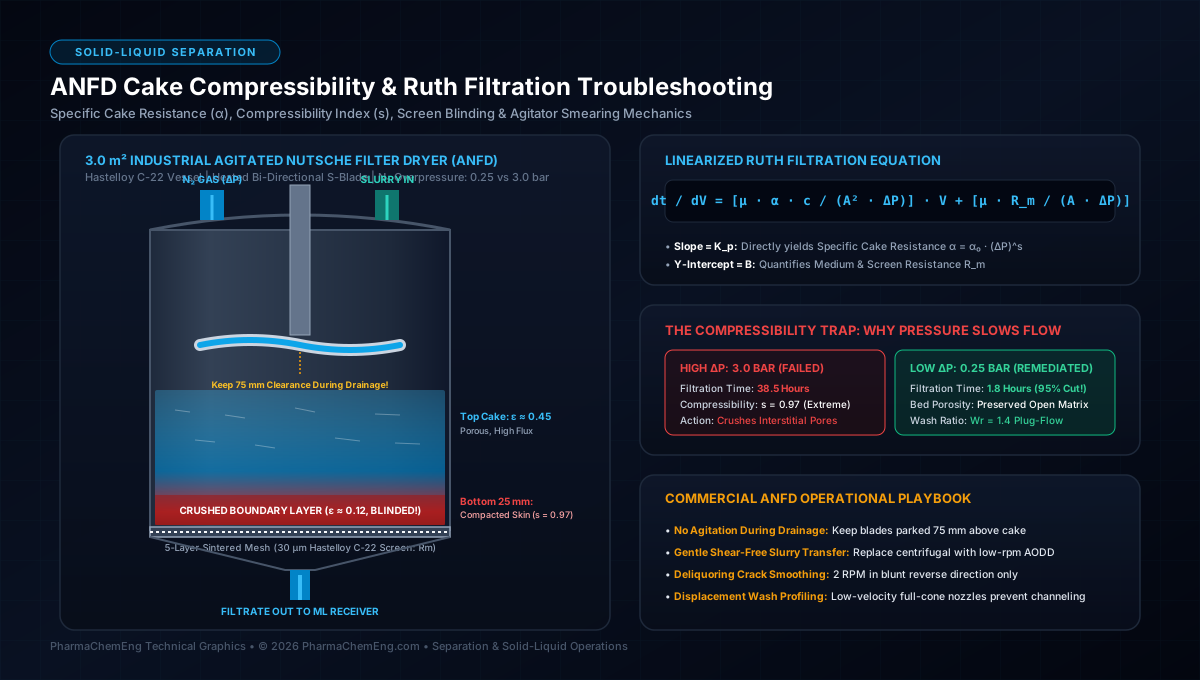
# ANFD & Centrifuge Troubleshooting: Why Filtration Takes 5 Minutes in the Lab and 36 Hours in the Plant (Ruth Equation & Cake Compaction)
# A Quantitative Troubleshooting Guide to Specific Cake Resistance (), Compressibility (), Filter Screen Blinding, and Washing Hydrodynamics in Commercial API Isolation
# Executive Summary
One of the most frequent and costly failures encountered during pharmaceutical technology transfer is the filtration stall: a crystalline slurry that filters in under 5 minutes on a laboratory Buchner funnel suddenly requires 24 to 48 hours to de-liquor inside a commercial 2–4 Agitated Nutsche Filter Dryer (ANFD) or basket centrifuge.
When filtration stalls, the commercial repercussions are severe:
- Batch Delays & Degradation: APIs sitting in mother liquor for days undergo solvate transformation, crystal ripening, or hydrolytic degradation.
- Filter Screen Blinding: Sintered multi-layer stainless steel mesh or woven polyketone (Halar/ECTFE) cloths become permanently blinded with micro-fines.
- Cracked Filter Cakes & Impure API: Deep cake fissures allow wash solvent to channel directly to the drain, failing residual impurity and drying specifications.
The root cause of this failure is almost never "bad equipment." It is a fundamental misunderstanding of porous bed hydrodynamics, Darcy-Ruth filtration physics, cake compressibility indices (), and mechanical agitator shear smearing.
This publication provides the complete mathematical theory of solid-liquid separation, diagnostic procedures for identifying compressible vs. incompressible cakes, agitator blade interaction dynamics, and a fully worked industrial troubleshooting case study where filtration time was slashed from 38 hours down to 2.5 hours.
# 1. The Physics of Solid-Liquid Separation: Darcy and Ruth Filtration Theory
In solid-liquid separation across a porous medium, the instantaneous filtrate flux () is governed by Darcy's Law for Porous Media:
Where:
- : Cumulative filtrate volume ()
- : Filtration time ()
- : Total filtration surface area ()
- : Net pressure differential across cake and medium ()
- : Mother liquor dynamic viscosity ()
- : Cake hydraulic resistance ()
- : Filter medium and support plate resistance ()
   Slurry Feed (Overpressure N2: ΔP = 2 - 4 bar)
          │
          ▼
┌──────────────────────────────────┐
│   Supernatant Liquid Layer       │
├──────────────────────────────────┤ ◄── High Porosity (Top Cake: ε ≈ 0.45)
│   Crystalline Cake Bed           │
│   (Specific Resistance α)        │ ◄── Compressed Zone (Bottom Cake: ε ≈ 0.20, Fines Trapped!)
├──────────────────────────────────┤
│══════════════════════════════════│ ◄── Sintered Filter Screen (Medium Resistance Rm)
└──────────────────────────────────┘
          │
          ▼ Filtrate Discharge (To Mother Liquor Receiver)
# 1.1 The Linearized Ruth Filtration Equation
As filtration proceeds at constant applied differential pressure (), cake resistance grows proportionally with the deposited dry solid mass per unit filtrate volume ():
Substituting into Darcy's law and inverting yields the linearized Ruth Filtration Equation:
Plotting experimental plant or laboratory data as vs. produces a straight line where:
- Slope (): Directly reveals the Specific Cake Resistance ():
- Y-Intercept (): Directly quantifies the Filter Medium Resistance ():
# 2. The Cake Compressibility Trap: Why Higher Pressure Slows Down Filtration
In novice engineering handbooks, it is commonly assumed that if a filter cake runs slowly, the operator should simply turn up the nitrogen overpressure (from 1 bar to 3 bar).
In industrial reality, for organic APIs, this action frequently stops flow completely.
# 2.1 The Compressibility Index ()
Organic crystals (platelets, needles, amorphous solvates) are mechanically flexible. Under applied compressive drag stress (), the bed void fraction () collapses, squeezing pores shut.
Specific cake resistance is a power-law function of differential pressure:
Where is the Cake Compressibility Index ():
Compressibility Index (s):
  s = 0.0          s = 0.2 - 0.4        s = 0.5 - 0.8         s > 0.9 (Catastrophic!)
[Incompressible]   [Slightly Comp.]    [Highly Comp.]         [Total Bed Collapse]
(Sand, NaCl)      (Large Prisms)      (Needles, Plates)      (Gels, Amorphous API)
Flow ∝ ΔP         Flow ∝ ΔP^0.7       Flow ∝ ΔP^0.3          Flow Decreases as ΔP Increases!
Substituting back into the filtration rate equation:
# 2.2 Centrifugal Separation Hydrodynamics & G-Force Sizing
In vertical basket or peeler centrifuges, the driving force for filtration is centrifugal acceleration rather than pneumatic gas overpressure:
Where:
- : Centrifugal G-factor (dimensionless, typically )
- : Basket internal radius ()
- : Basket rotational speed ()
The hydraulic pressure generated by the rotating liquid pool ring of thickness () is:
Correct Centrifuge Strategy: Perform the initial de-liquoring step at low centrifugal speed (, ), increasing to high speed only for final spin drying.
# 3. Why the Lab Buchner Funnel Lies: The 5 Scale-Up Disconnects
| Laboratory (1 L Bench Buchner) | Commercial (4,000 L ANFD / Basket Centrifuge) | Physical Consequence on Scale-Up |
|---|---|---|
| Cake Depth: | Cake Depth: | Pressure drop across thick beds generates massive axial compressive stress; pore collapse is exponential with depth. |
| Pumping Velocity: Hand-poured gently in 5 seconds | Transferred through pumps, valves, and dip pipes over 1–2 hours | Shear-induced crystal attrition: High-shear impeller and pump cavitation generate secondary micro-fines (). |
| Settling / Segregation: Rapid; zero classification | 4,000 L vessel drains slowly over 60 minutes | Hydraulic classification: Large crystals settle first; fines settle last, forming a dense, blinding glaze on the cake surface. |
| No Mechanical Agitation | Heavy S-curved heated agitator blades moving axially | Agitator smearing: Rotating blades smear soft crystalline faces into the filter media pores, increasing by . |
| Vacuum-Only () | Pressurized Nitrogen overpressure () | Laboratory tests never reach the critical compaction pressure threshold (-trap). |
# 4. ANFD Agitator Mechanics: Deliquoring, Cracking, and Smearing
Commercial Agitated Nutsche Filter Dryers feature a bi-directional, heated, variable-pitch agitator (typically dual S-blades with bottom teeth). Correct operation of this blade is the single most critical factor in successful filtration:
    ┌───────────────────────────────┐
    │     [ANFD Agitator Shaft]     │
    │         ▲          ▲          │
    │        ╱            ╲         │
    │       ╱   S-Blade    ╲        │
    │      ▼                ▼       │
────┴─────────[ Cake Surface ]──────┴────
═════════════════════════════════════════  ◄── Filter Screen
# 4.1 The Re-Smoothing / Deliquoring Window
During final de-liquoring, as mother liquor drains below the cake surface, capillary suction forces induce tensile shrinkage stresses:
These stresses tear large vertical fissures (cracks) into the cake. Once a crack penetrates through to the screen, nitrogen overpressure bypasses through the gap, and capillary de-liquoring halts completely.
- Correct Engineering Action: Lower the agitator slowly at low RPM () with the blade rotating in the smoothing direction (blunt heel compressing downwards), gently closing cracks without disturbing the deeper core of the bed.
- Catastrophic Operating Error: Lowering the blade into the cake at high speed () while slurry is still filtering. This creates intense localized shear stresses, crushing crystals into colloidal fines that blind the bottom filter mesh.
# 5. Washing Hydrodynamics: Displacement vs. Reslurry Washing
Achieving low residual solvent and removing color or mother-liquor impurities requires optimized washing.
Displacement (Plug-Flow) Wash              Reslurry (Mix & Refilter) Wash
┌──────────────────────────────┐          ┌──────────────────────────────┐
│ Wash Liquid Piston Flow (Vw) │          │ Agitator Resuspends Entire   │
│      ↓↓↓↓↓↓↓↓↓↓↓↓↓↓↓↓        │          │ Slurry Into Homogeneous Mass │
│ Mother Liquor Pushed Down    │          │                              │
│ (Ideal: 1.5 - 2.0 Bed Vol.)  │          │ (Consumes 4 - 6 Bed Volumes) │
└──────────────────────────────┘          └──────────────────────────────┘
# 5.1 The Dispersion Wash Curve Equation
For plug-flow displacement washing, solute concentration in the effluent () decays according to the axial dispersion model:
Where:
: Wash ratio ()
: Peclet number for cake dispersion ()
In an uncracked cake (): bed volumes of wash solvent displace of the residual mother liquor.
In a cracked or channeled cake (): Even bed volumes fail to remove impurities, because solvent takes the path of zero hydraulic resistance through fissures.
# 5.2 Displacement Wash Volume vs. Solute Rejection Performance
| Wash Ratio () | Residual Mother Liquor Solute Remaining | Net Cake Purity | Solvent Efficiency |
|---|---|---|---|
| Sub-specification | Incomplete piston displacement | ||
| Marginal ( Impurity) | Early breakthrough of wash solvent | ||
| Pass ( Impurity) | Optimal Displacement Window | ||
| Exceptional () | Slight excess solvent consumption | ||
| Plateau | Wasteful; dissolves valuable product cake |
# 6. Worked Industrial Case Study: Rescuing a 38-Hour ANFD Filtration Stall
# 6.1 Process Background
- Equipment: Hastelloy C-22 Agitated Nutsche Filter Dryer (ANFD).
- Process Step: Intermediate isolation in an oncology API campaign.
- Batch Charge: slurry ( dry crystalline API, mother liquor: Ethyl Acetate / Heptane 60:40, ).
- Failure Mode: In the pilot plant ( filter), filtration finished in 45 minutes. At commercial scale (), after applying nitrogen overpressure, filtration slowed to a trickle (). The cake remained submerged in liquid after 38 hours, threatening batch decomposition.
# 6.2 Forensic Diagnostics
Specific Cake Resistance Testing:
A sample of slurry was tested in a pressurized laboratory filtration bomb at varying pressures (, , and ):- At :
- At :
- At :
Compressibility Calculation ():
- Particle Size Distribution (PSD) Analysis:
Microscopy revealed fragile, needle-shaped crystals (). During crystallization transfer from the reactor to the ANFD, an abrasive progressive cavity pump running at high speed had fractured the needles, dropping from to .
Original Needles (Lab: d10 = 38 µm) ───[ Shear Pump ]───► Shattered Fines (Plant: d10 = 4.2 µm) ───► Pore Blinding!
# 6.3 The 4-Step Engineering Remediation
- Low-Pressure Gentle Filtration Strategy:
Nitrogen overpressure was reduced from to during the first of liquid drainage, then stepped up to only after supernatant cleared. - Transfer Pump Modification:
Replaced the high-shear transfer pump with a gentle, oversized air-operated double diaphragm (AODD) pump operating at low cycle frequency (), preserving the needle aspect ratio. - Automated Agitator Stand-Off:
Programmed the DCS to keep the agitator parked above the calculated cake bed height during the entire filtration cycle, prohibiting any contact until the de-liquoring crack-smoothing phase. - Displacement Wash Recipe:
Switched from three heavy reslurry wash cycles to two controlled displacement plug-flow washes (), applied via low-velocity full-cone spray nozzles.
# 6.4 Results on Next Commercial Campaign Batch
| Metric | Baseline Failed Batch | Remediated Batch | Improvement |
|---|---|---|---|
| Mother Liquor Drainage Time | 38.5 hours | 1.8 hours | reduction |
| Washing Duration | 12.0 hours (Channeled) | 0.7 hours | reduction |
| Final Cake Residual Moisture | (Wet slush) | (Deliquored porous cake) | Ready for vacuum drying |
| Drying Cycle Time | 48 hours | 14 hours | reduction |
| Overall Stage Cycle Time | 98.5 hours | 16.5 hours | Saved 3.4 days per batch |
# 7. Plant Troubleshooting Decision Matrix
Symptom: Filtration Flow Decays Rapidly
│
├─► Check ΔP Sensitivity:
│     ├─► If increasing ΔP reduces flow → Cake is Compressible (s > 0.7).
│     │   └─► ACTION: Drop ΔP to 0.2 - 0.5 bar immediately.
│     └─► If increasing ΔP has zero effect → Medium Resistance Dominates (Rm >> Rc).
│         └─► ACTION: Filter cloth is blinded. Perform CIP acid/solvent backwash.
│
└─► Check Agitator Interaction:
      ├─► Is agitator rotating in cake while liquid is draining?
      │   └─► ACTION: Stop agitator. Park at top dead center.
      └─► Are deep vertical cracks visible through sight glass?
          └─► ACTION: Lower agitator at 2 RPM in smoothing direction.