# Accelerating Rate Calorimetry (ARC) in Process Safety: Heat-Wait-Search, Adiabatic Kinetics, TMRad & Phi-Factor Correction
Accelerating Rate Calorimetry (ARC) is the premier experimental technique for evaluating the self-heating kinetics, thermal stability, and runaway potential of reactive chemicals under true adiabatic conditions.
While DSC provides fast screening at high heating rates () and RC1 evaluates desired synthesis reactions, the ARC quantifies slow secondary thermal decomposition reactions occurring over hours or days under zero heat loss conditions (). ARC data directly provides the Time to Maximum Rate under adiabatic conditions () and the safety limit, which are mandatory inputs for process safety management (PSM) and storage stability protocols.
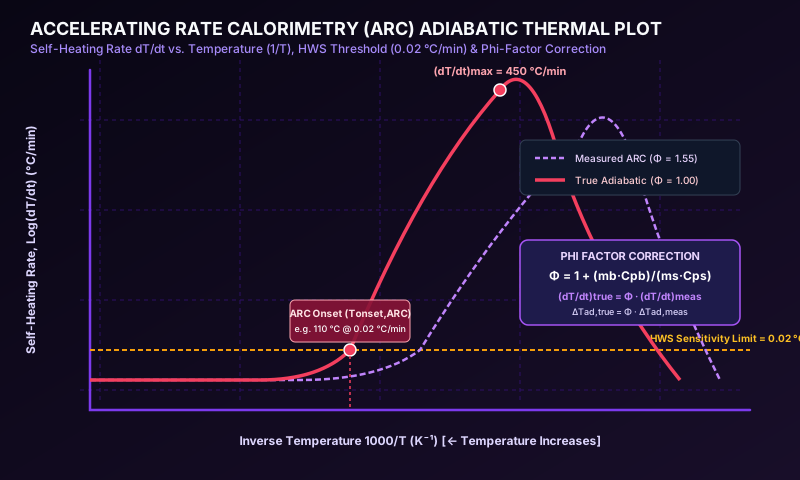
# 1. Operating Principles: The Heat-Wait-Search (HWS) Mode
An Accelerating Rate Calorimeter places a sample () inside a spherical heavy-walled metal bomb (titanium, Hastelloy, or stainless steel) suspended inside a nickel-plated copper jacket enclosure equipped with radiant heaters.
+---------------------------------------------------------------------------------------+
|                      ARC HEAT-WAIT-SEARCH (HWS) OPERATING CYCLE                       |
+---------------------------------------------------------------------------------------+
| 1. HEAT STEP: Raise sample temperature by ΔThws (typically 5.0 °C or 10.0 °C).       |
| 2. WAIT STEP: Allow sample and spherical bomb temperatures to equalize (15-20 min).  |
| 3. SEARCH STEP: Monitor self-heating rate (dT/dt) for 10-15 minutes.                  |
|    --> IF (dT/dt) < 0.02 °C/min: Exotherm NOT detected. Return to HEAT STEP.           |
|    --> IF (dT/dt) ≥ 0.02 °C/min: EXOTHERM DETECTED! Lock into ADIABATIC TRACKING MODE. |
+---------------------------------------------------------------------------------------+
# True Adiabatic Tracking Mode
When the self-heating rate exceeds the sensitivity threshold (typically ), the instrument locks into adiabatic mode. Top, side, and bottom jacket heaters dynamically match the sample temperature in real-time (), enforcing zero heat flux through the bomb walls:
Under adiabatic tracking, the sample heats itself purely from its own chemical reaction energy until the reaction is exhausted or maximum temperature/pressure limits are reached.
# 2. Governing Equations & Thermal Inertia (-Factor) Mathematical Correction
In an ideal adiabatic industrial reactor (e.g., a insulated storage tank), all heat released by the chemical reaction goes into heating the liquid reaction mass (). However, in a benchtop ARC experiment, a portion of the heat released is absorbed by the heavy metal sample vessel ().
# A. The Thermal Inertia / Phi-Factor () Formula
The ratio of total system thermal capacity to sample thermal capacity is defined as the Phi-Factor ():
where:
- and are the mass and specific heat capacity of the metal bomb (e.g., Titanium: ).
- and are the mass and specific heat capacity of the chemical sample.
Standard ARC spherical bombs typically yield .
# B. Mathematical Correction Equations for Measured ARC Data
Because the metal bomb absorbs energy, measured self-heating rates and measured adiabatic temperature rises are dampened compared to a full-scale plant vessel ().
To correct raw experimental data to true adiabatic plant conditions (), the following mathematical transformations must be applied:
# 1. True Adiabatic Temperature Rise ():
# 2. True Adiabatic Self-Heating Rate ():
# 3. True Adiabatic Pressure Rise Rate ():
# 4. True Adiabatic Temperature Trajectory ():
# 3. Derivation & Calculation of Time to Maximum Rate ()
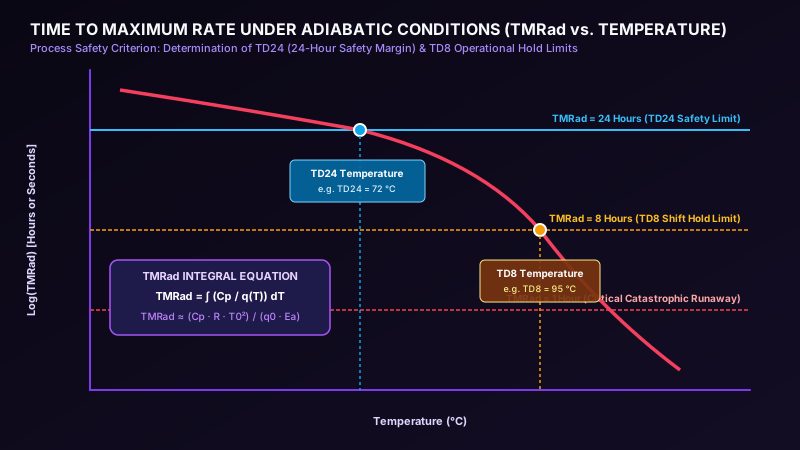
The Time to Maximum Rate under adiabatic conditions () is the remaining time required for an adiabatic runaway reaction to accelerate from a given starting temperature to its point of maximum heat release rate .
# A. Mathematical Integral Derivation
By definition, is calculated by integrating the reciprocal of the adiabatic self-heating rate from to :
# B. Zero-Order / Low-Conversion Kinetic Approximation
Assuming zero-order kinetics () at the early onset stage of decomposition, the Arrhenius self-heating rate is:
Substituting this rate expression into the integral yields the classical Townsend-Tou formula:
where:
- is the absolute starting temperature ().
- is the true adiabatic self-heating rate at ( or ).
- is the activation energy derived from the slope of versus .
# 4. Pressure Trajectory & Hazard Characterization
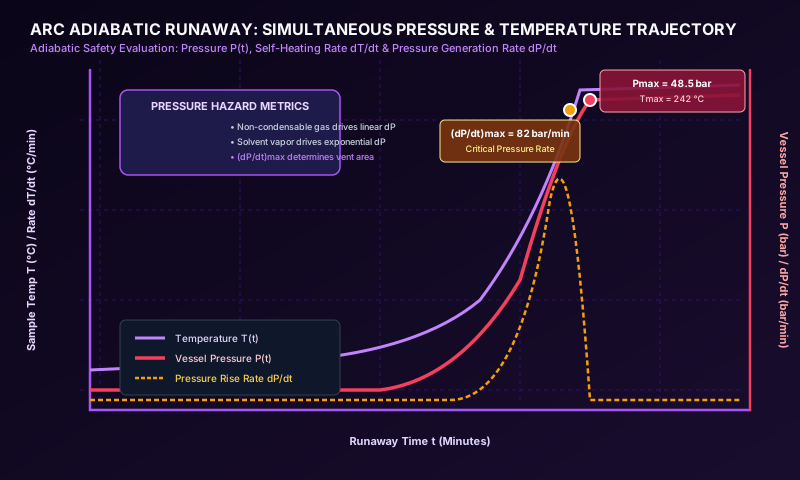
In addition to temperature monitoring, pressure transducers connected to the ARC bomb log real-time pressure generation and pressure rise rates .
# Identifying Pressure Generation Sources
- Vapor Pressure Acceleration: In tempered systems containing volatile solvents, pressure follows the exponential vapor pressure curve . Pressure drops back to initial values upon cooling.
- Non-Condensable Gas Generation: Decomposition of azides, diazonium salts, peroxides, or nitro compounds generates non-condensable gases (). Pressure increases rapidly and remains elevated after the vessel cools back to ambient.
# 5. Sample Analysis Illustration & Step-by-Step Result Derivation
To demonstrate the full numerical workflow of an ARC analysis, consider an experimental thermal stability test on an Organic Peroxide Intermediate Solution.
# A. Experimental Setup & Raw Readings
- Bomb Spec: Titanium spherical bomb (, ).
- Sample Mass (): solution ().
- Detected Onset Temperature (): () at .
- Final Decomposition Temp (): .
+---------------------------------------------------------------------------------------+
|                    ARC RAW TO PHI-CORRECTED DATA TRANSFORMATION                       |
+---------------------------------------------------------------------------------------+
| 1. Compute Phi Factor:  Φ = 1 + (8.10 g × 0.52) / (4.50 g × 2.10) = 1.446             |
| 2. True ΔTad:           ΔTad,true = 1.446 × (245.0 °C - 105.0 °C) = 202.4 K           |
| 3. True Onset Rate:     (dT/dt)true,onset = 1.446 × 0.025 °C/min = 0.03615 °C/min      |
| 4. Kinetic Fitting:     Slope d[ln(dT/dt)]/d(1/T) yields Ea = 115.4 kJ/mol           |
+---------------------------------------------------------------------------------------+
# B. Final Result Derivation & Safety Limits Table
| Step | Calculated Parameter | Value / Result | Physical & Safety Interpretation |
|---|---|---|---|
| Step 1 | Thermal Inertia Factor () | Moderate thermal dampening. Measured rates are lower than full-scale plant rates. | |
| Step 2 | True Self-Heating Rate @ | Extrapolated true self-heating rate at process storage setpoint (). | |
| Step 3 | at | Under total loss of cooling from , thermal runaway takes to reach peak. | |
| Step 4 | Determination | Temperature where . Absolute safe operating limit for uncooled storage. | |
| Step 5 | Determination | Temperature where . Maximum allowable hold time limit during shift change. | |
| Step 6 | Storage Setpoint Specification | FINAL PLANT DECISION: Chill bulk storage tank to to maintain of margin. |
# 6. Hazard Identification Parameters & Safety Thresholds
From the vs. Temperature curve (often called the TD24 Plot), process safety engineers extract critical operational thresholds:
| ARC Parameter | Definition & Formula | Industrial Safety Significance |
|---|---|---|
| Temperature where . | True baseline thermal stability limit under low heat loss. | |
| () | Temperature where . | Maximum Safe Operating & Storage Limit for uncooled vessels. |
| () | Temperature where . | Maximum allowable hold time limit during plant shift handovers. |
| Maximum pressure generation rate (). | Sizing parameter for containment and pressure relief systems. |
# 7. Where to Use ARC in Chemical Process Safety
- Storage & Shipping Stability Assessment: Determine maximum ambient storage temperature ( - Self-Accelerating Decomposition Temperature) for bulk storage tanks and intermediate bulk containers (IBCs).
- Process Hold-Time Validation: Evaluate safety margins during planned or unplanned batch interruptions (e.g., overnight holds of active reaction masses).
- Kinetic Model Parameterization: Supply activation energies (), pre-exponential factors (), and reaction orders () for advanced finite element thermal runaway simulations (e.g., AKTS, Netzsch Thermokinetics).