# Heat Exchanger Selection Guide for Pharmaceutical Processes: Double Tubesheet, Monolithic Stainless Steel & Graphite Blocks, Plates, Spiral & Microchannels
# 1. Introduction: Thermal Unit Operations in cGMP Pharmaceutical Manufacturing
Heat exchangers are the thermal workhorses of active pharmaceutical ingredient (API) synthesis, biopharmaceutical fermentation, solvent recovery, formulation, and clean utility loops. Unlike general chemical engineering applications, selecting a heat exchanger for pharmaceutical service is constrained by stringent regulatory mandates (ASME BPE, FDA 21 CFR Part 211.65, EU GMP Annex 15, and ISPE Baseline Guides):
- Zero Cross-Contamination Risk: Prevention of utility coolant or heating fluid migration into high-purity process streams.
- Hygienic Cleanability & Drainability: Complete self-drainage without liquid pooling, crevice-free electropolished surfaces ( / ), and compatibility with automated Clean-In-Place (CIP) and Steam-In-Place (SIP) at .
- Extreme Pressure & Severe Chemical Resistance: Withstanding high-pressure reactions ( in hydrogenation or supercritical extraction) as well as highly aggressive halides and acids (, , , chlorination, concentrated , and boiling solvents).
- Thermal Responsiveness & Process Intensification: Rapid heating/cooling ramp rates to protect thermally labile biologics and active molecules from thermal degradation.
# 2. Comprehensive Heat Exchanger Architecture Matrix
The technical matrix below illustrates the mechanical configurations, flow channels, and comparative performance of all core and specialized pharmaceutical heat exchangers, including Monolithic Stainless Steel, Monolithic Graphite & SiC, Double Tubesheet STHE, Plates, Spiral, and Microchannels:
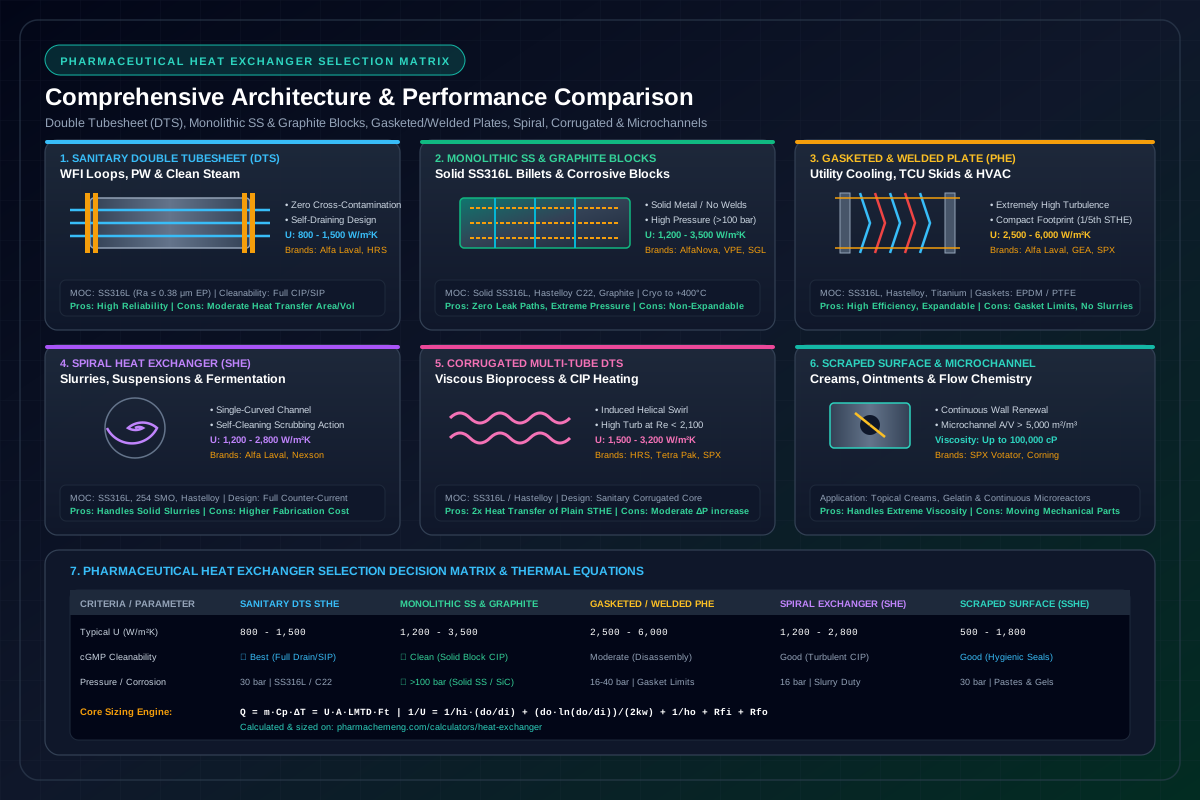
Interactive Engineering Tool: Perform rigorous thermal sizing, calculate overall heat transfer coefficients (), determine LMTD, and compute tube/shell pressure drops using our interactive Heat Exchanger Design Calculator.
# 3. Comprehensive Breakdown of Pharmaceutical Heat Exchanger Technologies
# 3.1 Sanitary Double Tubesheet (DTS) Shell & Tube Heat Exchangers
# A. Working Principle & Mechanical Architecture
The Sanitary Double Tubesheet (DTS) exchanger is the gold standard for high-purity pharmaceutical duties (Water for Injection [WFI] cooling loops, Purified Water [PW] sub-coolers, Point-of-Use [POU] coolers, and Clean Steam Condensers).
It features two independent tubesheets at each end of the tube bundle, separated by an atmospheric expansion gap:
- The inner tubesheet seals the utility shell-side fluid (cooling tower water, chilled glycol, or plant steam).
- The outer tubesheet seals the high-purity tube-side process fluid (WFI, sterile product).
- If a tube-to-tubesheet weld fails, the fluid leaks harmlessly into the open atmospheric air gap, immediately triggering visual or electronic leak detection without any cross-contamination.
+-------------------------------------------------------------------------+
|              SANITARY DOUBLE TUBESHEET (DTS) EXPANSION GAP              |
+------------------------------------+------------------------------------+
| Tube-Side (WFI / Sterile Product)  | Shell-Side (Utility Glycol / Steam)|
| Outer Tubesheet (Welded & Expanded)| Inner Tubesheet (Shell Seal)       |
|                 ||                 |                 ||                 |
|                 || <--- OPEN ATMOSPHERIC GAP --->   ||                 |
|                 ||   (Immediate Leak Detection)     ||                 |
+------------------------------------+------------------------------------+
# B. Materials of Construction & Standards
- Wetted Tube Side: SS316L (Low Carbon , sulfur per ASME BPE), Hastelloy C-22 (UNS N06022).
- Surface Finish: Mechanical polish + Electropolish to () with full passivation certs.
- Tube Geometry: Seamless orbital welded tubes with minimum slope ( or ) ensuring complete gravity self-drainage.
# C. Best Market Manufacturers & Global Brands
- Alfa Laval (Pharma-line series)
- HRS Heat Exchangers (SP Series Sanitary)
- Pfaudler Normag / GEA Process Engineering
- Kelvion / Mersen Sanitary Systems
# D. Pros and Cons
- Pros:
- Guaranteed zero cross-contamination between process and utility.
- Complete drainability and full compliance with ASME BPE and cGMP.
- High pressure and temperature withstand (up to , ).
- Excellent for high-purity condensations (Clean Steam / Solvent vapors).
- Cons:
- High capital cost compared to standard industrial STHEs.
- Lower heat transfer area-to-volume ratio () requiring large footprint.
- Shell-side is non-drainable/non-hygienic unless specialized sanitary shell construction is ordered.
# E. Performance Envelopes
- Overall Heat Transfer Coefficient (): (Liquid/Liquid); (Steam Condenser).
- Operating Limits: ; Full Vacuum to .
# 3.2 Monolithic Stainless Steel (SS) & Solid Billet Block Heat Exchangers
# A. Working Principle & Solid-State Fusion Architecture
In high-pressure pharmaceutical processes (such as catalytic API hydrogenation, supercritical extraction, high-pressure homogenization, and thermal cycling units), traditional welded tube bundles and gasketed plate packs present structural failure risks due to weld fatigue, crevice corrosion, or elastomer dissolution.
Monolithic Stainless Steel (SS) Heat Exchangers solve this by creating a single solid block of 100% stainless steel (SS316L / Hastelloy C-22) with zero weld seams, zero tube joints, and zero internal gaskets:
- Machined Monolithic Billets: Cross-drilled process and utility channels machined directly from a solid forged block of SS316L.
- Diffusion-Bonded / Fusion-Bonded Monolithic Blocks (e.g. Alfa Laval AlfaNova, VPE, Heatric): High-precision pressed stainless steel corrugated plates are fused together at the atomic level in a high-temperature vacuum furnace () under intense mechanical pressure. The metal grains recrystallize across the interface, transforming the entire stack into a homogeneous solid block of pure 100% stainless steel.
+-------------------------------------------------------------------------+
|      MONOLITHIC 100% STAINLESS STEEL (DIFFUSION-FUSED SOLID MATRIX)     |
+-------------------------------------------------------------------------+
| [Solid SS316L Core]  == Zero Brazing Material (No Copper / No Nickel)   |
|                      == Zero Internal Welds (No Weld Fatigue / Pitting)  |
|                      == Zero Gaskets (Immune to Solvent Attack)          |
|                      == Operating Pressure: Full Vacuum up to 100-500 bar|
+-------------------------------------------------------------------------+
# B. Pharmaceutical Applications & Cleanability
- Supercritical Extraction & Chromatography: Extreme pressures () with pristine sanitary fluid contact.
- High-Pressure Catalytic Hydrogenation: High-temperature/high-pressure thermal quenching ().
- High-Purity Solvent Heating/Cooling: Completely eliminates the copper or nickel leachables present in brazed plate heat exchangers (BPE mandates 100% stainless steel product contact).
- Cryogenic Freeze-Thaw & Lyophilizer TCU Skids: Operating smoothly from to without thermal shock gasket leaks.
# C. Best Market Manufacturers & Global Brands
- Alfa Laval (AlfaNova™ 100% Stainless Steel AlfaFusion Technology)
- Vacuum Process Engineering (VPE) (Diffusion-Bonded Microchannel Exchangers)
- Heatric (Meggitt) (Printed Circuit Monolithic Heat Exchangers)
- Pfaudler Normag (Machined Monolithic Stainless Steel & Hastelloy Blocks)
- Chart Industries
# D. Pros and Cons
- Pros:
- 100% SS316L metallurgy: Zero risk of copper/nickel ion leaching into API solutions.
- Extreme pressure withstand () and wide thermal envelope ( to ).
- Highly compact process intensification ().
- High overall heat transfer coefficient ().
- Cons:
- Solid monolithic matrix cannot be opened for manual mechanical rodding; relies strictly on turbulent chemical CIP.
- Fixed thermal capacity: not expandable by adding plates after fabrication.
- Higher manufacturing cost than conventional gasketed PHEs.
# 3.3 Monolithic Graphite & Silicon Carbide (SiC) Block Heat Exchangers
# A. Monolithic Impervious Graphite Block Exchangers
In bulk API chemical synthesis, organic reactions frequently involve severe acidic halides (, and chlorination). Standard stainless steels and even high-nickel Hastelloy alloys suffer catastrophic pitting, stress corrosion cracking (SCC), or metal leaching.
Monolithic Graphite Block Exchangers (e.g. SGL Carbon, Mersen) consist of a solid, isotropic synthetic graphite block impregnated with ultra-pure phenolic resin or PTFE to seal all porosity:
- Process and utility passages are cross-drilled through the solid monolithic block at right angles.
- Graphite provides exceptional thermal conductivity (—over 8 times higher than SS316L and 15 times higher than Hastelloy).
- Blocks are stacked under permanent spring-loaded tie-rod compression to absorb thermal expansion stresses.
# B. Monolithic Silicon Carbide (SiC) Heat Exchangers
For extreme applications where oxidizing acids (, Aqua Regia, Oleum, ), strong alkalis, or high pressures destroy graphite impregnations, Monolithic & Tube Silicon Carbide (SiC) exchangers (e.g. Mersen Boostec, Coractive) provide the ultimate solution:
- Sintered alpha-SiC possesses extreme hardness (second only to diamond), zero free silicon, and universal chemical inertness across .
- Thermal conductivity () matches graphite.
- Ultra-pure dense ceramic structure prevents any leaching of heavy metals or resin extractables into active pharmaceutical batches.
# C. Best Market Manufacturers & Global Brands
- SGL Carbon (DIABON® Monolithic Graphite Block & Cylindrical Exchangers)
- Mersen (Graphilor® Impregnated Graphite & Boostec® Silicon Carbide)
- Pfaudler / Edlon (Corrosion Resistant Systems)
- Carbone Lorraine
# D. Pros and Cons
- Pros:
- Impervious to virtually all aggressive non-oxidizing acids, halogens, and corrosive solvents.
- Very high thermal conductivity yielding compact dimensions and high -values.
- Cylindrical block design withstands severe vacuum and condensing duties.
- Cons:
- Brittle material: vulnerable to mechanical impact, severe thermal shocks ( sudden gradient), and water hammer.
- Requires spring-loaded tie-rod tensioning to maintain gasket compression without crushing the block.
- Phenolic impregnated graphite cannot handle strong oxidizing agents (, concentrated ).
# E. Performance Envelopes
- Overall Heat Transfer Coefficient (): (Condensing / Liquid cooling).
- Operating Limits: Graphite: , up to ; SiC: , up to .
# 3.4 Gasketed & Welded Plate Heat Exchangers (PHE & Compabloc)
# A. Gasketed Plate Heat Exchangers (GPHE)
Gasketed Plate Heat Exchangers comprise a pack of pressed corrugated metal plates with chevron patterns clamped between a fixed frame and movable pressure plate:
- High shear turbulence is generated at low Reynolds numbers (), breaking the boundary layer.
- Channels alternate hot and cold streams in true counter-current flow.
- Temperature cross is easily achieved ( approach temperatures as close as ).
# B. Welded Plate / Block Exchangers (Alfa Laval Compabloc / Packinox)
For high-pressure, solvent-rich, or high-temperature API operations where elastomer gaskets are chemically attacked, All-Welded Plate Block Exchangers eliminate gaskets entirely:
- Fully welded corrugated plate pack enclosed in four removable side panels.
- Allows access to both sides for mechanical or chemical cleaning while handling solvents at up to and .
# C. Best Market Manufacturers & Global Brands
- Alfa Laval (BaseLine, ClipLine Sanitary, Compabloc)
- GEA Ecoflex / Kelvion (Varitherm, NT Series)
- SPX FLOW / APV (Paraflow Series)
- Tranter
# D. Pros and Cons
- Pros:
- Highest heat transfer coefficient among conventional exchangers ().
- Extremely compact footprint (, smaller than STHE).
- Modular: easily expanded by adding more plates.
- Cons:
- Elastomer gaskets (EPDM, FKM, NBR) degrade over time and pose contamination/leak risks.
- Narrow plate gap () makes them prone to clogging if solids, fibers, or crystals are present.
- Higher liquid pressure drop ().
# 3.5 Spiral Heat Exchangers (SHE)
# A. Working Principle & Slurry Capability
A Spiral Heat Exchanger is fabricated by rolling two long, parallel metal sheets around a central core to form two concentric spiral channels:
- Single Flow Channel: Fluid travels continuously through a single passage without manifold distribution.
- Self-Cleaning / Scrubbing Effect: If local fouling or solids deposition begins, the flow cross-section narrows, causing local velocity and shear stress to surge automatically, scouring deposits away.
- Ideal For: High-solids crystallization slurries, fermentation biomass broths, wastewater evaporation, and spent solvent recovery with particulates.
# B. Best Market Manufacturers
- Alfa Laval (Spiral Pro, Spiral Condenser)
- Nexson Group (GreenSpiral™)
- Gooch Thermal Systems
# C. Pros and Cons
- Pros:
- Unmatched resistance to particulate clogging and slurry fouling.
- True pure counter-current flow with .
- Compact circular design with easy hinged door access for inspection.
- Cons:
- Higher unit fabrication cost.
- Limited maximum operating pressure (typically ).
- Difficult to repair if internal spiral channel develops a leak.
# 3.6 Corrugated Multi-Tube Sanitary Heat Exchangers
# A. Working Principle
Corrugated multi-tube exchangers take the classic double tubesheet shell & tube concept and replace smooth inner tubes with helically corrugated tubes:
- The helical indentation imparts a rotational swirl to the fluid, inducing turbulent eddy mixing right at the inner tube wall.
- Breaks laminar boundary layer drag at low Reynolds numbers (), increasing the convective heat transfer coefficient by compared to smooth tubes.
# B. Best Market Manufacturers
- HRS Heat Exchangers (Unicus & MI/MR Series)
- Tetra Pak / SPX Flow
# 3.7 Scraped Surface & Microchannel Exchangers
# A. Scraped Surface Exchangers (SSHE)
For ultra-high viscosity formulations (topical creams, ointments, petroleum jelly, concentrated gelatin, and crystallizing pastes up to ):
- Jacketed cylinder with internal rotating scraper blades continuously wiping the wall to renew heat transfer surfaces.
- Leading brands: SPX FLOW / APV (Votator II), HRS (Unicus).
# B. Microchannel & Printed Circuit Exchangers (PCHE)
For continuous flow microreactors and intense exothermic chemistries:
- Diffusion-bonded microchannels () yielding .
- Leading brands: Corning (Advanced-Flow™), Chemtrix, Heatric.
# 4. Empirical Design Equations & Mathematical Sizing Engine
The thermal sizing of any pharmaceutical heat exchanger follows a unified mathematical progression:
[ Process Duty Q ] ---> [ LMTD & Ft Factor ] ---> [ Heat Transfer Coeffs (hi, \rho) ] ---> [ Surface Area A ] ---> [ ΔP Check ]
# 4.1 Fundamental Thermal Energy Balance
For sensible heating/cooling of a process stream:
For phase-change boiling or condensing service:
# 4.2 Logarithmic Mean Temperature Difference (LMTD) & Correction
The effective temperature driving force across counter-current flow is:
Where:
For multi-pass shell & tube or cross-flow arrangements, apply the correction factor :
Where is determined from thermal effectiveness and heat capacity ratio :
# 4.3 Overall Heat Transfer Resistance Summation
The overall heat transfer coefficient referred to the outside surface area () is computed by summing all thermal resistances in series:
Where:
- = Inside and outside film convective heat transfer coefficients ()
- = Inside and outside fouling resistances ()
- = Thermal conductivity of the tube/plate wall material ()
- = Inside and outside tube diameters ()
# Material Thermal Conductivities ():
| Material of Construction | Thermal Conductivity () | Relative Heat Transfer Resistance |
|---|---|---|
| Monolithic Graphite (Impregnated) | Very Low (Excellent) | |
| Silicon Carbide (SiC) | Very Low (Excellent) | |
| Titanium Grade 2 | Low | |
| Stainless Steel 316L (Monolithic / Tubes) | Moderate | |
| Hastelloy C-22 (UNS N06022) | Higher Resistance | |
| Borosilicate Glass 3.3 | High Resistance |
# 4.4 Convective Film Coefficient Correlations ()
# A. Turbulent Flow in Smooth Tubes (): Sieder-Tate Correlation
# B. Laminar Flow in Tubes ():
# C. Corrugated Tubes Turbulence Enhancement:
# D. Plate & Monolithic Fusion Channels:
(For chevron: ; For high-theta chevron: )
# 4.5 Pressure Drop Formulations
# A. Tube-Side Pressure Drop:
Where (for turbulent flow) and is number of tube passes.
# B. Plate & Monolithic Block Pressure Drop:
# 5. Comprehensive Heat Exchanger Selection Decision Matrix
Use the engineering decision tree below to navigate to the ideal heat exchanger for your process:
IS THE PROCESS STREAM STERILE / INJECTABLE / WFI?
├── YES ──> Sanitary Double Tubesheet (DTS) Shell & Tube (SS316L Ra ≤ 0.38 μm)
└── NO
    │
    IS FLUID UNDER EXTREME PRESSURE (>50 bar) OR REQUIRES 100% SS WELDLESS DESIGN?
    ├── YES ──> Monolithic Stainless Steel (SS316L / AlfaNova / VPE Diffusion-Bonded)
    └── NO
        │
        IS FLUID HIGHLY CORROSIVE (HCl, HBr, Chlorination, Strong Acids)?
        ├── YES
        │   ├── Oxidizing / High P / Halogens ──> Monolithic Silicon Carbide (SiC)
        │   └── Non-Oxidizing Acidic ───────────> Monolithic Graphite Block (SGL / Mersen)
        └── NO
            │
            DOES STREAM CONTAIN SUSPENDED SOLIDS, CRYSTALS OR SLURRY?
            ├── YES
            │   ├── Slurry / Fermentation Broth ─> Spiral Heat Exchanger (SHE)
            │   └── Creams / Pastes / Viscous ───> Scraped Surface Exchanger (SSHE)
            └── NO
                │
                IS HIGH THERMAL EFFICIENCY / COMPACT FOOTPRINT REQUIRED?
                ├── High P / High Temp Solvent ─> Welded Plate Compabloc / Printed Circuit
                └── Standard Clean Utility / TCU ──> Gasketed Plate Heat Exchanger (GPHE)
# 6. Summary Comparison Table of All 8 Heat Exchangers
| Heat Exchanger Type | Typical -Value () | Max Pressure () | Max Temp () | Primary Pharma Application | Leading Global Brands |
|---|---|---|---|---|---|
| Sanitary DTS STHE | WFI loops, PW cooling, Clean Steam | Alfa Laval, HRS, Pfaudler | |||
| Monolithic Stainless Steel (SS) | Hydrogenation, Supercritical , TCU | Alfa Laval (AlfaNova), VPE, Heatric | |||
| Monolithic Graphite Block | , Chlorination, Acid recovery | SGL Carbon, Mersen | |||
| Silicon Carbide (SiC) | , Aqua Regia, Universal pH 0–14 | Mersen Boostec, Coractive | |||
| Gasketed Plate (GPHE) | Utility cooling, Glycol TCU skids | Alfa Laval, GEA, SPX Flow | |||
| Welded Plate (Compabloc) | Solvent condensers, High-pressure TCU | Alfa Laval, Packinox | |||
| Spiral Exchanger (SHE) | Slurries, Broths, Crystalline feed | Alfa Laval, Nexson | |||
| Corrugated Multi-Tube | Viscous bio-solutions, CIP heating | HRS, Tetra Pak | |||
| Scraped Surface (SSHE) | Ointments, Creams, Gelatins () | SPX Votator, HRS |
# 7. Governing Regulatory & Engineering Standards
- ASME BPE (Bioprocessing Equipment): Section SD (Design for Cleanability and Drainability) and Part DT (Dimensions and Tolerances).
- TEMA Standards (10th Edition): Standards of the Tubular Exchanger Manufacturers Association (Classes R, C, B).
- FDA 21 CFR Part 211.65: Equipment Construction and Non-Reactivity.
- ISPE Baseline Pharmaceutical Engineering Guide: Volume 4 (Water and Steam Systems).
- EN 10204 Type 3.1: Material Inspection & Certification Standard for Pressure Vessels and Heat Exchanger Tubes.
# Applicable Engineering Standards & Codes Used
The engineering methodologies, design correlations, and safety criteria detailed in this article adhere to the following international standards and industry codes:
- ASME Boiler and Pressure Vessel Code (BPVC) Section VIII Division 1 & 2: ASME Boiler and Pressure Vessel Code (BPVC) Section VIII Division 1 & 2
- API 620 & API 650: Welded Tanks for Oil, Chemical and Liquid Storage
- TEMA Class R, C & B: Tubular Exchanger Manufacturers Association Standards
- DIN EN 13445: Unfired Pressure Vessels European Standard
- IS 2825: Code for Unfired Pressure Vessels (Bureau of Indian Standards)